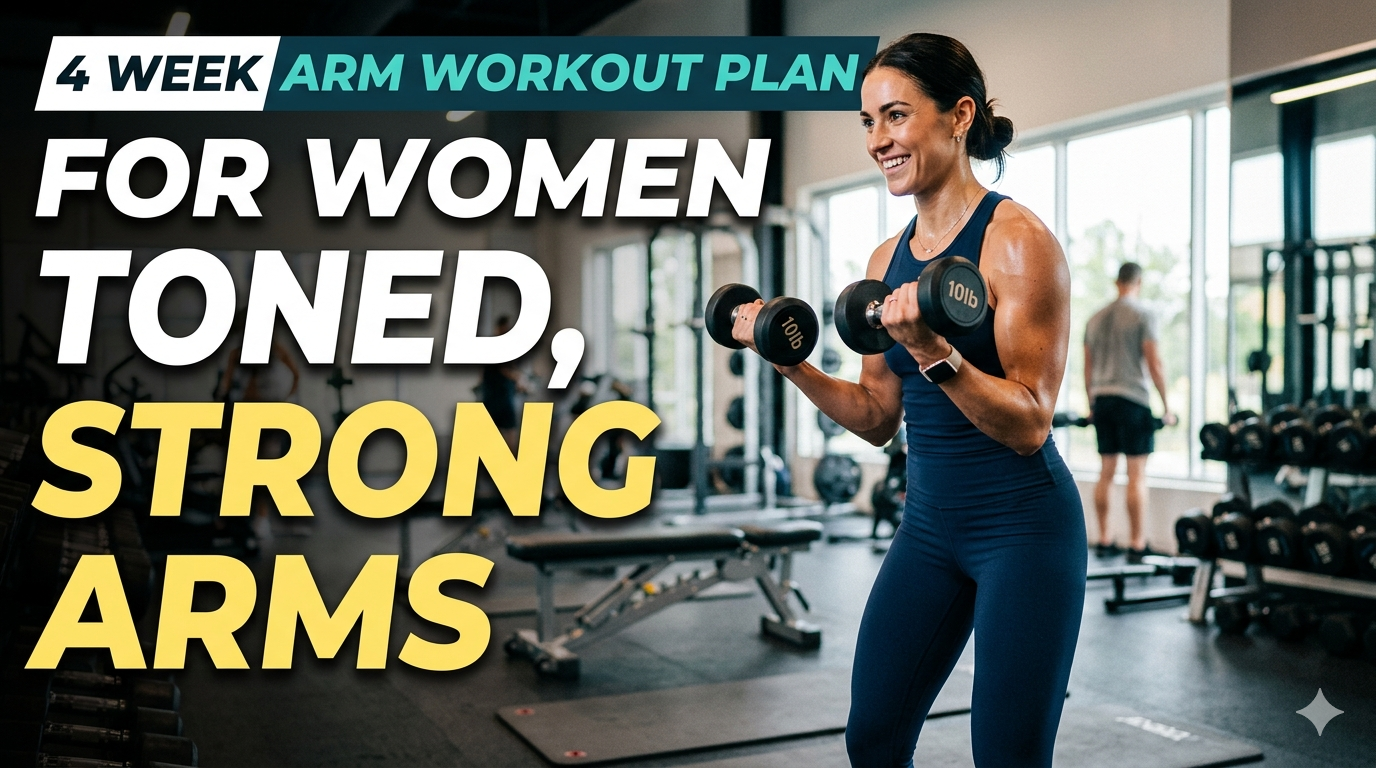
Arm Workout Women Actually Need: A 4 Week Plan for Toned, Defined Arms
What an Arm Workout for Women Actually Is (and Why Most Routines Miss the Point)
An arm workout for women is a structured resistance training routine targeting the biceps, triceps, forearms, and shoulders through progressive overload. Unlike cardio, it directly stimulates muscle fiber development and reduces soft tissue in the upper arms. Done consistently, it builds visible definition not bulk within 4 to 6 weeks.
Here’s the honest starting point: most women who search this topic are already exercising. She’s been going to classes, she’s consistent, she’s frustrated and that’s actually the most common starting point we see.
Cardio burns calories. Resistance training changes the shape of what’s underneath. Those aren’t the same thing.
Women who’ve tried dozens of YouTube arm videos often report the same experience they feel the burn in the moment, but nothing visibly changes across weeks. That’s because most of those videos skip the one variable that actually drives results: progressive overload. More on that in the workout plan section.
What makes an arm workout effective for women? According to a 2023 systematic review published in PLOS ONE, upper body strength gains in women develop more slowly than lower body gains in resistance trained individuals meaning random, non progressive arm exercises produce very little visible change over time. Effective arm training for women requires structured, incrementally increasing resistance, not simply higher rep counts or longer sessions.
This guide covers dumbbell and resistance band training for home and standard gym environments. It does not address competitive powerlifting, Olympic weightlifting, or training with pre existing shoulder and elbow injuries.
The Science: Why Women Won’t Bulk Up (and Why That Fear Is Costing You Results)
Let’s settle this permanently.
Women produce roughly 15 to 20 times less testosterone than men. Testosterone is the primary hormonal driver of significant muscle hypertrophy the kind that produces visibly large, dense muscle mass. Without it at sufficient levels, the arms simply cannot grow “too big” from a standard dumbbell program.
Or maybe I should say it this way: the women you’ve seen with very muscular arms have trained specifically and intensely for years to achieve that look, and many of them follow highly structured nutrition protocols alongside that training. It does not happen as a side effect of doing tricep kickbacks twice a week.
Why don’t arm workouts make women bulky? The concern is biologically unfounded for most women. According to research published in PMC (2025) reviewing resistance training adaptations specific to women, training outcomes are primarily driven by neural efficiency gains and muscle endurance improvements rather than significant hypertrophy. The natural result of consistent arm training for women is leaner, firmer definition not size increase.
Some coaches argue you don’t need a dedicated arm day at all that compound movements like rows, pull downs, and bench press cover everything. That’s valid if your only goal is general functional strength. But if you want visible definition, especially in the triceps (which make up roughly two thirds of your total upper arm volume), targeted isolation work fills what compound lifts miss.
I’ve seen conflicting data here some research shows compound only programs produce comparable upper arm definition to isolation focused ones at matched volumes. Others show isolation work pulls ahead for tricep development specifically in women. My read is: if you have the time and the goal is visible arm shape, include both.
The Best Arm Exercises for Women: Biceps, Triceps, and Shoulders
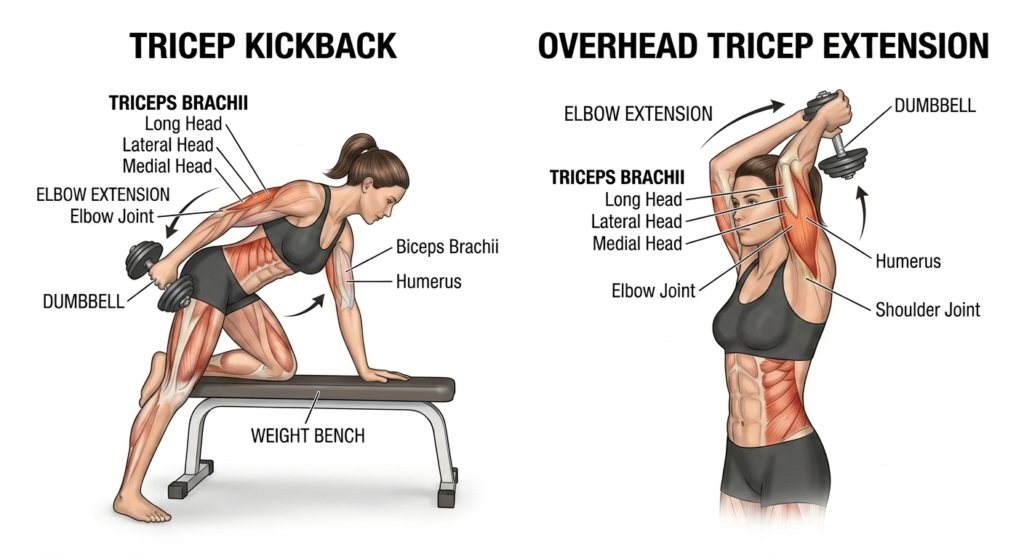
Tricep Exercises (Don’t Skip These First)
The triceps sit on the back of the upper arm. They’re also the most undertrained muscle group in standard women’s fitness content and the one most responsible for that undefined “soft” feeling women describe.
Tricep Kickback. Hold a dumbbell in each hand, hinge forward at the hips, keep your back flat. Drive both weights back until your arms extend fully. Squeeze for one second at the top. 3 sets × 12–15 reps.
Overhead Tricep Extension. Grip one dumbbell with both hands, raise it overhead, lower it behind your head by bending at the elbows. Keep your upper arms tight to your ears throughout. This specifically hits the long head of the tricep the portion most visible from behind which most exercises skip entirely.
Tricep Dips (Bodyweight). Use a sturdy chair or low bench. Hands beside your hips, fingers pointing forward. Lower until elbows reach 90 degrees. Don’t let your shoulders shrug upward. 3 sets × 8–12 reps.
Bicep Exercises
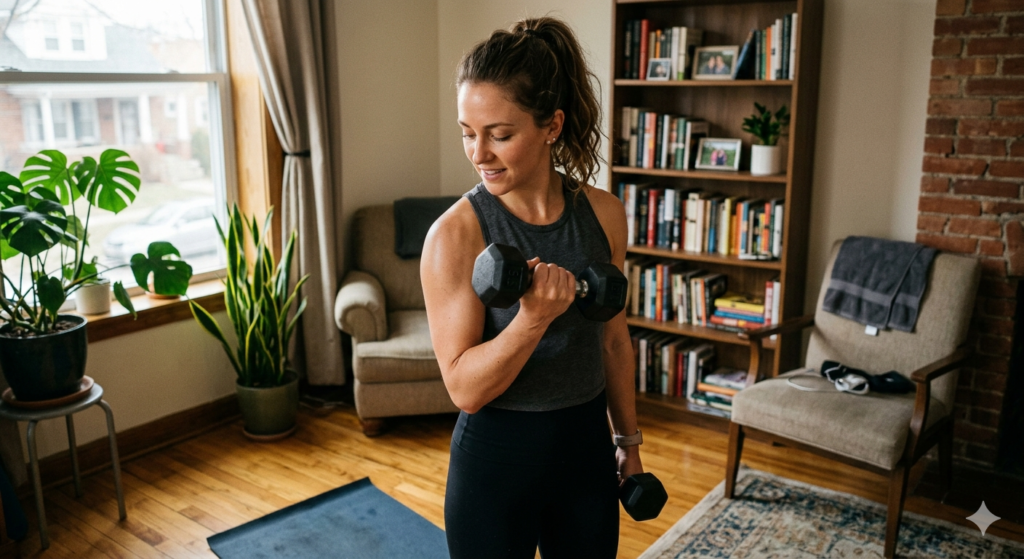
Dumbbell Bicep Curl. Classic but most women rush the movement. Use a weight where reps 10–12 feel genuinely hard. The eccentric phase (the lowering) matters as much as the lift itself. Controlled descent over 2–3 seconds per rep makes a real difference.
Hammer Curl. Same motion, palms facing inward throughout the entire rep. Targets the brachialis a muscle sitting just beneath and outside the bicep which adds width and a more defined contour to the whole upper arm.
Shoulder Exercises (The Definition Multiplier)
Lateral Raise. Arms out to the sides, dumbbells level with your shoulders, slight bend in elbows. Pause at the top. The shoulders frame the entire arm a well developed lateral head makes your arms look defined even at rest. Women almost always skip these.
Your 4 Week Arm Workout Plan (Progressive, Not Random)
To build toned arms in 4 weeks, follow these steps:
- Choose a dumbbell weight where reps 10–12 feel genuinely difficult.
- Train arms 2x per week, resting at least 48 hours between sessions.
- Week 2: add one additional set to every exercise.
- Week 3: increase weight by 2–5 lbs or move to the next resistance band level.
- Week 4: reduce rest between sets from 60 seconds to 45 seconds.
- Log every session reps, weight, rest time to track real progress.
- Bicep curl: 3 sets × 10 reps
- Hammer curl: 3 sets × 10 reps
- Tricep kickback: 3 sets × 12 reps
- Overhead tricep extension: 3 sets × 10 reps
- Lateral raise: 3 sets × 10 reps
- Rest: 60–75 sec between sets
- Same 5 exercises
- Add one set to each 4 sets per exercise
- Keep the same weight as Week 1
- Rest: 60 sec between sets
- Back to 3 sets per exercise
- Increase weight 2–5 lbs
- TheraBand users: move up one color
- Rest: 60 sec between sets
- Same weight as Week 3
- 3 sets per exercise
- Reduce rest to 45 sec between sets
- This is your intensity deload before repeating the cycle heavier
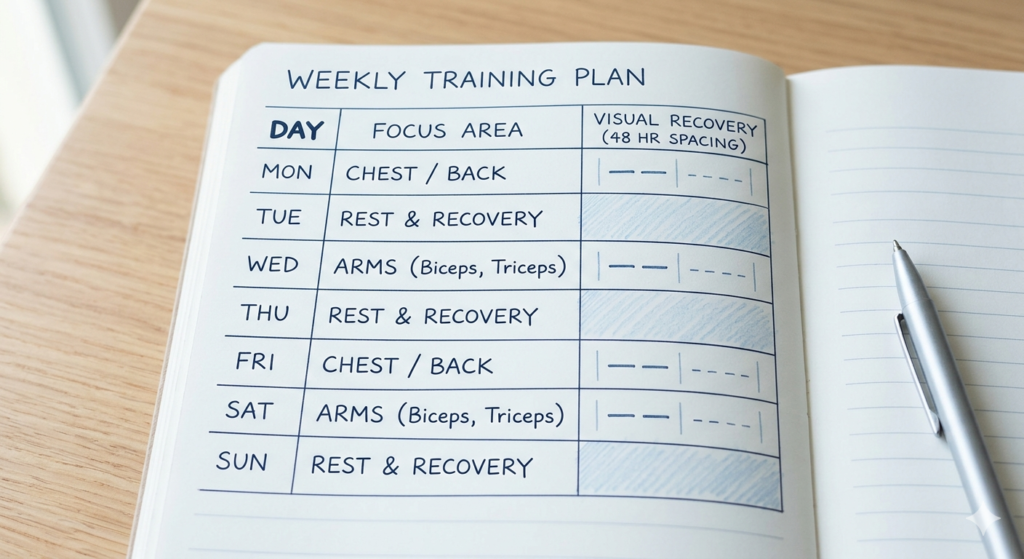
Look if you’re doing this properly, you’ll find that arm sessions work best placed at least 48 hours after any heavy chest or back training. Both compound pulling and pushing movements tax your biceps and triceps significantly. Stacking an arm session right after a back day means those muscles are already partially fatigued before you even pick up the dumbbell.
How often should women train arms per week? Most evidence supports 2 dedicated arm sessions per week for visible definition without overtraining. According to the Health and Fitness Association’s 2024 data, women’s participation in weight training rose from 11% in 2019 to 14% in 2024 but frequency consistency over 4+ weeks, not session volume alone, is the strongest driver of visible arm changes.
Dumbbells vs. Resistance Bands: Which Should You Use?
Dumbbells vs. resistance bands for arm workouts: dumbbells are better suited for progressive overload because the load is fixed and measurable, making progress straightforward to track over weeks. Resistance bands work better for travel, rehab, or beginners finding dumbbell weight increments too large. The key difference is load consistency dumbbells deliver constant resistance throughout the rep; bands increase tension as you extend.
| Option | Best For | Key Benefit | Limitation |
|---|---|---|---|
| Bowflex SelectTech 552 (adjustable dumbbells) | Home training with full progressive range | 5–52.5 lbs in one unit replaces 15 pairs | Higher upfront investment (~$300–350) |
| Fixed Dumbbells (5–20 lb set) | Budget home setup for beginners | Simple, durable, always ready | Requires buying heavier pairs as you progress |
| TheraBand Resistance Bands | Travel, recovery sessions, beginners | Portable, color-coded progression, joint-friendly | Harder to quantify exact load; less stable |
| Bala Bangles (wrist weights) | Adding resistance to bodyweight moves or walks | Hands free, stylish, low barrier to use | Very limited weight range; not a primary tool |
| Gym Cable Machine | Advanced isolation with constant tension | Tension throughout full range of motion | Requires gym access; technique learning curve |
Anyway, the equipment debate matters far less than people think. A consistent routine with TheraBand bands will outperform an inconsistent one with Bowflex dumbbells every single time. Pick the tool you’ll actually use.
6 Mistakes Women Make in Arm Workouts That Stall Results
What most guides skip is this: the exercises are rarely the problem. The variables around them are.
- 1 Using weights that are too light Comfortable is not effective. The last 2 reps of each set should feel genuinely hard. If they don’t, increase the weight by 2–5 lbs. A 3 lb dumbbell does not provide enough mechanical tension to change the shape of your tricep.
- 2 Skipping the triceps entirely The tricep accounts for roughly 60–65% of your upper arm volume. Doing only bicep curls is structurally equivalent to painting one wall of a room and calling it done.
- 3 Eliminating rest between sets Going continuously might feel more productive. But muscles need 45–75 seconds to partially recover before the next working set produces meaningful stimulus. Cutting rest too short just turns strength work into suboptimal cardio.
- 4 Training once a week and expecting changes One arm session every 10 days does not produce visible results. Twice a week, consistently, for at least four weeks that’s the minimum effective threshold before you can evaluate whether the program is working.
- 5 Training arms the day after chest or back Your biceps are heavily involved in every row and pulldown. Your triceps are taxed in every pressing movement. Scheduling an arm session the very next day means you’re starting already depleted.
- 6 Ignoring protein intake entirely Muscles are rebuilt during recovery not during the workout itself. Most evidence supports 0.7–1g of protein per pound of bodyweight for women doing consistent resistance training. That’s not extreme. It’s just consistent.
Disclaimer: This guide is for general fitness information only. If you have an existing shoulder, elbow, or wrist injury, consult a qualified physiotherapist before beginning any resistance training program.high-protein meals for women “hit your protein targets for muscle recovery”PLOS ONE 2023 (Jung et al.) proves upper body strength gains require progressive structure in resistance trained women