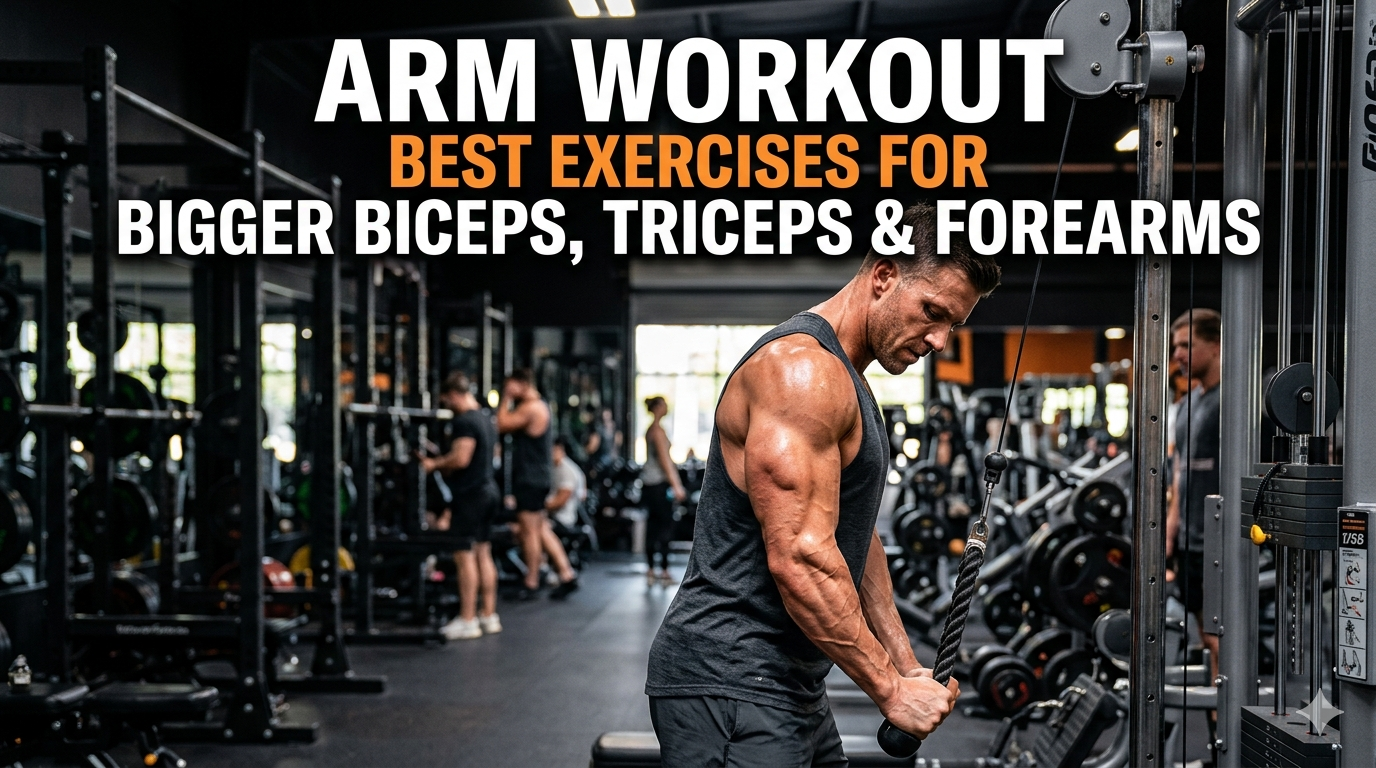
The Arm Workout That Actually Builds Size Not Just a Pump
Most arm workout articles give you a list of exercises. What they don’t give you is a reason your arms aren’t growing and that gap is exactly what this guide fills.
You’ll get the best exercises for biceps, triceps, and forearms, a science backed explanation of why your current approach probably isn’t working, and a weekly program you can copy and use starting today.
This guide is designed for gym goers with 3–12 months of training experience. It does not cover competitive bodybuilding periodization, post surgical arm rehab, or sport-specific arm strength development.
What Is an Arm Workout?
An arm workout is a structured resistance training session targeting the biceps, triceps, and forearms the three muscle groups that determine the size, shape, and definition of your arms. A complete arm workout trains all three across multiple movement angles to maximize muscle fiber recruitment and balanced development.
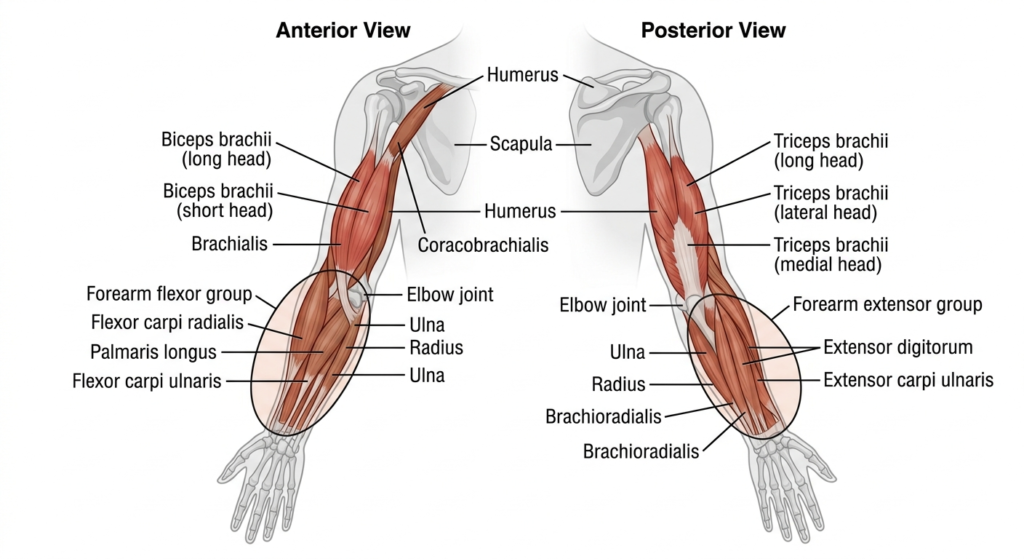
There are 24 muscles in the arm total. For most people chasing visible size and definition, training breaks into three areas: the biceps brachii (front of the upper arm), the triceps brachii (back of the upper arm), and the forearm muscles responsible for wrist control, grip, and lower arm thickness.
According to upper limb anatomy research published in the Journal of Biomechanics (Holzbaur et al., 2007 one of the most cited upper limb muscle volume studies in exercise science), the triceps brachii has the largest volume fraction of any muscle crossing the elbow joint. That single anatomical fact has major implications for how you should be spending your training time more on that in the next section.
Why Your Arms Aren’t Growing
Here’s the thing: if you’ve been curling consistently for months and still see nothing in the mirror, the problem probably isn’t your bicep training.
It’s your triceps.
The triceps brachii make up approximately two thirds of your total upper arm mass. That means the muscle most people ignore or treat as an afterthought tacked onto the end of a chest session is the primary driver of how big your arms actually look. If you’re not prioritizing triceps properly, you won’t see the arm growth you’ve been working for no matter how many curls you do.
Focusing your arm training on biceps while underdoing triceps work is like painting only the front of a car and wondering why it doesn’t look finished from the side.
Look if you’ve been ending every gym session with three casual sets of curls and calling it arm day, here’s what actually works: flip the ratio. For every two bicep exercises in your program, include at least two to three triceps movements that hit all three heads of the muscle.
There’s also a specific error in how most beginners train their triceps. A 2022 hypertrophy study found that training the triceps long head in an overhead position produced significantly greater muscle growth compared to training with the arm in a neutral or downward position. Most beginners stick exclusively to cable pushdowns a neutral/downward movement which leaves the long head chronically understimulated. The long head is the largest of the three triceps heads. Ignoring it means ignoring most of the muscle.
I’ve seen conflicting interpretations of this research some coaches argue pushdowns are sufficient if total volume is high enough, others treat overhead work as non negotiable. My read is: include at least one overhead triceps movement per session. The cost is zero. The upside is real.
The Best Arm Exercises Biceps, Triceps & Forearms
Best Biceps Exercises
The biceps brachii has two heads the long head (outer, responsible for the visual “peak”) and the short head (inner, adds width when seen from the front). You can’t fully isolate either head, but grip width and arm position shift the emphasis between them.
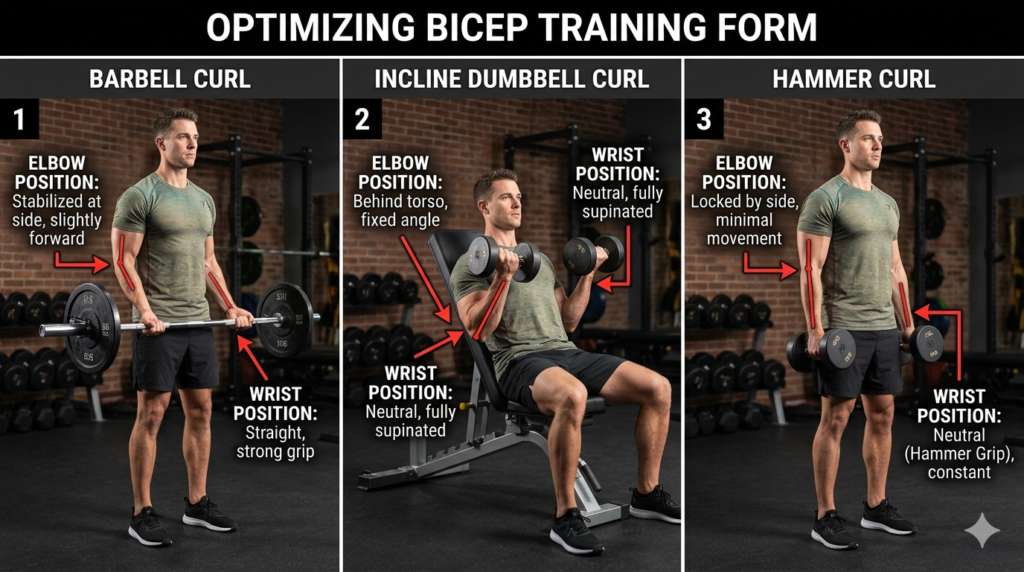
Barbell Bicep Curl The gold standard for overall bicep mass. Training both arms with a barbell allows heavier loading than dumbbell variations, and heavier loading is the engine of progressive overload. Keep elbows pinned to your torso throughout. Don’t swing.
Incline Dumbbell Curl Sit on a 45° incline bench and let your arms hang fully extended behind your body before curling. This stretched starting position increases long head recruitment and extends the time the muscle is under tension. Control the eccentric (lowering) phase to 3–4 seconds. Worth the extra setup.
Hammer Curl A neutral grip (palms facing in) shifts emphasis to the brachialis and brachioradialis. The brachialis alone generates roughly 50% more elbow flexion force than the biceps brachii itself, so training it directly adds real thickness beneath the bicep the kind that makes arms look built even when you’re not flexing.
Quick note: if standard curls are your only bicep movement, you’re missing the muscles that give the upper arm its actual shape from underneath.
Best Triceps Exercises
Close-Grip Bench Press Start here. It’s the best compound triceps builder in the gym. It lets you load heavy, recruits all three heads, and directly improves pressing strength on regular bench. Hands just inside shoulder width. Keep elbows tucked don’t let them flare out toward your sides.
Overhead Triceps Extension (Cable or Dumbbell) Based on the 2022 hypertrophy research, this is the single most important triceps exercise most beginners aren’t doing. The overhead arm position places the long head in a fully stretched position, which research consistently shows produces greater hypertrophy. Use a cable with a rope attachment for constant tension, or a single dumbbell held overhead with both hands. Don’t skip this one.
Rope Pushdown A cable staple for the lateral and medial heads. At the bottom of each rep, separate the rope handles slightly and rotate your wrists outward to increase range of motion and peak contraction. Pair with the overhead extension and you’ve covered both ends of the triceps strength curve.
Skull Crusher (EZ Bar or Dumbbell) Lie flat on a bench, lower the weight toward your forehead under full control, press back to lockout. Use an EZ bar to reduce wrist stress. This is a direct mass builder for all three triceps heads. Don’t rush the eccentric.
Best Forearm Exercises
The forearms are the most overlooked muscle group in arm training and the most visible when they’re underdeveloped. Thin forearms undercut well developed biceps and triceps the moment you’re not flexing.
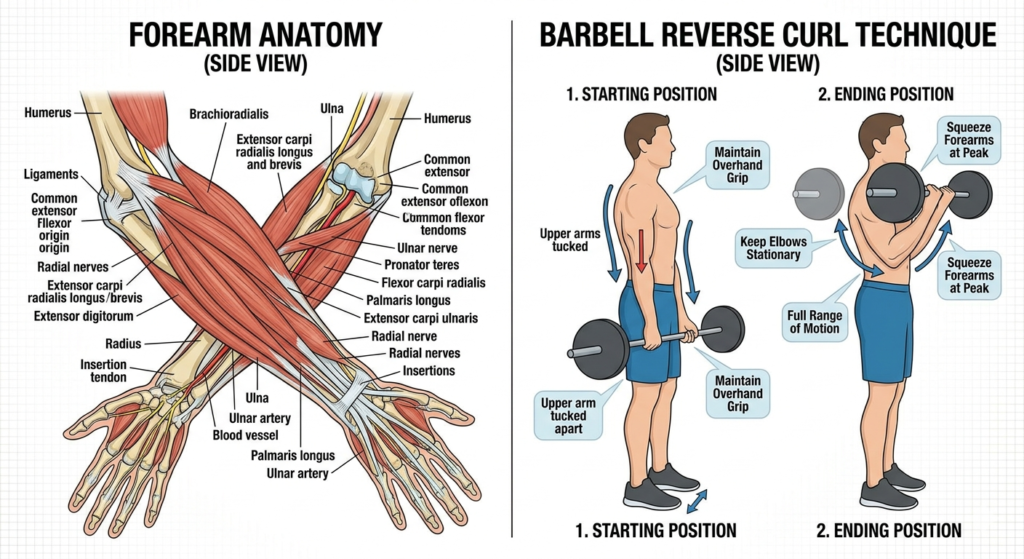
Hammer Curl Already listed above for biceps, but it earns its place here too. It directly trains the brachioradialis, the forearm muscle that runs from elbow to wrist and defines the outer forearm shape.
Reverse Curl An overhand grip on a barbell or dumbbell. Harder than it looks. Builds the extensor compartment of the forearm and improves grip strength for all pulling movements. Start light most people are significantly weaker here than they expect.
Farmer’s Carry or Dead Hang Often dismissed as a “strongman drill.” Both build functional forearm and grip endurance that transfers directly to deadlifts, rows, and pull ups. Two 30 second dead hang holds per session is enough to start noticing a difference in grip strength within a few weeks.
Quick Comparison: Arm Exercise Types
| Exercise | Best For | Key Benefit | Limitation |
|---|---|---|---|
| Barbell Curl | Biceps mass overall | Heaviest loading, best for progressive overload | Less range of motion than dumbbell variations |
| Incline Dumbbell Curl | Biceps long head (peak) | Stretched position activation, high time under tension | Requires incline bench, lighter loads |
| Overhead Extension | Triceps long head size | Targets the most neglected and largest triceps head | Requires adequate shoulder mobility |
| Close Grip Bench Press | Triceps compound strength | Heaviest triceps loading possible, improves pressing | Load can shift to chest if elbow form breaks |
| Hammer Curl | Brachialis + forearm thickness | Builds arm density and grip, two muscle groups at once | Not a direct biceps peak builder |
How to Structure Your Arm Workout
To build arm size effectively, follow these steps:
- Start with one compound movement (close grip bench press or weighted chin up): 3–4 sets of 6–8 reps.
- Add one bicep isolation exercise: 3 sets of 10–12 reps.
- Add one overhead triceps movement: 3 sets of 10–12 reps.
- Finish with one forearm or brachialis movement: 2–3 sets of 12–15 reps.
- Total session time: 35–50 minutes. Recovery is where growth happens more volume is not always better.
Research published in the Journal of Strength & Conditioning Research (2024) found that pairing antagonist muscles like biceps and triceps in supersets improves time efficiency and increases total training volume, both of which drive greater hypertrophy. In practice: do a set of curls, immediately follow with a pushdown, then rest 60–90 seconds. That’s one superset. Repeat for 3 rounds.
Or maybe I should say it this way: you don’t need a longer workout. You need a smarter sequence.
For rep ranges heavy work (6–8 reps) builds density and strength; moderate work (10–12 reps) builds size; higher rep work (15+) builds muscular endurance and creates metabolic stress that supports hypertrophy. Use all three across your training week, not just one range exclusively.
Disclaimer: If you’re managing a prior elbow, wrist, or shoulder injury, consult a physiotherapist before adding high volume isolation work. Overhead triceps extensions in particular load the long head through a fully stretched position start with lighter loads than you think you need.
Your Weekly Arm Workout Program
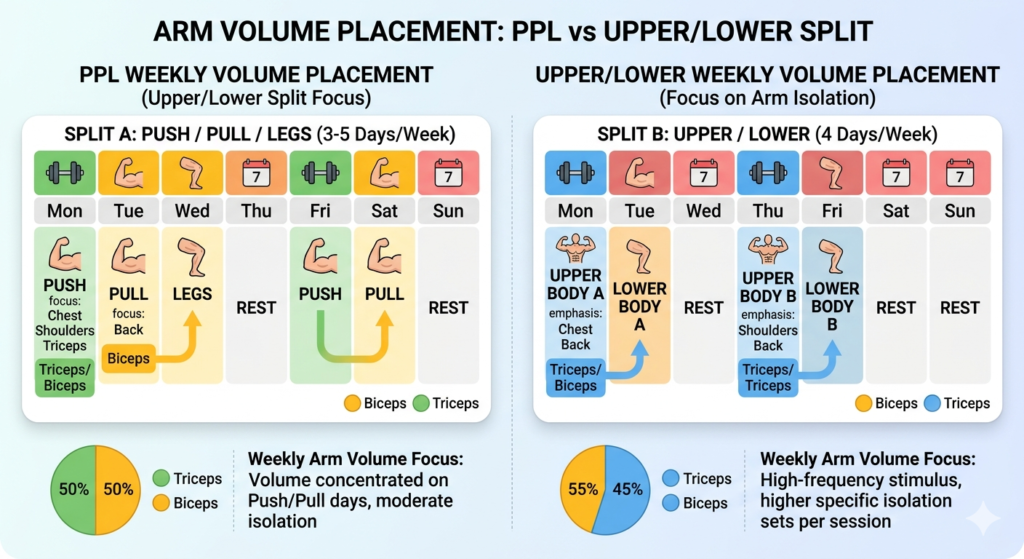
Option 1: Push/Pull/Legs Split (3–5 days/week)
In a PPL split, biceps get indirect work on Pull day (from rows and pull ups) and triceps get indirect work on Push day (from bench and overhead press). That means dedicated arm isolation volume should be focused not a full separate arm session stacked on top.
Add to Pull Day (alongside your rows and pull ups):
- Barbell Curl: 3 × 10
- Hammer Curl: 3 × 12
- Reverse Curl: 2 × 15
Add to Push Day (alongside your bench and overhead press):
- Close-Grip Bench Press: 3 × 6–8 (do this first, before main chest pressing)
- Overhead Cable Extension: 3 × 10–12
- Rope Pushdown: 3 × 12
Option 2: Upper/Lower Split (4 days/week)
Add a short arm finisher at the end of each Upper training day. Keep it to 3–4 total sets per muscle group to avoid excessive overlap with the compound pressing and pulling already in the session.
Upper Day A: Incline Dumbbell Curl 3 × 10 + Skull Crusher 3 × 10 Upper Day B: Hammer Curl 3 × 12 + Overhead Dumbbell Extension 3 × 12
Two arm focused sessions per week. That’s enough provided each session includes progressive overload. Two focused sessions where you consistently add weight beats four random sessions every single time.
Dumbbell vs. Barbell for Arms: Barbells allow heavier loading and are better suited for progressive overload in the early stages of training. Dumbbells offer greater range of motion and are better for isolation, form correction, and home training. The key difference is load capacity not a universal “better.”
Common Arm Training Mistakes
Training biceps more than triceps. Given that triceps make up roughly two thirds of total upper arm mass, this is the single biggest reason arms stay flat for people who are otherwise training consistently. Equalize your volume at minimum.
No overhead triceps work. If your entire triceps routine is cable pushdowns, you’re leaving the long head severely undertrained. One overhead movement per session is a minimum, not a bonus.
Skipping forearms entirely. Weak forearms limit your grip strength on curls, rows, and deadlifts and they’re the first thing someone notices when you’re not flexing. Two sets of reverse curls per week is enough to begin building them.
No progressive overload. This one ends more training programs than any exercise selection mistake. Doing the same weight for the same reps every week for six months isn’t training it’s maintenance. Track your weights in a notes app or a simple log. When you can hit all sets and reps with clean form for two consecutive sessions, add 2.5-5 lbs the next session.
Some coaches argue arm isolation work is unnecessary when compound movements are programmed correctly. That’s valid if pure strength is the goal. But if visible arm size is the outcome you’re after, compound movements alone typically leave the biceps long head and triceps long head understimulated. Both things can be true simultaneously the disagreement is about goal, not training science.