The 45 Minute Full Body Dumbbell Routine You Can Do at Home
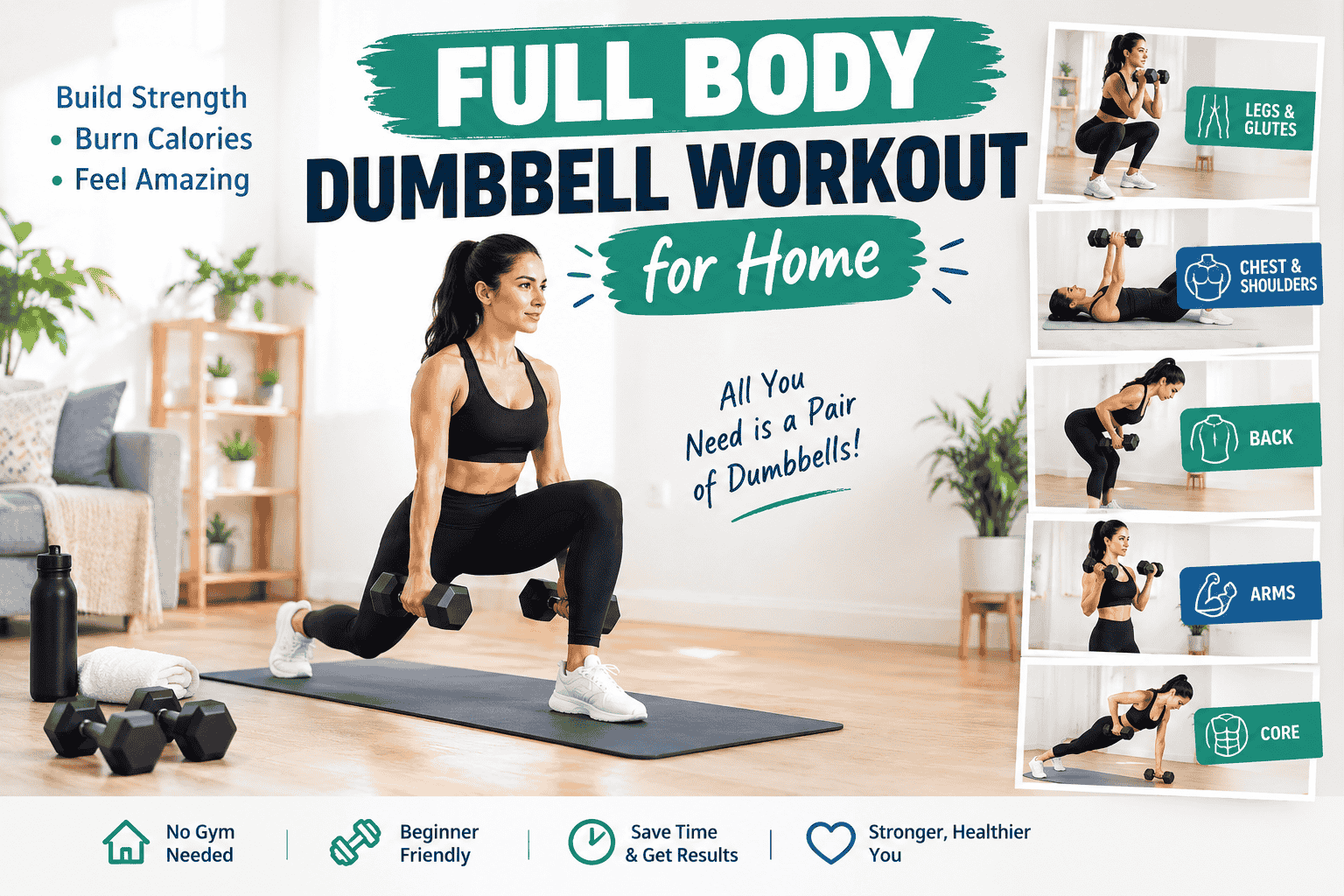
Here’s the short answer. Do six dumbbell exercises, three sets each, resting about 75 seconds between sets, three days a week. That’s roughly 45 minutes per session, and nothing in it needs a bench, a rack, or a gym membership to get it done.
A full body dumbbell workout is a single session that trains every major muscle group, including legs, hips, chest, back, shoulders, and core, using only dumbbells. Most people run it two or three times a week with a rest day between sessions.
This works best for beginners and early intermediates training at home. It won’t help if you’re chasing a heavy one rep max. This guide covers general fitness training at home. It does NOT address injury rehab, pregnancy specific programming, or competitive bodybuilding. Check with a doctor first if you have a heart condition or joint problems.
The 45 Minute Routine: Exercises, Sets, and Reps
A full body dumbbell workout should take about 45 minutes, including warm up. According to the 2018 Physical Activity Guidelines for Americans, adults need muscle strengthening work for all major muscle groups on at least two days a week. Six exercises at three sets each, plus short rests, fit that window without rushing.
Warm up for five minutes first. Bodyweight squats, hip hinges, and arm circles are enough. Then work through the table top to bottom, finishing all sets of one exercise before moving to the next.
| Exercise | Sets × Reps | Main Muscles | Quick Cue |
|---|---|---|---|
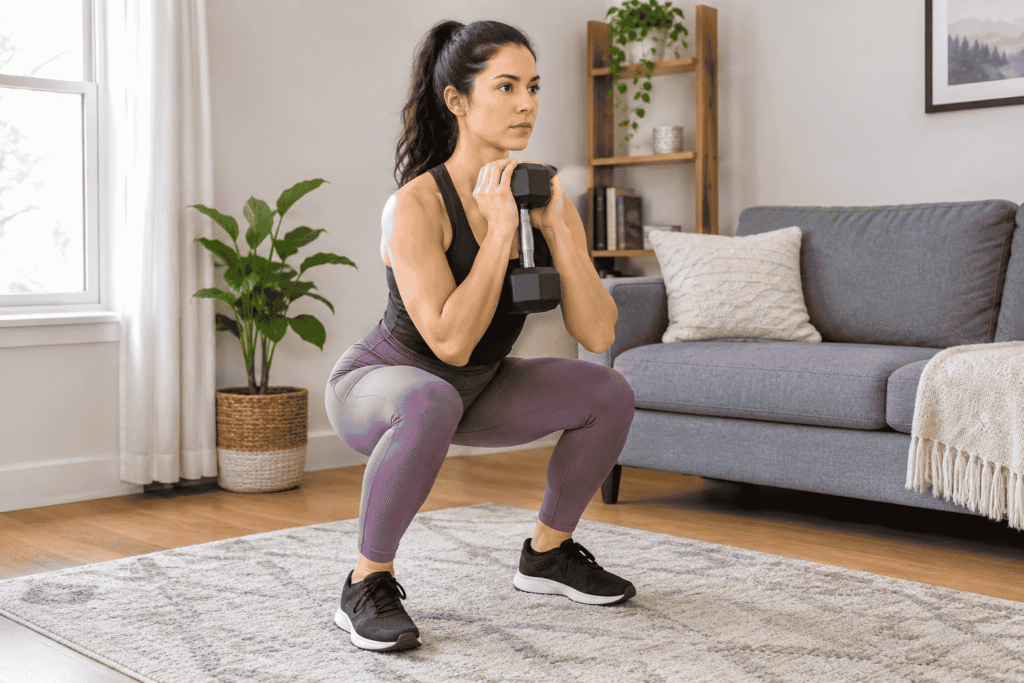
| Goblet squat | 3 × 10–12 | Quads, glutes | Keep elbows inside your knees at the bottom |
| Dumbbell Romanian deadlift | 3 × 10–12 | Hamstrings, glutes | Push hips back, keep weights close to your legs |
| Dumbbell floor press | 3 × 8–12 | Chest, triceps | Elbows at about 45 degrees |
| One-arm dumbbell row | 3 × 10 per side | Upper back, biceps | Pull your elbow toward your hip |
| Standing overhead press | 3 × 8–10 | Shoulders, triceps | Ribs down, glutes tight |
| Reverse lunge | 3 × 8 per leg | Quads, glutes | Step back, keep your torso tall |
| Suitcase carry (finisher) | 2 × 30 sec per side | Core, grip | Don’t lean toward the weight |
To complete a full body dumbbell workout in 45 minutes, follow these steps:
- Warm up for five minutes with bodyweight squats and arm circles.
- Do six exercises, three sets each.
- Rest 60 to 90 seconds between sets.
- Choose weights that leave two reps in reserve.
- Finish with a two set suitcase carry.
Choosing Weight: Closer to Failure Beats Heavier
The right dumbbell weight for a full body workout is one that lets you finish your target reps with about two reps left in the tank. If the last rep of a set looks identical to the first, go heavier next time. Most beginners start lighter than they need to.
Most people assume you need heavy weights to build muscle. The data says otherwise. A 2017 meta analysis in the Journal of Strength and Conditioning Research found similar muscle growth from lighter and heavier loads when sets ended near failure, although heavier loads built more strength.
That’s why one or two pairs can carry you a long way.
How Often to Train Three Days a Week, With Rest Between
A full body dumbbell workout works best two to three times per week, with at least one rest day between sessions. According to a 2016 meta analysis by Schoenfeld and colleagues in Sports Medicine, training each muscle twice weekly produced more muscle growth than once weekly. Three sessions hits that frequency with room to recover.
Some experts argue that body part splits beat full body training for muscle growth, since each session can pile more sets onto one muscle. That’s valid for lifters with five free days and a rack of heavy dumbbells, which is the setup behind plans like the 5 day split on Muscle & Strength.
But if you’ve got three days and one or two pairs of dumbbells, hitting every muscle three times a week is the better trade.
What most guides skip is spacing. A full body routine only works if sessions sit far enough apart that you can repeat your weights. If Tuesday’s legs are still wrecked on Thursday, your numbers drop and the session turns into a recovery test.
Look if you can only train twice a week, run it twice. The guidelines count two days as enough. Or maybe I should say it this way: a routine you’ll actually repeat beats a perfect schedule you’ll abandon by week three.
You’ve got a job, you’ll have bad weeks, and you won’t hit every session. That’s normal.
Progression: Add Reps First, Then Weight
Progress means giving your muscles a reason to adapt. With dumbbells you’ve got two levers, reps and weight, and the simplest method is to pull reps first.
Pick a rep range, such as 8 to 12. Start at the bottom with a weight you can control. Add a rep per set each session until every set reaches 12, then move up in weight and drop back to 8.
- Weeks 1–2: Learn the movements. Stay at the low end of each range, with about three reps in reserve.
- Weeks 3–4: Add reps each session until you reach the top of the range.
- Weeks 5–6: Increase the weight on any lift where you hit the top, then reset to the low end.
- Weeks 7–8: Add a fourth set to your two weakest lifts, or lower each rep over three seconds.
I’ve seen conflicting data on how fast beginners should add load. Some sources say add weight every session, others say let reps lead. My read: reps first, because form tends to break down before strength does.
Here’s the thing: none of this works if you don’t write the numbers down. A notes app is enough, and users who’ve tried tracking apps like Fitbod often report that automatic logging of sets, reps, and weights removes the guesswork about what to lift next.
My opinion, and some readers will push back: skip training to failure on overhead presses and lunges. Those lifts fail messy, with a wobbling spine or a collapsing knee, and stopping a couple of reps short still counts as hard work.
No Bench, One Pair, or Tight Space? Swaps That Work
You don’t need to buy anything today. Three common limits have simple fixes.
- No bench: Do floor presses instead of bench presses. The floor stops your elbows, which many people find easier on the shoulders.
- Only one pair: Pick the weight for your weakest lift, usually the overhead press. Then make legs harder with a three second lowering phase, a pause at the bottom, or single leg versions.
- Small space: Every move in the table fits in a small patch of floor.
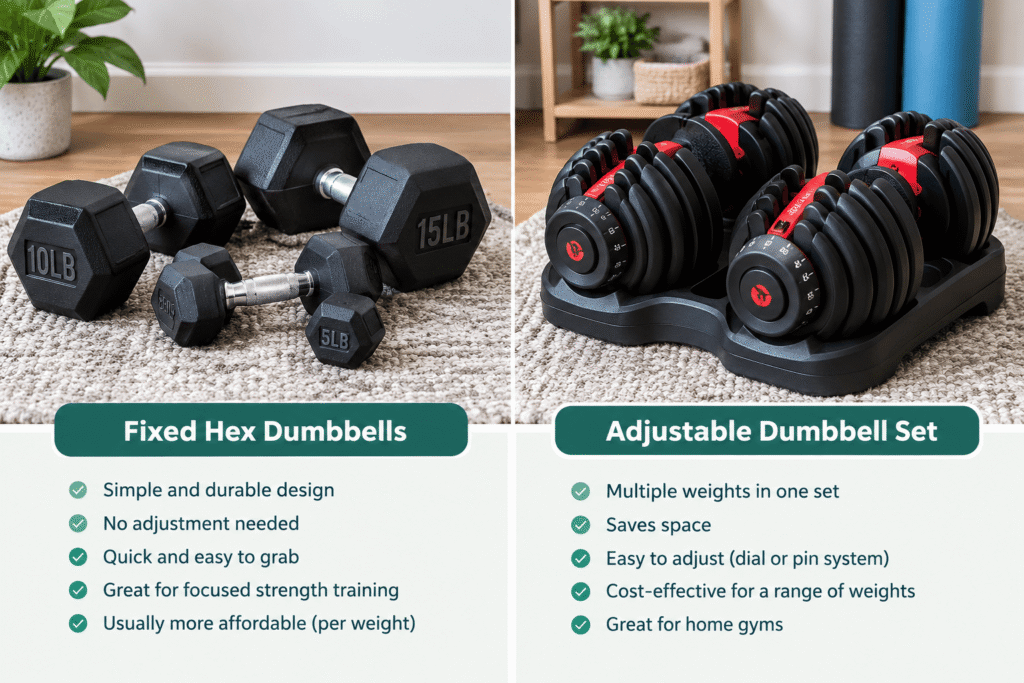
If you do plan to buy, there are two broad routes.
Quick Comparison
| Option | Best For | Key Benefit | Limitation |
|---|---|---|---|
| Fixed hex pairs | Beginners starting with one or two weights | Fast to grab, nothing to adjust | Cost and storage grow with each added pair |
| Bowflex SelectTech 552 | Small spaces, long-term progression | One pair covers 5 to 52.5 lb per dumbbell | Bulky end plates can feel awkward on some moves |
| PowerBlock Elite EXP | Lifters who expect to outgrow 50 lb | Compact frame, expandable with add on kits | Squared design takes getting used to; higher price |
Adjustable vs fixed dumbbells: Adjustable sets are better suited for small spaces and long term progression because one set replaces many pairs. Fixed pairs work better when you want fast changes between exercises. The key difference is speed of switching versus space and cost.
Users who’ve tried adjustable sets often report that the extra seconds spent changing weights are the real trade off.
Quick Answers
Short responses to the questions people ask out loud.
Q: What’s the best full body dumbbell workout for beginners?
A: Goblet squats, Romanian deadlifts, floor presses, one arm rows, overhead presses, and reverse lunges. Do three sets of 8–12 reps, three days a week, resting a day between sessions.
Q: How do I do a full body dumbbell workout without a bench?
A: Do floor presses instead of bench presses, brace one hand on a sturdy chair for rows, and keep squats and lunges as they are. The floor limits range of motion slightly, but chest and triceps still work hard.
Q: Should I do a full body dumbbell workout every day?
A: No. Muscles need recovery time to grow. Train two to three non consecutive days a week. On off days, walk or stretch lightly. Daily full body sessions raise injury and burnout risk for most beginners.
Q: Why does my full body dumbbell workout feel too easy?
A: Your weight or rep count is probably too low. Choose a load that leaves about two reps in reserve, slow the lowering phase to three seconds, or add a fourth set.
Q: When should I increase the dumbbell weight?
A: Increase when you complete every set at the top of the rep range with good form, two sessions in a row. Go up by the smallest jump available, usually 2.5 to 5 pounds.
Your First Week
Pick three days. Screenshot the table. Use weights that leave two reps in the tank, write down what you lift, and repeat next session with one more rep than last time.
This article is general fitness information, not medical advice. Stop any exercise that causes sharp pain, and talk to a healthcare professional if something doesn’t feel right.