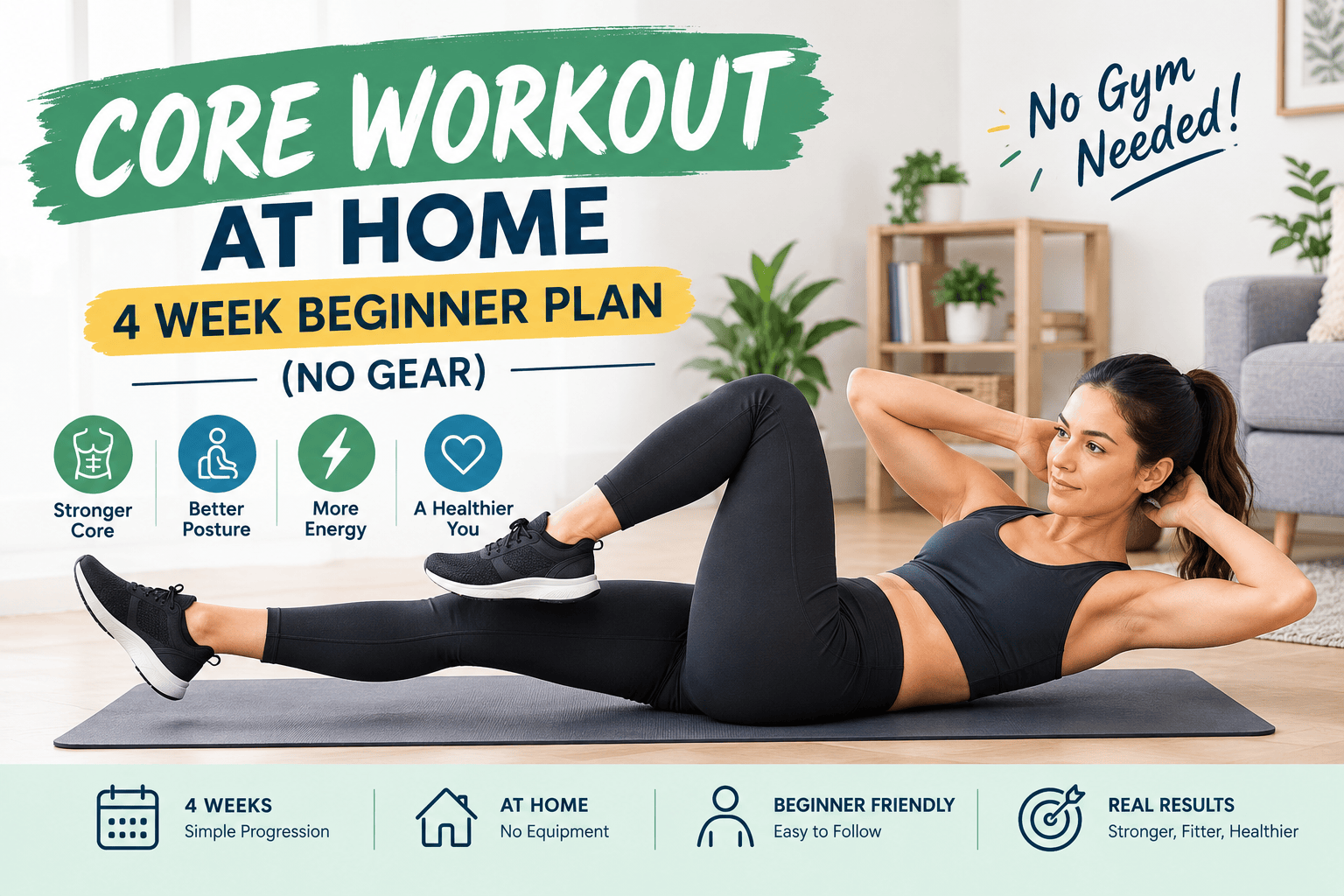
Core Workout at Home Build a Stronger Midsection in 4 Weeks, No Equipment
Last updated: October 2026
Short answer: do three bodyweight moves (dead bug, bird dog, and a knee or forearm plank) for about 10 minutes, three non consecutive days a week, and make them slightly harder every seven days. That’s the whole plan.
The rest of this article covers how to brace, what to do each week, and why the crunches you’ve been grinding through probably aren’t working.
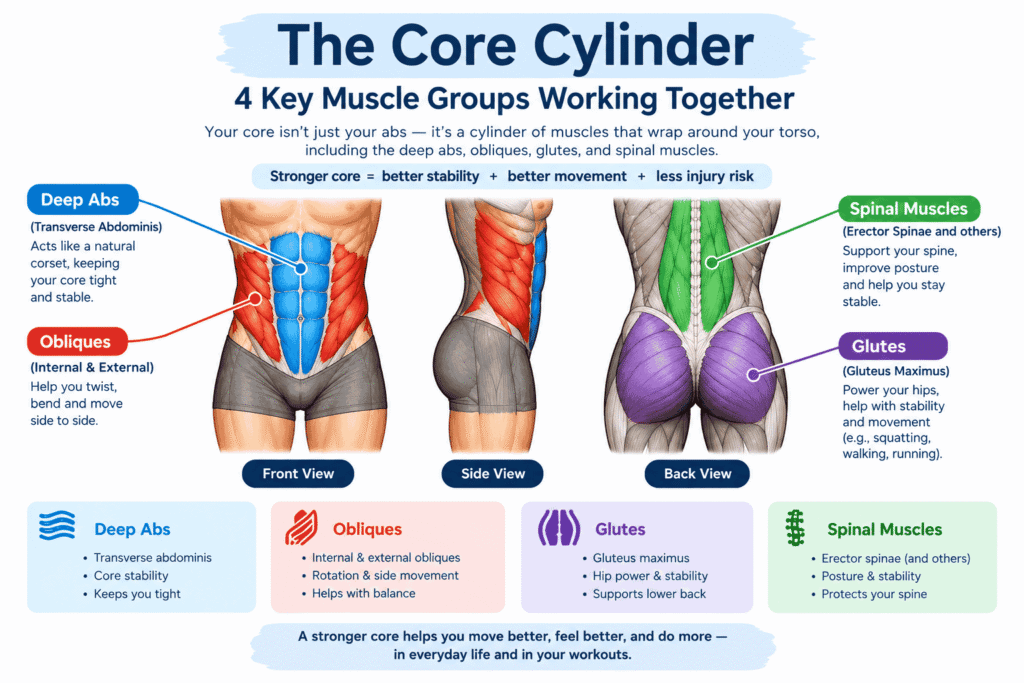
A core workout at home is a routine of bodyweight exercises that train the muscles around your trunk, including the abs, obliques, deep stabilizers, and lower back, without gym equipment. It builds stability first and strength second.
This works best for healthy adults who sit most of the day and want a no equipment ab workout they can start tonight. It won’t help if you’re hoping to shrink belly fat from core work alone. It also doesn’t cover pregnancy, postpartum recovery, or rehab after back surgery. Treat everything here as general fitness information, not medical advice, and see a clinician first if back pain shoots into a leg or comes with numbness.
What Should a Core Workout at Home Actually Train?
A core workout at home trains the muscles that stabilize your spine and pelvis, not just the abs you can see. According to Stuart McGill’s research at the University of Waterloo, the core’s main job is resisting unwanted motion, which is why plank style and anti rotation moves anchor most back friendly programs.
Most people assume the answer is “abs.” The research on spine health points somewhere else.
If you’ve been doing daily crunches and they haven’t made your core feel stronger, you’re not doing them wrong. You’re training one muscle and skipping the rest.
Crunches build the rectus abdominis but leave the rest of the core undertrained. According to the American Council on Exercise’s 2001 study at San Diego State University, the bicycle crunch and captain’s chair leg raise activated that muscle most, yet activation isn’t the same as spine stability, which is why a routine needs planks and bird dogs too.
I’ve seen conflicting data on how much that ranking matters. Some sources treat it as the final word on ab exercises, while others point out it measured muscle activity in a small sample, not results over weeks. My read: it’s a good tool for choosing exercises and a poor one for designing a whole program.
Some experts argue crunches are perfectly fine for healthy backs and do build the visible ab muscle. That’s valid for people with no back pain who want bigger abs. But if your lower back aches after long sitting days, train the stabilizers first and keep crunches small.
Stability first, size second.
How Do You Brace Your Core and Breathe Before Each Rep?
Bracing your core means gently tensing your abs, sides, and lower back at once, like preparing for a light poke to the stomach, while you keep breathing. You’re aiming for about 30 percent effort, not a full power clench. It protects your spine under load and makes every exercise harder in the right way.
To brace your core correctly, follow these steps:
- Lie on your back, knees bent, feet flat.
- Exhale slowly until your ribs drop toward your hips.
- Tighten your midsection gently, like bracing for a poke.
- Keep breathing in short, quiet breaths.
- Hold that tension while you move one limb.
What most guides skip is the exhale. Flared ribs are a common reason people feel planks in their lower back instead of their abs, and a slow breath out that pulls the ribs down often fixes it faster than any extra rep. Users who’ve tried planks for the first time often report the burn landing in the lower back or shoulders. That usually points to flared ribs and a sagging pelvis, not weak abs.
Or maybe I should say it this way: if the plank hurts your back, the plank isn’t the problem. Your position is.
Try the brace once before reading on.
What Does a 4 Week Core Workout at Home Look Like?
Train three days a week with a rest day between sessions. Each one runs about 10 minutes, so this doubles as a 10 minute core workout you can fit in before dinner.
The World Health Organization’s 2020 guidelines recommend muscle strengthening activity on two or more days a week for adults, so three short sessions is plenty. Rest 30 to 45 seconds between sets.
No equipment is required. A yoga mat from Gaiam or Manduka saves your tailbone on hard floors, and a resistance loop band like Fit Simplify’s can add challenge after week four. If you like being talked through a session, the Nike Training Club or Fitbod apps offer guided options.
Week 1: Build the Brace
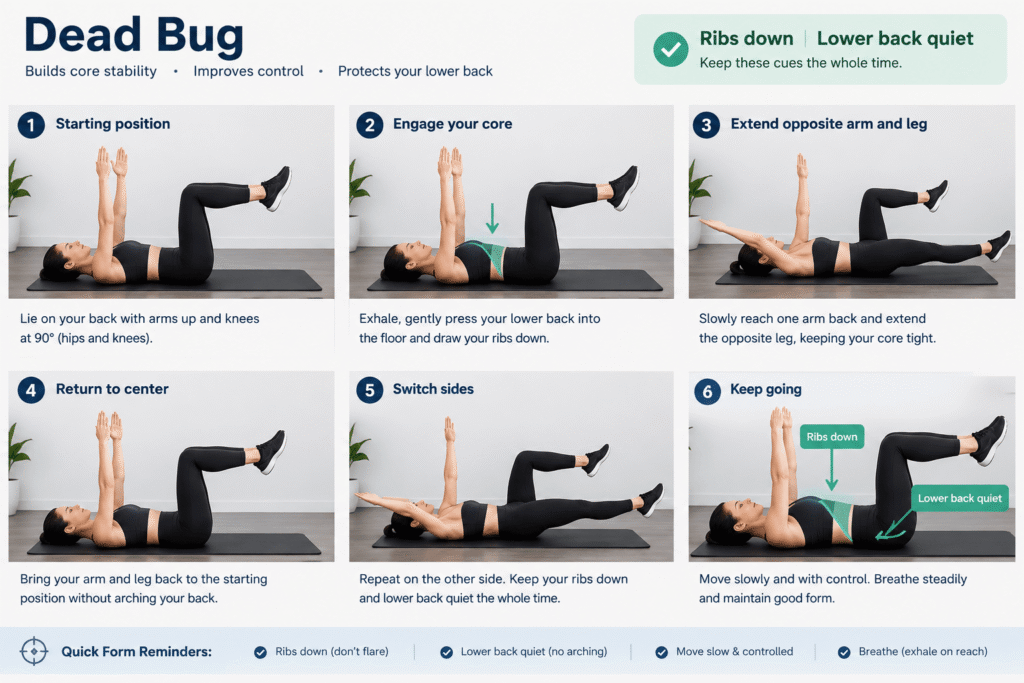
- Dead bug: 2 sets of 6 per side
- Glute bridge: 2 sets of 10
- Bird dog: 2 sets of 5 per side
- Knee plank: 2 sets of 15 seconds
Move slowly. If your lower back lifts off the floor during the dead bug, shrink the range.
Week 2: Add Time Under Tension
- Dead bug: 3 sets of 8 per side
- Bird dog with a 3 second hold: 3 sets of 6 per side
- Forearm plank on knees: 3 sets of 20 seconds
- Knee side plank: 2 sets of 15 seconds per side
Week 3: Lengthen the Lever
- Dead bug, slow 4 count: 3 sets of 10 per side
- Full forearm plank: 3 sets of 20 to 30 seconds
- Side plank (knees or feet): 3 sets of 20 seconds per side
- Small-range reverse crunch: 2 sets of 8
Week 4: Test Your Strength
- Forearm plank: 3 sets of 40 seconds
- Side plank: 3 sets of 25 seconds per side
- Bicycle crunch, slow: 3 sets of 10 per side
- Reverse crunch: 3 sets of 8
Move up a week only when your last set feels like a seven out of ten with clean form. Repeat a week if it doesn’t. Nobody’s grading you.
Dead bugs and reverse crunches are what most people mean by a lower ab workout at home. Strictly speaking, the rectus abdominis is one long sheet of muscle rather than separate upper and lower parts, but tilting your pelvis shifts the effort lower.
Which Core Exercise Should Beginners Start With?
Dead bug vs plank: the dead bug is better suited for beginners with lower-back sensitivity because it keeps your spine supported on the floor. The plank works better once you can brace and breathe at the same time. The key difference is that the dead bug trains control while moving, and the plank trains endurance while still.
Quick Comparison
| Option | Best For | Key Benefit | Limitation |
|---|---|---|---|
| Dead bug | Week 1 beginners, sore lower backs | Teaches bracing while limbs move | Easy to rush and arch the back |
| Bird dog | Desk workers with stiff hips | Builds spine stability and glute control | Hard floors can bother wrists and knees |
| Forearm plank | Building endurance after week 2 | Works the full front of the trunk | Ribs flare and hips sag when tired |
| Side plank | Obliques and hip stability | Trains the sides without spinal flexion | Shoulder strain if elbow is misplaced |
| Bicycle crunch | Visible ab muscle work | High rectus abdominis activity in ACE testing | Neck pulling and fast reps ruin it |
Look if you’re a desk worker whose back aches by 6 p.m., here’s what actually works: start with dead bugs, not planks.
Here’s the thing: I’d drop full sit ups from a beginner’s routine entirely. Plenty of trainers disagree, since sit ups still show up in fitness tests. My reason is that they let the hip flexors do much of the work and load the lower back repeatedly, which is exactly the area most desk workers are trying to protect.
Why Does Your Lower Back Hurt During Core Workouts?
Lower back pain during core work usually traces to arching, flared ribs, or rushing. Each has a fix.
- Arching: press your lower back lightly toward the floor and shrink the range of motion.
- Flared ribs: exhale until your ribs drop, then keep them there for the whole rep.
- Rushing: slow every rep to a four count, because fast reps hide weak bracing.
Can’t hold a plank cleanly? Drop to your knees, or lean into a wall plank until your form holds for the full set.
Muscle burn is normal. Sharp pain, or pain that travels down a leg, isn’t. Stop, and see a clinician if it lingers beyond a week or two.
One reality check on belly fat. Most people assume core work burns it off, and it doesn’t, at least not selectively. Fat loss comes from overall energy balance, so pair this routine with walking and sensible eating.
Core Workout at Home: Quick Answers
Q: What’s the best core workout at home for beginners?
A: Start with dead bugs, bird dogs, and a knee plank, three days a week for about 10 minutes. These train bracing and spine stability without loading your lower back.
Q: How do I do a core workout at home without equipment?
A: Use bodyweight moves on a mat or carpet: dead bugs, bird dogs, planks, and bridges. Slow tempo creates the challenge, not weights. Add reps or hold time each week.
Q: Should I do core exercises every day?
A: No. Three non consecutive days a week is enough for beginners, and muscles need rest to adapt. Daily training mostly adds fatigue and back soreness.
Q: Why does my lower back hurt during planks?
A: Usually your ribs flare, your hips sag, or you hold too long. Brace gently, tuck your pelvis slightly, and drop to your knees until you can hold clean.
Q: When should I expect results from a core workout at home?
A: Most people feel steadier and stronger within two to four weeks. Visible changes depend on body fat, which exercise alone can’t target.