Last updated: May 2026 This guide covers back exercises for healthy adult women dealing with general back weakness, posture issues, or mild chronic discomfort. It does NOT address acute spinal injuries, herniated discs, spinal stenosis, or post surgical recovery those require individualized guidance from a physical therapist or physician.
10 Back Exercises for Women That Build Real Strength (Not Just a Sore Spine)
Your back is working right now. Even as you read this probably slightly hunched, screen in front of you your spinal erectors are firing, your rhomboids are straining, and your lats are quietly doing their best impression of support beams two sizes too small for the job.
That’s the problem for most women. The back is always working. It’s almost never trained.
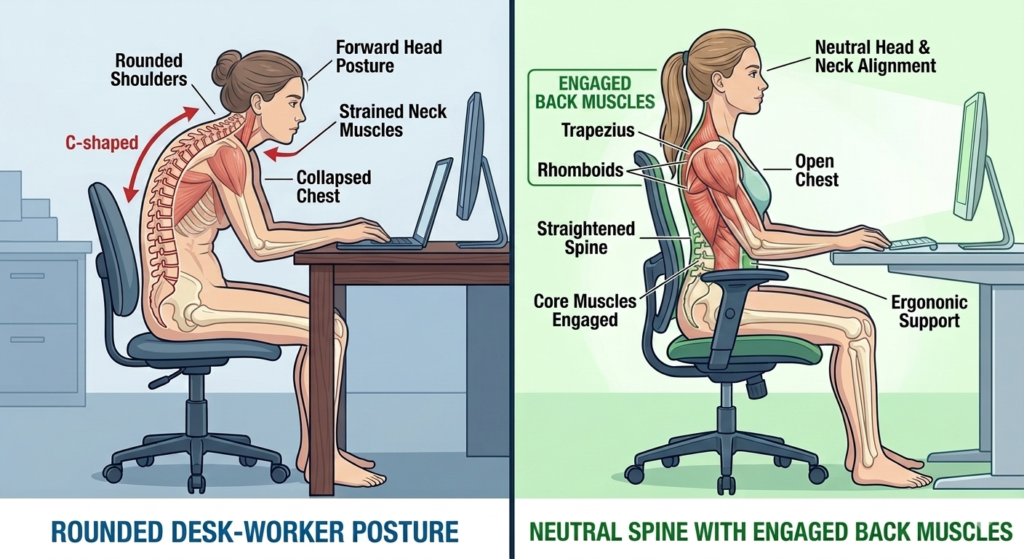
Back exercises for women are targeted strength and mobility movements that train the muscles running along and supporting the spine including the lats, rhomboids, erector spinae, and traps. Unlike generic back workouts, the best versions for women account for posture patterns common in desk workers, hormonal effects on connective tissue, postpartum recovery needs, and daily load patterns like bag-carrying and childcare.
Here’s what this guide gives you: 10 specific exercises, an actual weekly plan with sets and reps, and the information most back articles quietly skip.
Why Women Carry More Back Pain Than Men
The numbers are not subtle.
According to a June 2023 systematic analysis published in The Lancet Rheumatology (Institute for Health Metrics and Evaluation), an estimated 395 million women globally live with low back pain compared to 225 million men.
That’s nearly 170 million more women. Back pain has ranked as the world’s number one cause of disability for three consecutive decades.
Here’s the thing: it’s not simply that women are more likely to report pain. There are real physiological mechanisms at work.
Estrogen plays a protective role in maintaining intervertebral disc hydration and spinal bone density. As estrogen drops during perimenopause, postpartum recovery, or even across a normal menstrual cycle connective tissue becomes temporarily looser and more vulnerable to strain. Pregnancy shifts the body’s center of gravity, loading the lumbar spine with forces it wasn’t engineered to sustain for nine consecutive months. Research published in Frontiers in Endocrinology (2025) found that among postmenopausal women, incident cases of low back pain nearly doubled between 1990 and 2021 rising from 35.2 million to 70.3 million largely driven by estrogen loss accelerating disc degeneration.
Most articles don’t cover this. They hand you a list of exercises. This guide explains the context because knowing why your back hurts the way it does changes how seriously you take the fix.
One counterintuitive finding worth knowing: chronic low back pain affects 41.3% of women compared to 34.3% of men, according to multiple pain epidemiology sources. The conventional assumption is that physically demanding labor explains this gap. The data suggests otherwise desk workers, caregivers, and sedentary women are substantially affected. Sitting for extended periods increases lumbar disc pressure by more than 40% compared to standing. The office is as much a risk environment as the construction site.
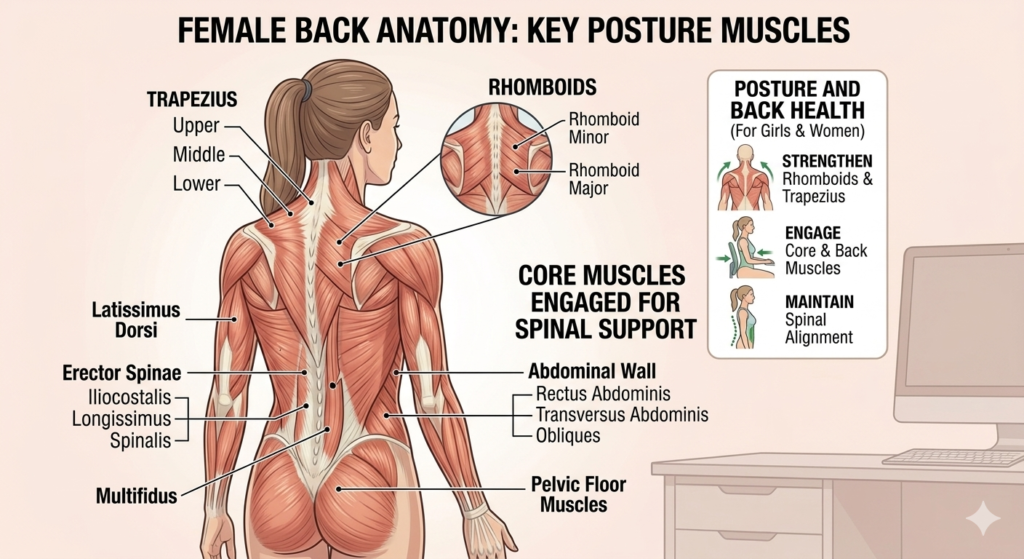
The Back Muscles Women Actually Need to Train
You don’t need to memorize anatomy. But you do need to know what’s getting neglected because that’s usually where pain lives.
Rhomboids (upper-mid back): Pull your shoulder blades together. Chronically weak in desk workers. Responsible for that aching “knot” between the shoulder blades that no stretch seems to fix permanently. Almost every posture problem starts here.
Trapezius (upper and mid back): Three regions upper, middle, lower. The upper traps get overworked and tight. The middle and lower traps get underworked and weak. Correcting this imbalance is the fastest route to better posture.
Latissimus dorsi (lats): The large, V shaped muscles running down the sides of your back. Trained almost exclusively by pulling movements rows and pulldowns. Underdeveloped in the vast majority of women who skip resistance training.
Erector spinae (lower back): Run parallel to the spine from the sacrum to the skull. They hold you upright. Weak erectors cause lower back fatigue after standing or walking for extended periods a complaint that gets misdiagnosed as “just being tired” constantly.
Multifidus: Small stabilizing muscles sitting deep in the spine. Critical after childbirth, when the core pressure system partially collapses and these muscles stop firing properly. Most back workout articles skip these entirely. That’s a real gap.
Quick note: you can’t strengthen one of these areas while ignoring the others. The back functions as a system. A well designed program hits all five.
10 Best Back Exercises for Women
To build a stronger back as a woman, follow this approach:
- Warm up with 5 minutes of cat cow and shoulder circles (10 reps each)
- Begin with the bodyweight or banded exercise matched to your current level
- Complete 3 sets per exercise, resting 60–90 seconds between sets
- Finish with 2 minutes of foam roller thoracic spine release
- Train back 2–3 times per week with at least 48 hours between sessions
1. Cat Cow Stretch
Targets: Erector spinae, multifidus, thoracic spine mobility Level: All levels Sets/Reps: 2 sets × 10 slow reps
Start on all fours, wrists under shoulders, knees under hips. Inhale and drop the belly, lifting the head and tailbone (cow). Exhale and round the spine toward the ceiling, tucking your chin to your chest (cat). Move slowly this is not a bounce. Each direction counts as one rep.
Why it matters: The thoracic spine stiffens first in desk workers, creating a cascade of compensation patterns that progressively overload the lumbar spine. Cat cow restores segmental spinal motion before you load the spine with resistance. Skip it and you’re training on a locked structure.
Progression: Add a 3 second hold at each end position.
2. Superman Hold
Targets: Erector spinae, glutes, posterior chain Level: Beginner Sets/Reps: 3 sets × 10 reps, 2 second hold at top
Lie face down, arms extended overhead. Simultaneously lift your arms, chest, and legs off the floor. Hold two seconds. Lower with control. Keep your neck neutral don’t strain it upward toward the ceiling.
Why it matters: Directly trains the erectors without compressive load on the lumbar spine. Safe for early postpartum return to exercise and for women rebuilding after a long break from training.
Progression: Add Bala Bangles (1–2 lb wrist/ankle weights) for resistance without needing any new equipment.
3. Resistance Band Pull Apart
Targets: Rhomboids, rear deltoids, middle trapezius Level: Beginner Sets/Reps: 3 sets × 15 reps
Hold a resistance band with both hands at shoulder width, arms straight in front of you at shoulder height. Pull the band apart until your arms form a T, squeezing your shoulder blades together at the end range. Return slowly. Don’t let your shoulders shrug up toward your ears.
Why it matters: This is the most underrated posture exercise for women. The rhomboids and middle traps the muscles that pull your shoulders back and down are chronically undertrained in anyone who spends significant time at a screen. Three sets of this daily will shift your posture faster than any passive stretch.
Or maybe I should say it this way: if you only do one exercise from this entire list, do this one.
Progression: Use a heavier band or add a 1 second pause at full extension.
4. Dead Bug
Targets: Multifidus, transverse abdominis, lumbar stabilizers Level: Beginner–Intermediate | Sets/Reps: 3 sets × 8 reps each side
Lie on your back, arms pointing toward the ceiling, knees bent at 90 degrees in a tabletop position. Slowly lower your right arm overhead and extend your left leg simultaneously keep your lower back firmly pressed into the floor throughout. Return to start. Alternate sides.
Why it matters for women specifically: Postpartum core dysfunction doesn’t only affect the abdominals it directly weakens the multifidus, the deep spinal stabilizer most responsible for protecting the lumbar spine during everyday movement. The dead bug retrains this system without any external load and without the spinal compression of exercises like sit ups or back extensions.
Progression: Hold a 2–5 lb dumbbell in the lowering hand.
5. Dumbbell Bent Over Row
Targets: Lats, rhomboids, biceps, erector spinae (as stabilizer) Level: Intermediate Sets/Reps: 3 sets × 10–12 reps
Hold a dumbbell in each hand. Hinge forward at the hips until your torso is roughly parallel to the floor, back flat, knees soft. Row both dumbbells toward your lower ribs, elbows close to your body. Lower with control a 2 second lowering phase. Don’t round your lower back to generate momentum.
Common mistake: Most women start too heavy here and immediately compensate with a swinging torso. Use a weight you can fully control for all 12 reps. If your lower back is straining during the set, that’s your form breaking down not your back working.
Progression: Move to a single arm row with one hand supported on a bench for a greater range of motion and heavier loading.
6. Face Pull (Band or Cable)
Targets: Rear deltoids, external rotators, middle and lower trapezius Level: Intermediate Sets/Reps: 3 sets × 12–15 reps
Attach a resistance band to a door anchor or cable machine at face height. Grip with both hands, thumbs up. Pull the band toward your face, flaring your elbows out to the sides and squeezing the backs of your shoulders at full contraction. Return slowly.
Why it belongs here: Face pulls directly counteract the internal shoulder rotation pattern that desk work creates over months and years. They also strengthen the external rotators of the shoulder a muscle group dramatically undertrained in most women’s programs and directly connected to upper back and neck tension.
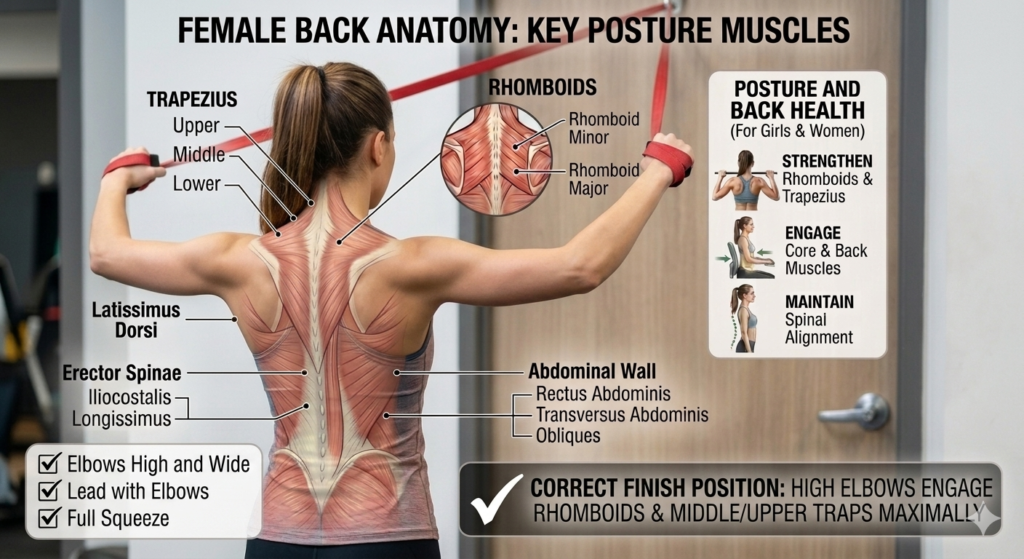
Progression: Use a cable machine with a rope attachment for greater resistance range and cleaner movement path.
7. Single Arm Dumbbell Row
Targets: Lats, rhomboids, middle trapezius Level: Intermediate Sets/Reps: 3 sets × 10–12 reps each side
Place one knee and same-side hand on a bench for support. Hold a dumbbell in the opposite hand. Row it straight up toward your hip not your shoulder. Keep the elbow close to your body. Lower with full control, letting the shoulder blade glide forward at the bottom.
Supporting the body allows heavier loading than the bilateral bent over row, which is how you start building real lat width and density. The lat is the single largest muscle of the back, and most women under develop it simply because standard exercise lists don’t program it with enough volume or load.
Progression: Increase dumbbell weight when you can complete all reps with a controlled 2 second lowering phase across three consecutive sessions.
8. TRX Row (or Bodyweight Table Row)
Targets: Lats, rhomboids, biceps, core Level: Beginner Intermediate Sets/Reps: 3 sets × 10–12 reps
Set TRX Suspension Trainer handles to waist height. Lean back holding the handles, body straight as a plank. Pull your chest up to the handles, squeezing your shoulder blades at the top. Lower with control.
No TRX? Use the underside of a sturdy table. Same movement, zero equipment cost.
Why it’s more versatile than it looks: The TRX row is self scaling the more upright you stand, the easier it is; the more horizontal your body, the harder. That makes it ideal for women at different fitness levels training in the same session, or for home workouts without a full dumbbell set.
Progression: Walk your feet forward to lower your body angle closer to horizontal.
9. Good Morning (Bodyweight)
Targets: Erector spinae, glutes, hamstrings Level: Intermediate | Sets/Reps: 3 sets × 10–12 reps
Stand feet hip width apart, hands behind your head. Hinge at the hips pushing them back as you lower your torso until it’s nearly parallel to the floor then drive through your hips to return upright. Neutral spine throughout. This is a hip hinge, not a squat.
Some experts argue that good mornings are too risky for general populations. That’s valid for heavily loaded barbell versions. Bodyweight good mornings, performed with a controlled hinge and no rounding, are safe, highly effective for the posterior chain, and significantly underused in women’s programming. The risk profile changes entirely with load.
Progression: Hold a 5–10 lb dumbbell at your chest while performing the hinge.
10. Lat Pulldown (Cable or Band)
Targets: Latissimus dorsi, lower trapezius, biceps Level: Intermediate Sets/Reps: 3 sets × 10–12 reps
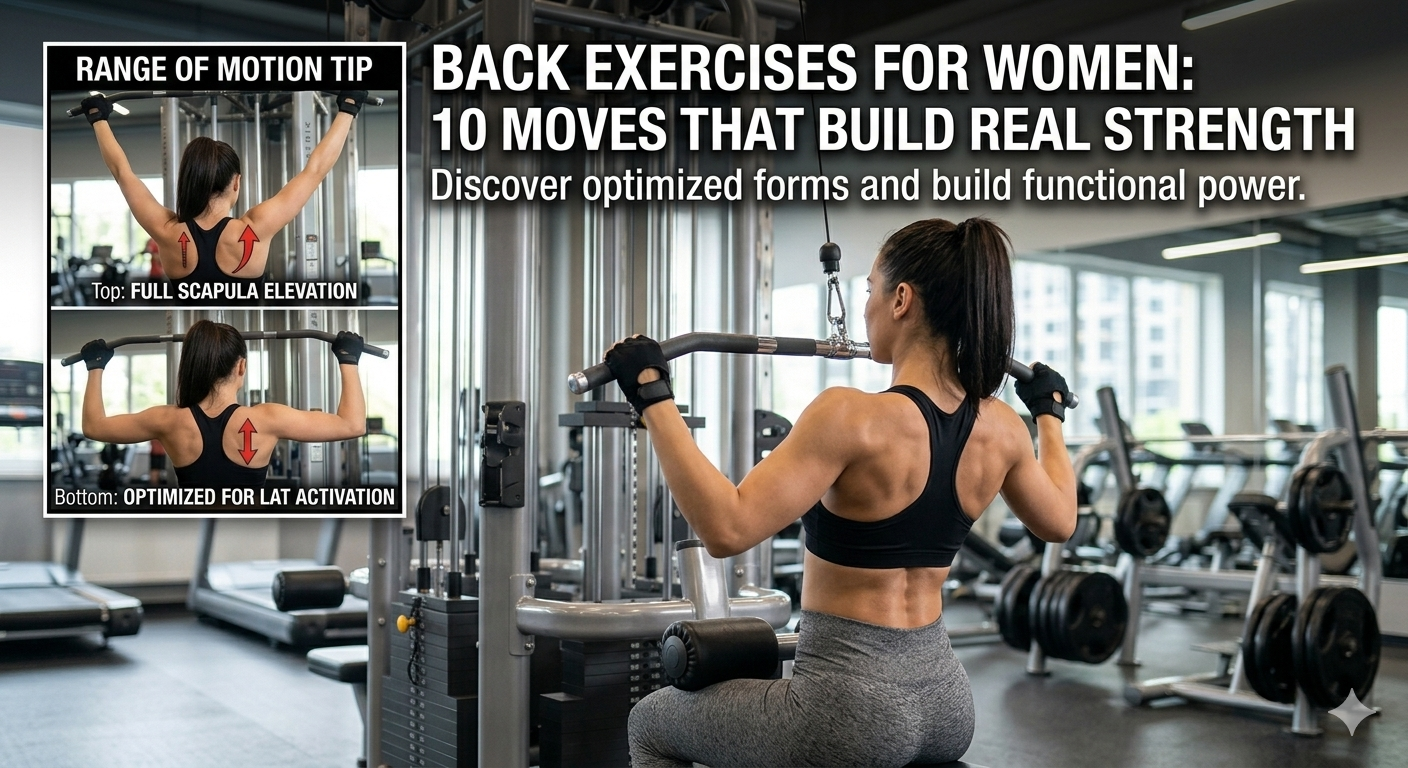
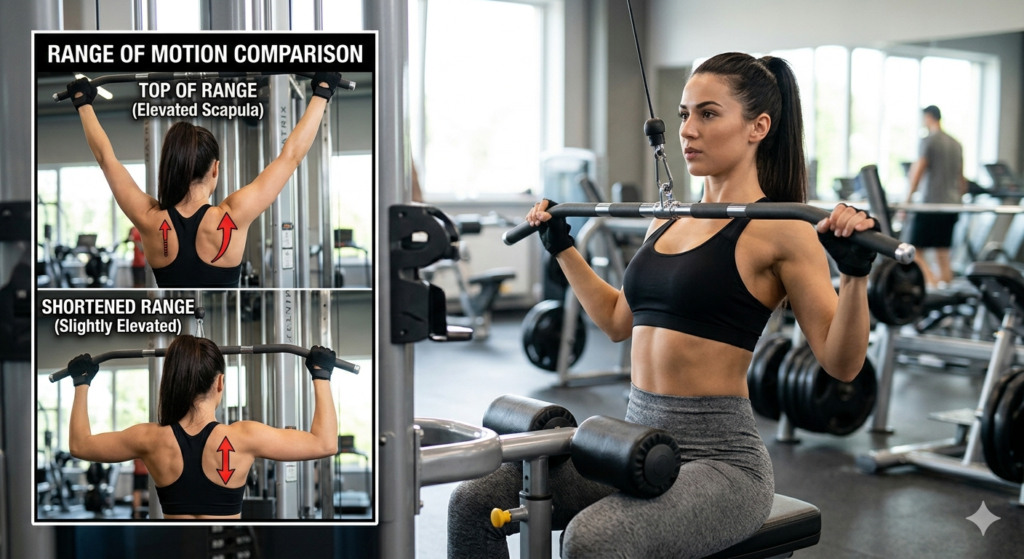
At a cable machine, grip the bar slightly wider than shoulder width. Lean back about 15 degrees. Pull the bar down to your upper chest, leading with your elbows. Squeeze your lats at the bottom. Return with control, letting your shoulder blades rise fully at the top.
At home: loop a resistance band over a door anchor. Kneel or sit, grip both ends, replicate the same motion.
What most guides skip: The most critical part of the lat pulldown is the full stretch at the top letting your shoulder blades elevate completely. Most women shorten this range to lift heavier. That defeats the purpose. Go lighter, go longer, feel the full range.
Quick Comparison Back Exercise Equipment for Women
| Option | Best For | Key Benefit | Limitation |
|---|---|---|---|
| Bodyweight (Superman, Dead Bug, Cat Cow) | Beginners, postpartum recovery | Zero equipment; very low injury risk | Progressive overload is limited over time |
| Resistance Bands (Pull Apart, Face Pull) | Home workouts, posture correction | Portable; constant tension throughout movement | Resistance caps out; bands degrade with repeated use |
| Dumbbells (Bent Over Row, Single Arm Row) | Intermediate strength building | Easy to incrementally load; highly versatile | Technique errors transfer directly to strain |
| TRX / Cables (TRX Row, Lat Pulldown) | Gym goers; full range training | Greatest lat development and widest load range | Requires gym access or TRX purchase |
Resistance bands vs. dumbbells for back exercises: Bands are better suited for beginners and posture correction work because they provide constant tension and are highly joint friendly. Dumbbells work better for progressive strength building once basic movement patterns are established. The key difference is load progression you can always move to heavier dumbbells; bands max out relatively quickly and can’t replicate the overload needed for long term muscle development.
Your Weekly Back Workout Plan Beginner to Intermediate
This is the part competitors leave out. WebMD lists exercises. Mayo Clinic covers rehabilitation. Neither gives you a structured program with actual sets, reps, and a progression path.
Beginner Plan Weeks 1–4 Train 2 days per week, minimum 48 hours apart.
| Exercise | Sets | Reps |
|---|---|---|
| Cat Cow | 2 | 10 |
| Superman Hold | 3 | 10 (2 sec hold) |
| Resistance Band Pull Apart | 3 | 15 |
| Dead Bug | 3 | 8 each side |
| TRX Row / Table Row | 3 | 10 |
Rest 60 seconds between sets. Total time: 25–30 minutes.
Intermediate Plan Weeks 5–8 Train 3 days per week.
| Exercise | Sets | Reps |
|---|---|---|
| Cat Cow warm up | 2 | 10 |
| Dumbbell Bent Over Row | 3 | 10–12 |
| Face Pull (band) | 3 | 15 |
| Single Arm Dumbbell Row | 3 | 12 each side |
| Good Morning (bodyweight) | 3 | 10 |
| Lat Pulldown (band or cable) | 3 | 10–12 |
Rest 75–90 seconds between sets. Total time: 35–40 minutes.
After week 8, increase dumbbell weight by 5 lb or move up one band resistance level. Repeat the intermediate plan for another 4–6 weeks before reassessing.
Mistakes That Keep Your Back Weak
Doing cardio and skipping resistance training entirely. Cardio doesn’t load the posterior chain. Running won’t strengthen your rhomboids. Walking won’t rebuild your erectors. The American College of Sports Medicine has recommended resistance training at least 2–3 days per week since their foundational 2009 position stand a recommendation that hasn’t shifted since.
Training only mirror muscles. Chest, shoulders, abs. If that describes your current routine, your pulling muscles your entire back are probably undertrained by a ratio of 3:1. Back training volume should match your pushing volume. Given how most women sit and carry loads daily, it should arguably exceed it slightly.
Using momentum instead of control. Look if you’re rowing a dumbbell by jerking your elbow up and swinging your torso, here’s what actually works: cut the weight in half, slow the lowering phase to 3 seconds, and feel the muscle work through the full range. You’ll be significantly sorer the next day from less weight. That’s the point.
Skipping the warm up. Cold thoracic spines don’t move. The erectors stiffen under resistance load when they haven’t been primed. Five minutes of cat cow before every back session is the single lowest cost intervention in this guide. Skipping it is borrowing soreness from your future self.
Ignoring daily postural loads. This is genuinely underreported in exercise content. Upper trapezius tightness in women is frequently worsened by bra strap pressure, single shoulder bag carrying, and baby carrying and nursing positions held for hours daily. The exercises in this guide will help but identifying and reducing these daily stressors accelerates recovery significantly.
I’ve seen conflicting data on whether resistance training alone or a combined strengthening plus mobility approach produces better long term outcomes for chronic low back pain in women some studies favor pure strengthening, others favor the combined model. My read is that strengthening is the foundation and mobility work like cat cow is the accelerant. Neither works as well alone as the two do together.
A quick post session tip: use a Gaiam Restore Foam Roller for 2 minutes of thoracic spine release after back training rolling the upper back over the roller between the shoulder blades helps restore the thoracic extension that desk posture progressively steals.
Medical disclaimer: This article is for general informational purposes only and does not constitute medical advice. If you have a diagnosed spinal condition, recent back injury, or are in early postpartum recovery, consult a licensed physical therapist or physician before beginning any resistance training program. The exercises described here are appropriate for generally healthy adults.