Build Your Chest at Home With Dumbbells No Bench, Real Results
You don’t need a bench. You don’t need a barbell. And you definitely don’t need a gym membership.
What you do need is a pair of dumbbells, enough floor space to lie down, and a training plan built for the situation you’re actually in not the one fitness channels assume you’re in.
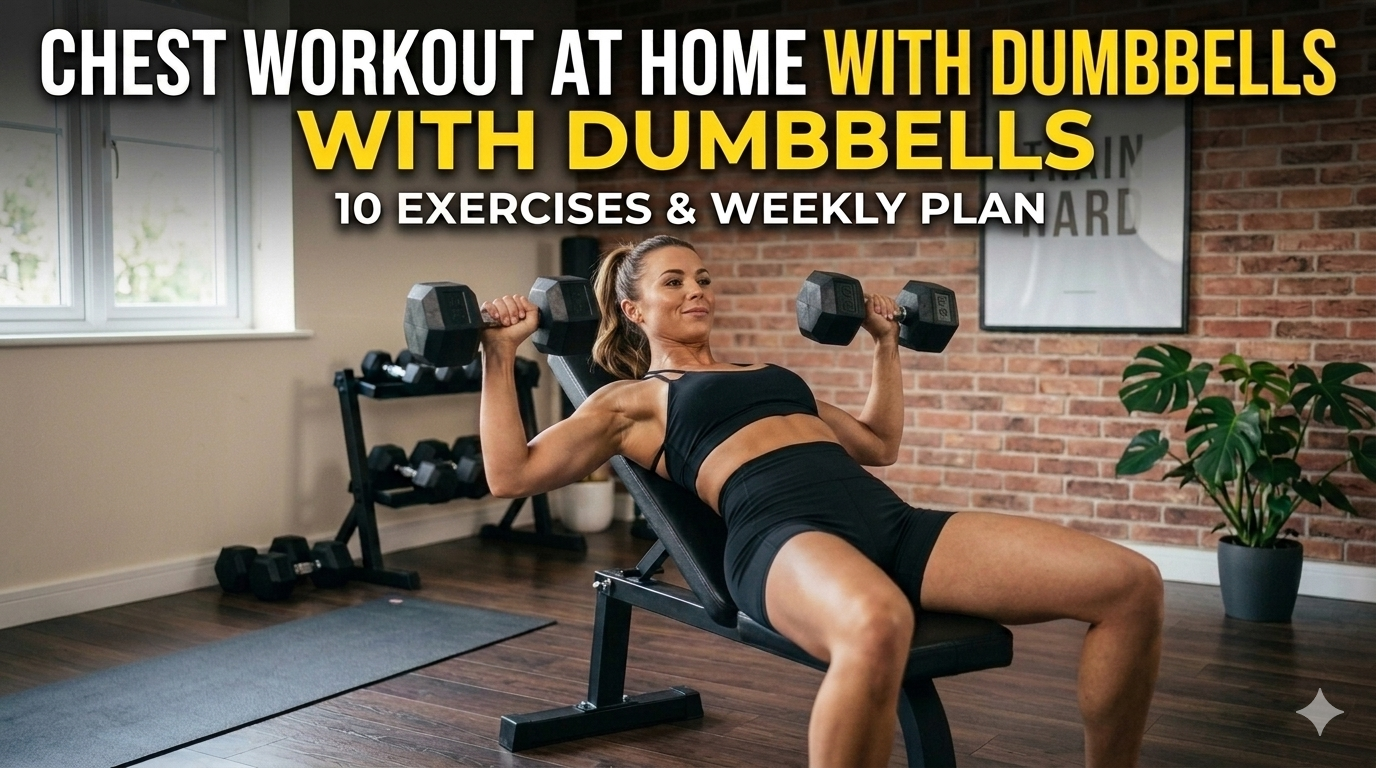
This guide covers 10 exercises that target every region of the chest, with specific sets and reps for each, plus a 4 week progressive training structure. This works best for beginner-to-intermediate trainees working out in a home or apartment setting with a single pair of adjustable dumbbells. It does NOT address barbell programming, cable machine alternatives, or training modifications for shoulder injuries.
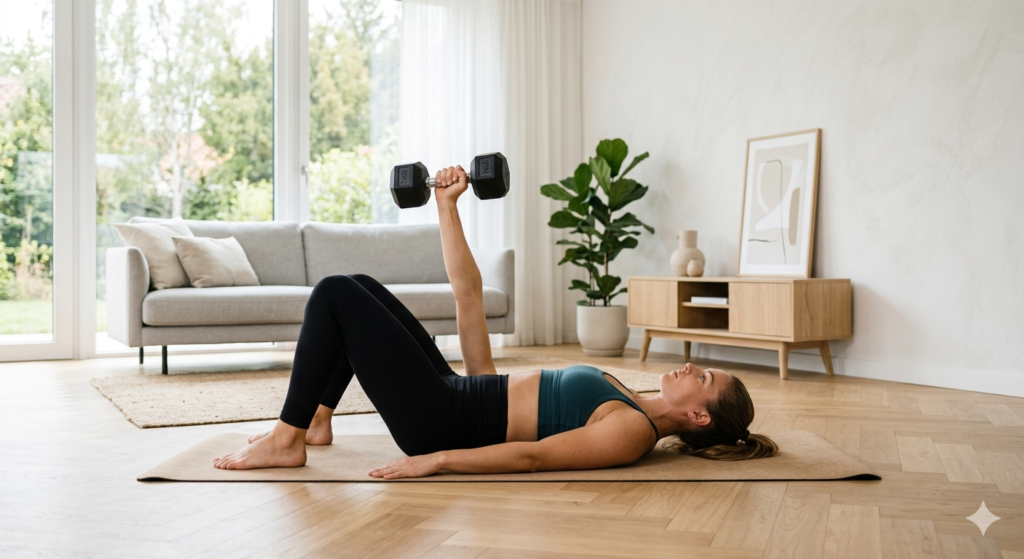
What a Chest Workout at Home With Dumbbells Actually Involves
A chest workout at home with dumbbells uses floor based pressing, fly movements, and standing exercises to train the pectoralis major and minor without a bench or gym. The exercises target all three chest regions upper, mid, and lower using progressive resistance and varied movement angles. No bench is required when exercise selection accounts for pressing angle and grip position.
Many people wonder whether a dumbbell chest workout at home can match gym training for muscle development. The short answer is yes, for most trainees at most stages. Research published in the Journal of Human Kinetics (2015) found that dumbbell pressing produces comparable pectoralis major activation to barbell bench pressing with the added advantage of greater stabilizer muscle recruitment due to independent arm movement. Your chest doesn’t know what it’s lying on. It responds to tension, stretch, and progressive load.
Here’s the anatomy piece that matters. The chest has two primary muscles: the pectoralis major and the smaller pectoralis minor beneath it. The pec major has two distinct heads the clavicular head (upper chest) and the sternal head (mid and lower chest). Most home gym trainees default to flat floor pressing and completely neglect the clavicular head for months. That’s why so many people end up with a chest that looks full in the center and hollow at the top.
10 Dumbbell Chest Exercises That Target Every Region
The best dumbbell chest exercises at home cover pressing and fly movements across multiple angles. According to the American Council on Exercise (ACE), the flat dumbbell fly and dumbbell bench press rank among the top five movements for pectoralis major activation both of which can be performed on the floor without any modification.
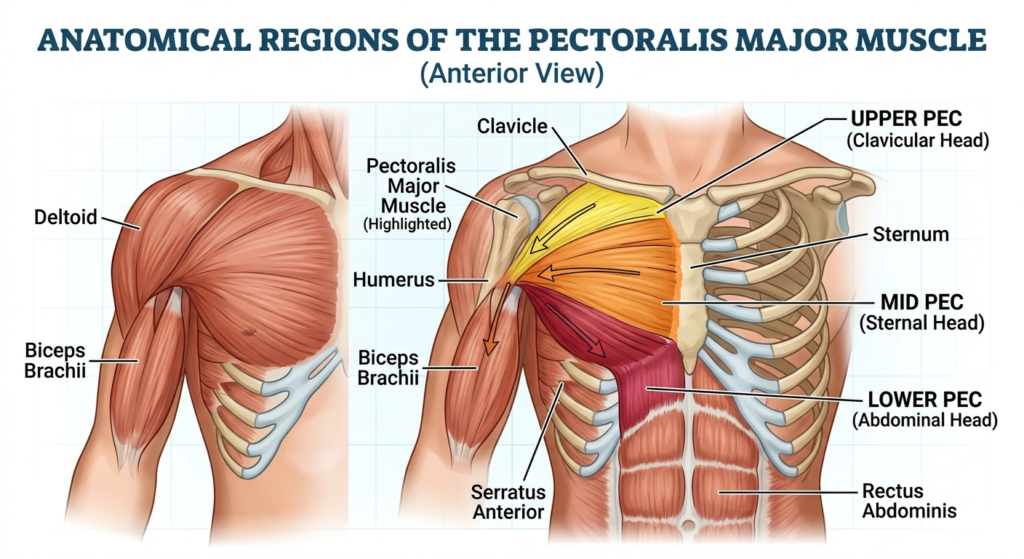
Mid Chest Exercises Floor Press Variations
1. Dumbbell Floor Press
The foundation. Lie flat on your back, knees bent, feet planted firmly. Hold dumbbells at chest height with elbows at 45 degrees from your torso not flared out to 90 degrees. Press straight up until your arms are nearly locked, then lower with control until elbows lightly graze the floor.
Sets & Reps: 3–4 sets | 8–12 reps | Rest: 60 seconds
The floor cuts off your range of motion at the bottom and that’s a feature, not a bug. It prevents the shoulder impingement that excessive elbow depth causes on a full bench press. Most people with nagging shoulder pain from barbell pressing report zero discomfort on this movement.
2. Close Grip Dumbbell Floor Press
Same setup as above. Palms face each other, elbows stay tucked close to the ribs throughout the press. This variation shifts emphasis toward the inner pec fibers and increases tricep involvement, making it a strong pairing with the standard floor press.
Sets & Reps: 3 sets | 10–15 reps | Rest: 45 seconds
3. Dumbbell Floor Fly
Lie on your back with dumbbells extended above your chest, elbows slightly bent. Lower the weights in a wide arc until elbows lightly touch the floor. Squeeze the chest to bring them back up in the same arc. Don’t straighten the elbows at the bottom that converts a fly into a press and removes pec stretch entirely.
Sets & Reps: 3 sets | 12–15 reps | Rest: 45 seconds
Quick note: If you’re feeling this exercise more in your front delts than your chest, drop the weight by 20% and slow the eccentric phase to a deliberate 3 second count. The chest engagement will return immediately.
Upper Chest Exercises: No Bench Incline Solutions
This is where most home workout guides completely fall apart. And it’s the most important section in this article.
Both Ativafit and Gymreapers two of the most-cited sources for this topic list floor press variations and basic flies. Neither one addresses the actual structural problem: building the clavicular head without an incline bench. The result is months of training that produces a chest with a full lower half and almost nothing on top.
Look if you’ve been doing floor presses consistently and your upper chest still looks underdeveloped, this is almost certainly the reason. The clavicular head only gets meaningfully loaded when your pressing angle sits between 30 and 45 degrees relative to horizontal. Flat pressing doesn’t reach that range.
Here’s the fix.
4. Feet-Elevated Dumbbell Push Up
Place your feet on a sturdy chair, sofa, or low box. Grip two dumbbells on the floor at shoulder width. Perform a push up, allowing your chest to descend between the dumbbells for a full stretch at the bottom. The elevated foot position shifts the loading angle squarely onto the clavicular head.
Sets & Reps: 3 sets | 10–15 reps | Rest: 60 seconds
5. Stability Ball Incline Dumbbell Press
If you have a stability ball, this is your single best upper chest movement at home. Position the ball under your upper back at roughly a 30–45 degree incline, hips raised, feet planted on the floor. Press dumbbells upward from chest height. The incline directly targets the fibers that flat work consistently misses.
Sets & Reps: 3–4 sets | 8–12 reps | Rest: 75 seconds
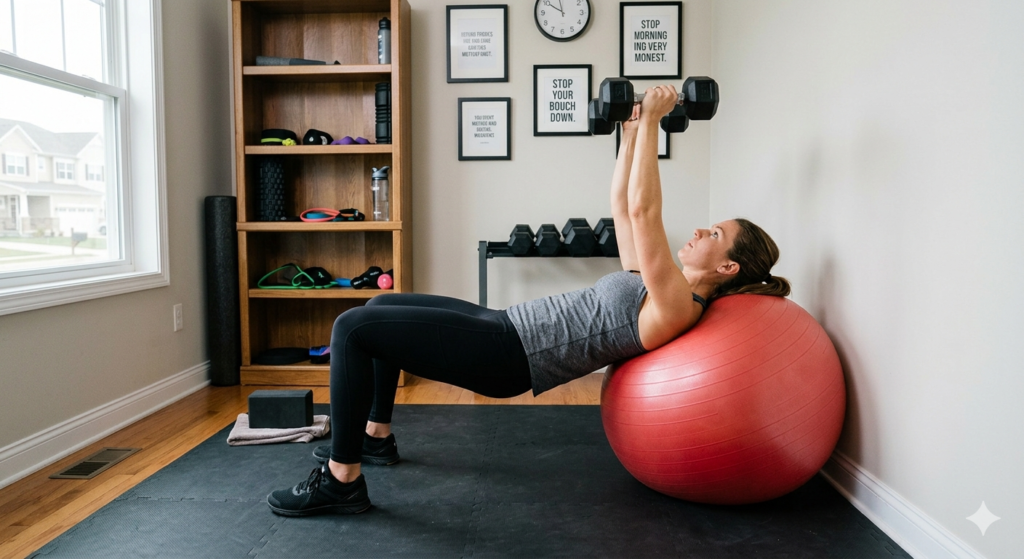
6. Towel-Stack Incline Dumbbell Press
No stability ball? Stack firm sofa cushions or tightly folded towels under your upper back to create a 20–30 degree incline. This approach isn’t suited for heavy loads keep it in the 12–20 lb range but for upper chest activation at controlled tempos, it works consistently well.
Sets & Reps: 3 sets | 12–15 reps | Rest: 45 seconds
Or maybe I should say it this way: the specific object you use matters far less than the angle it creates. Anything that gets your torso 20–30 degrees off horizontal will load the upper chest differently than the floor alone.
Fly Movements: Inner and Outer Chest
7. Single Arm Floor Fly
Lie on your back with one dumbbell in the working hand, non working arm extended out to the side for balance. Start with the dumbbell extended above your chest, elbow slightly bent. Lower it in a wide arc until your elbow grazes the floor. Contract the chest to return. Training one side at a time exposes and corrects strength imbalances that bilateral work masks and most home trainers develop noticeable asymmetries without realizing it.
Sets & Reps: 3 sets | 12 reps per side | Rest: 45 seconds
8. Standing Dumbbell Fly Low to High Arc
Stand with feet shoulder width apart. Hold dumbbells at hip height, palms facing forward. Raise them in a wide arc until they meet at shoulder height, squeezing the chest hard at the top. The upward path of the arc mimics a cable cross-body movement. It loads the upper and inner pec fibers in a way floor pressing alone can’t replicate.
Sets & Reps: 3 sets | 15 reps | Rest: 30 seconds
Standing Exercises: Active Days and Finishers
9. Svend Press
Hold both dumbbells pressed flat against each other at chest height, palms facing each other. Push them forward while actively squeezing the dumbbells together with maximum effort throughout the full movement. Return slowly. The constant compression creates uninterrupted inner chest tension the entire mechanism of this exercise depends on that continuous squeeze.
Don’t underestimate this one because of the light weight involved. That’s the point.
Sets & Reps: 3 sets | 12–15 reps | Rest: 30 seconds
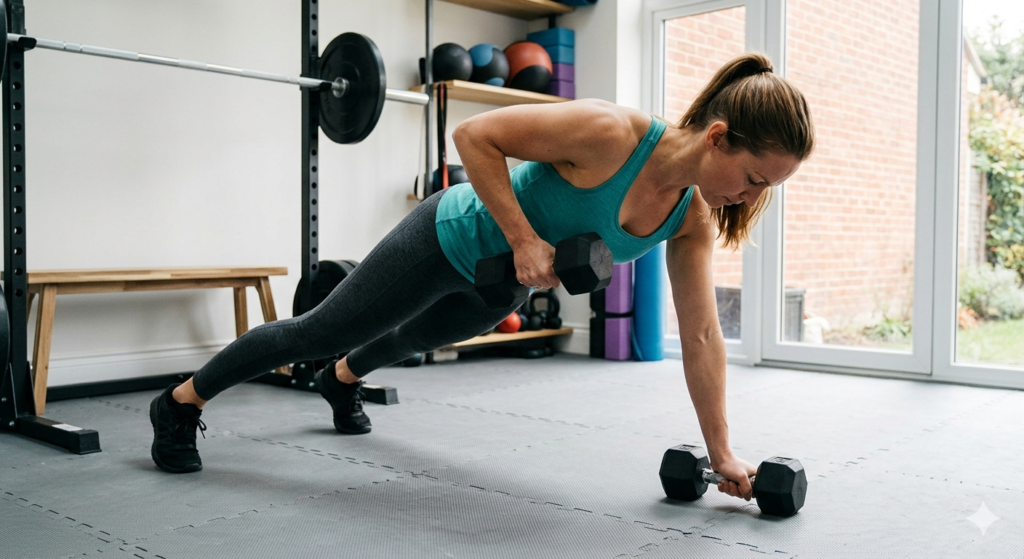
10. Dumbbell Push Up with Row
Place two hex dumbbells on the floor slightly wider than shoulder width. Get into a push up position, gripping both handles. Perform one full push up. At the top, row one dumbbell to your hip, lower it, then repeat the push-up and row the other side. This compound movement trains the chest, back, and core simultaneously it works particularly well as a conditioning finisher at the end of a session.
Sets & Reps: 3 sets | 8 reps per side | Rest: 75 seconds
To perform the dumbbell floor press correctly:
- Lie on your back, knees bent, feet flat on the floor.
- Hold a dumbbell in each hand at chest height, elbows at 45 degrees.
- Press both dumbbells upward until arms are nearly extended.
- Lower slowly until elbows touch the floor.
- Pause one second, then press again.
Keep your lower back in contact with the floor throughout arching it off the ground during the press means the weight is too heavy.
Your 4 Week Progressive Training Plan
A structured plan is what separates a chest program that builds muscle from one that just maintains it. Progressive overload systematically increasing training stimulus over time is the primary driver of hypertrophy, according to the National Strength and Conditioning Association (NSCA). Without a progression structure, your chest adapts within 2–3 weeks and stops responding to the same stimulus.
Most articles give you exercises. They stop there. Here’s the part they skip.
Train chest twice per week, with at least 48 hours between sessions. Monday and Thursday works well for most people. Wednesday and Saturday also works. The exact days don’t matter the gap does.
Weeks 1–2: Volume Foundation
| Exercise | Sets | Reps | Rest |
|---|---|---|---|
| Dumbbell Floor Press | 3 | 10 | 60 sec |
| Dumbbell Floor Fly | 3 | 12 | 45 sec |
| Feet-Elevated Push-Up | 3 | 10 | 60 sec |
| Standing Dumbbell Fly | 3 | 15 | 30 sec |
| Svend Press | 2 | 15 | 30 sec |
Weeks 3–4: Progressive Overload
Add one of these each week not all of them at once:
- Increase dumbbell weight by 2.5–5 lbs on pressing movements
- Add one set to the floor press (move from 3 sets to 4)
- Reduce rest to 45 seconds on fly and standing exercises
- Slow the lowering phase on the floor press to a 3-second eccentric
I’ve seen conflicting guidance on weekly chest frequency here some coaches recommend three sessions per week, citing research on elevated muscle protein synthesis windows for advanced trainees. Others, including data from the NSCA, suggest two sessions produces equivalent hypertrophy outcomes for most natural trainees when volume is matched. My read is that twice per week is the right starting point for anyone whose training has been inconsistent. Three sessions per week may accelerate results for trainees who’ve trained consistently for six months or more.
Why Your Upper Chest Keeps Lagging and How to Actually Fix It
This is the real issue. And it’s the thing most home workout content including the two top-ranking competitors for this keyword doesn’t address directly.
If you’ve been floor pressing for months and your upper chest still looks underdeveloped, the problem is structural: you have no incline variation in your training. The clavicular head only loads meaningfully at a 30–45 degree angle relative to horizontal. Flat floor pressing sits at 0 degrees. It doesn’t reach the upper pec fibers regardless of how heavy or how often you go.
The fix lives in exercises 4, 5, and 8 in this guide. Two of them require nothing beyond what you already have. The stability ball for exercise 5 costs roughly $15–20 at most sporting goods retailers.
Some coaches argue that the upper chest responds best to higher rep ranges 15 to 20 reps due to its fiber type composition. That’s a valid argument in certain advanced programming contexts. But for beginner to intermediate trainees, applying progressive overload in the 8–15 rep range will produce more visible changes than optimizing fiber-specific rep counts. Get the angle right first. Then fine tune the rep scheme.
Simple self assessment: Take a relaxed photo of your chest after week 4. If upper chest development is unchanged, exercises 5 and 8 need to be in every session going forward.
Equipment That Makes This Easier and What You Actually Need
You need dumbbells. That’s the non negotiable.
Everything else is optional but some options make a meaningful difference.
Adjustable vs. Fixed Dumbbells for Home Chest Training: Adjustable dumbbells are better suited for home chest training because they allow progressive weight increases without purchasing multiple sets. Fixed dumbbells are better when a trainee trains exclusively at one or two specific weights. The key difference is progression range quality adjustable sets cover 5 lbs to 52+ lbs in a single unit.
Quick Comparison
| Option | Best For | Key Benefit | Limitation |
|---|---|---|---|
| Bowflex SelectTech 552 | Most home trainees | Widest range (5–52.5 lbs), compact footprint | Higher upfront cost (~$350–$400) |
| PowerBlock Sport EXP | Small-space users | Block design, extremely compact | Grip can feel awkward during fly movements |
| Ativafit Adjustable Set | Budget beginners | Lower entry price point | Reduced max weight ceiling |
| Fixed Hex Dumbbell Pair | Minimalist / single weight users | Durable, no moving parts | No progression without buying additional pairs |
According to Business Research Insights (2024), the global dumbbell market was valued at USD 1.78 billion in 2024 and is projected to reach USD 3.67 billion by 2033 an 11.44% annual growth rate driven by sustained home fitness adoption. The home workout equipment market is dense right now. That makes programming quality matter more, not less.
Four Mistakes That Are Quietly Killing Your Home Chest Gains
Elbows flaring to 90 degrees. This is the most damaging and most common floor press error. When the elbows flare perpendicular to the torso, the shoulder joint absorbs a disproportionate share of the load and the pecs are largely bypassed. Keep elbows at 45 degrees from the body on every pressing movement.
Dropping the weight fast. The muscle building signal is generated primarily during the eccentric the lengthening phase. A 2–3 second controlled lowering doubles time under tension compared to a 1-second drop. Most beginners skip this entirely and wonder why they’re not progressing.
Training only one angle. Flat floor pressing is one angle. It is not a complete chest program. The clavicular head, inner chest, and outer pec fibers each require different movement patterns to be fully stimulated. This guide covers all of them.
Loading too heavy too fast. When the weight exceeds your current strength at the target rep range, the anterior deltoids and triceps compensate. The chest barely works. Use a weight where you feel the pecs contracting during every rep especially at peak contraction before adding load.
If you experience persistent shoulder, wrist, or elbow discomfort during any of these movements, stop the exercise and consult a physiotherapist or certified personal trainer before resuming.
Start Here. Build From There.
You’ve got the exercises. You’ve got the 4 week plan. You now know exactly why your upper chest has been lagging and what to do about it this week.
Here’s the one thing no article tells you plainly enough: consistency beats complexity every single time. The best chest workout is the one you actually complete twice a week, with progressive overload applied, for 8 to 12 weeks straight. No guide matters this one included if the dumbbells stay in the corner.
Pick the floor press. Add a fly. Add one upper chest variation.
Do it twice a week. Then come back for the rest.
Disclaimer: This content is for informational purposes only. Consult a qualified fitness professional or physician before starting any new exercise program, especially if you have pre existing injuries or health conditions.