
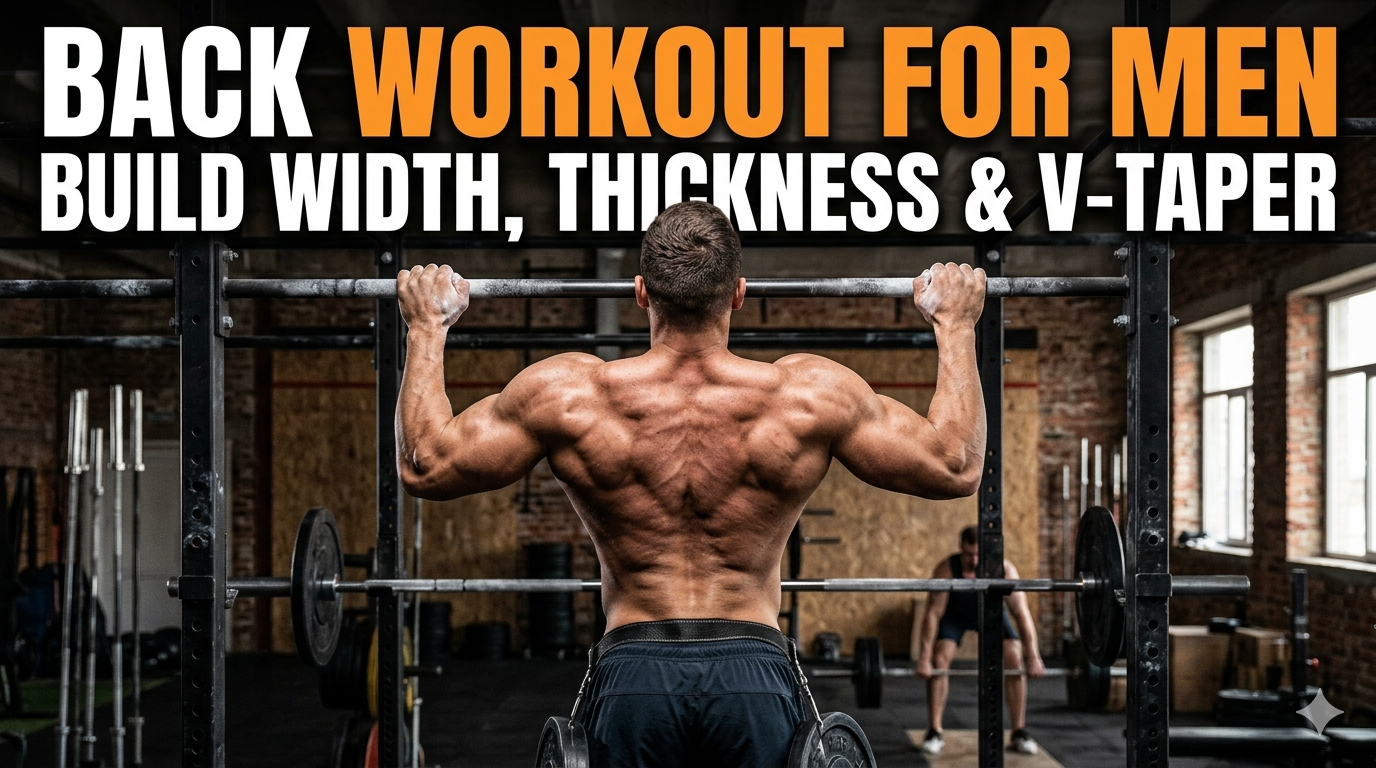
Last updated: May 2026 This routine works best for men with 6+ months of gym experience using standard commercial gym equipment. It does NOT address training around lumbar injuries, herniated discs, or rotator cuff impingement consult a physical therapist first if those apply to you.
Stop Doing the Same Two Exercises and Actually Build a V Taper
A back workout for men should hit five distinct muscle regions not just lats. Most guys repeat the same vertical pulls every week, end up with overdeveloped lats and a flat, underdeveloped mid back, and wonder why their physique still looks boxy from behind. This guide fixes that. You’ll get a complete routine, the science behind why each exercise earns its slot, a clear cue for every movement, and a 6 week progressive overload schedule the part every competitor article leaves out.
What is a complete back workout for men? A back workout for men is a training session that targets all five major regions of the back: the latissimus dorsi, trapezius (upper, mid, and lower fibers), rhomboids, erector spinae, and rear deltoids. Hitting all five not just the lats is what separates a wide, thick, V tapered back from a flat one. (48 words)
The 5 Back Muscles You’re Probably Undertraining
Men searching for back workouts typically want width and thickness. According to the National Strength and Conditioning Association (NSCA, 2024), EMG data confirms the conventional deadlift recruits more total back muscle fibers than nearly any other single movement yet most gym goers skip it on back day entirely, defaulting to pulldowns and rows that only hit part of the picture.
Here’s the thing: your back isn’t one muscle. It’s five overlapping regions, and each one requires a different pulling angle, grip position, or body angle to fully load.
The five regions:
- Latissimus dorsi gives you back width and that flared V taper silhouette
- Trapezius (upper, mid, lower) builds the shelf across your upper back and keeps your shoulder blades locked in position; each fiber division pulls the scapula in a different direction
- Rhomboids retracts the shoulder blades; weak rhomboids are the #1 driver of rounded shoulders in regular gym goers
- Erector spinae the column of muscles running your spine; you cannot deadlift or row heavy without these being strong
- Rear deltoids recruited during horizontal rows; often the missing link in upper back thickness for men who press more than they pull
Quick note: most programs treat “traps” as a single muscle you shrug to train. Upper, mid, and lower trap fibers are functionally distinct and need three different exercises to fully develop. That’s why shrugs alone never build the back people are actually after.
Why Your Rows Aren’t Working (The Lat Dominance Trap)
This is what most guides don’t cover.
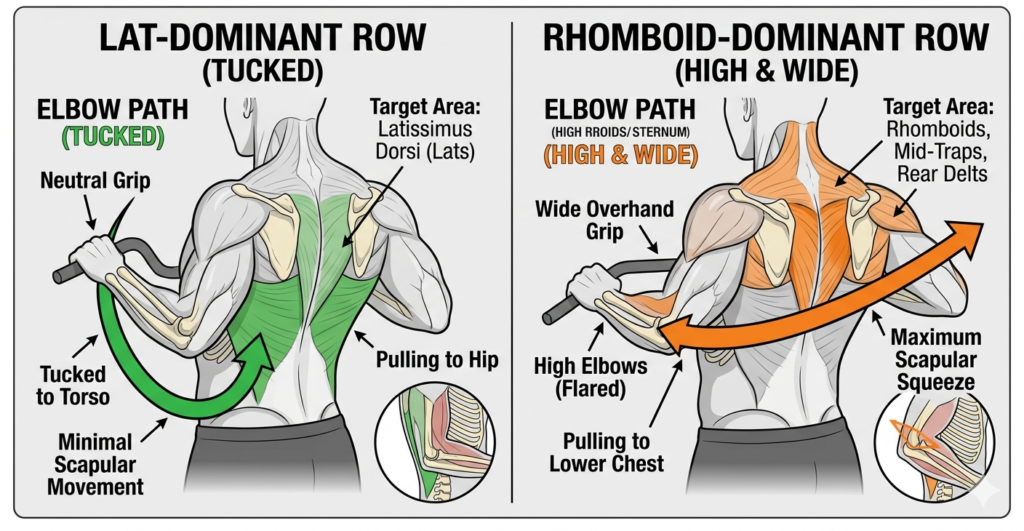
When you row barbell, cable, or dumbbell your strongest, most neurologically entrenched muscle takes over. For anyone who’s built their back on pulldowns and pull ups, that muscle is the lat. So instead of loading your rhomboids and mid traps during a bent over row, the lat does roughly 80% of the mechanical work. The movement looks right. The muscle building stimulus goes to the wrong place.
Men who’ve tried fixing this by adding more row volume often report the same result: bigger lats, no mid back thickness, and persistent rounded shoulders that stretching alone won’t correct. It’s not a volume problem. It’s a recruitment problem.
Or maybe I should say it this way the issue isn’t the exercise selection. It’s the neural pattern running it.
Two fixes that actually change the stimulus:
- Pre activate the rhomboids before heavy rows 2 sets of face pulls or band pull aparts at the start of the session fires up the muscles that would otherwise get bypassed. Takes 4 minutes. Changes the whole workout.
- Change the elbow path and grip rowing with the elbow pulled high and wide (rather than tucked at your side) shifts load toward the upper mid back. A supinated, underhand grip reduces lat engagement further. These are not minor cues they change which muscle receives the stimulus.
Some coaches argue that heavy compound rows handle everything and isolation work is unnecessary. That holds up for absolute beginners the first 6 months of lifting, everything works. But if you’ve been training more than a year and your mid back is still lagging, that position doesn’t hold. Muscle activation research is clear: the lat dominant pattern becomes more entrenched over time without deliberate correction.
The Complete Back Workout for Men: Sets, Reps, and Order
A complete back workout for men should include vertical pulling (for lat width), horizontal pulling (for mid back thickness), spinal extension (for erector strength), and at least one isolation movement targeting the rhomboids or lower traps. According to Schoenfeld et al. (2017) in the Journal of Strength and Conditioning Research, a clear dose response relationship exists between weekly resistance training volume and hypertrophy intermediate lifters generally need 10–20 sets per week per muscle group to keep adapting.
How to structure a complete back workout for men:
- Pre activate rhomboids: 2 sets of face pulls or band pull aparts before lifting.
- Vertical pull: 4 sets of pull ups or lat pulldowns, 6–10 reps.
- Horizontal row: 4 sets of barbell or cable rows, 8–12 reps.
- Spinal extension: 3 sets of conventional deadlifts or Romanian deadlifts, 5–8 reps.
- Isolation finish: 2–3 sets of neutral grip cable rows or chest supported rows, 12–15 reps.
Exercise 1 Face Pulls (Pre Activation)
Sets/Reps: 2 × 15–20 | Rest: 60 sec Target: Rear delts, lower traps, rotator cuff
Set the cable at forehead height. Use a rope attachment. Pull with your pinkies leading, elbows flaring high and wide not down. This isn’t a heavy movement. It’s not supposed to be. The goal is to fire the muscles that your lats will otherwise dominate during every exercise that follows.
Exercise 2 Pull Up or Lat Pulldown
Sets/Reps: 4 × 6–10 | Rest: 90 sec Target: Latissimus dorsi, lower traps, biceps
Shoulder width grip or slightly wider. Before pulling, squeeze your lats down and back like you’re trying to push your shoulder blades into your back pockets. That cue alone improves lat activation on the first rep. If you can’t do 6 controlled pull ups, use the lat pulldown machine; EMG activation is nearly identical at matched loads.
Don’t chase the bar with your chin. Pull until your upper chest meets the bar or the handle, then control the return over 3 seconds.
Exercise 3 Barbell Bent Over Row
Sets/Reps: 4 × 8–10 | Rest: 2 min Target: Mid traps, rhomboids, lats, erector spinae
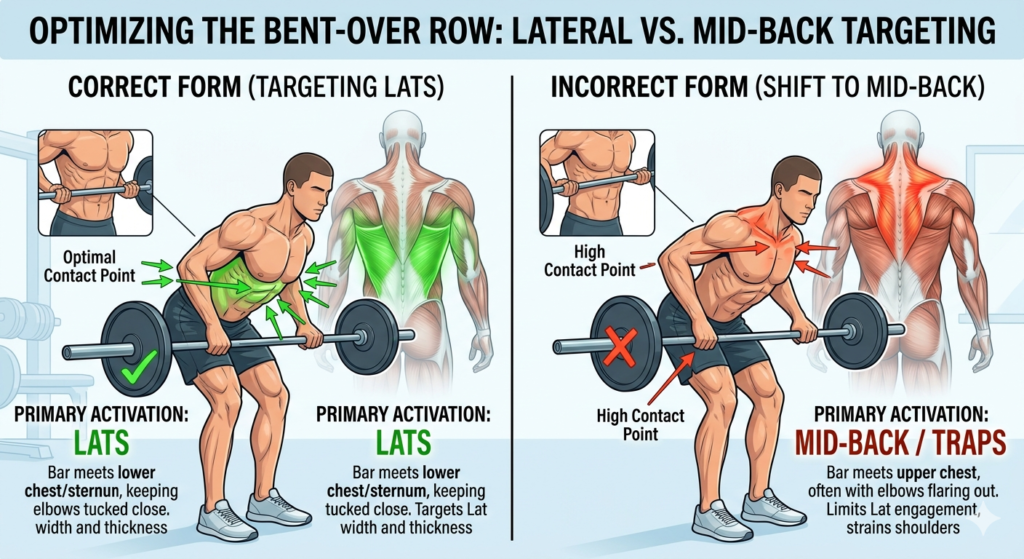
This is the anchor movement for back thickness. Use a standard barbell a Rogue Ohio Bar or equivalent and keep your torso at roughly 45 degrees: not parallel to the floor, not upright. Row the bar to your lower sternum, not your belly button. One inch of contact point changes the primary mover. Belly button contact = lat dominant. Lower sternum contact = mid back dominant. That’s the rep cue to drill.
Exercise 4 Conventional Deadlift
Sets/Reps: 3 × 5 | Rest: 2–3 min Target: Erector spinae, lats, traps, glutes, hamstrings
This is the exercise most back day routines skip. EMG research confirmed by the NSCA (2024) shows the deadlift recruits more back muscle fibers than nearly any other lift. Yet most men save it for “leg day” or skip it entirely because it’s hard. That’s a mistake.
Dead stop. Full lockout. Lower with control.
Use lifting straps or Versa Gripps on your last 1–2 working sets so grip fatigue doesn’t cut your back stimulus short. Your hands shouldn’t be the limiting factor on a back exercise.
Exercise 5 Neutral Grip Cable Seated Row
Sets/Reps: 3 × 12–15 | Rest: 90 sec Target: Rhomboids, mid traps, rear delts
Use the neutral grip (palms facing each other) handle. Pull to your lower chest. Pause for a full second at peak contraction shoulder blades fully squeezed together then resist the return for 3 seconds. That slow eccentric is what most men skip, and it accounts for roughly half the mechanical tension signal driving hypertrophy.
Exercise 6 Single Arm Dumbbell Row
Sets/Reps: 3 × 10–12 per side | Rest: 60 sec Target: Lats, rhomboids, rear delts
Brace your free hand on a bench. Let the dumbbell hang until you feel a full lat stretch at the bottom don’t rush past that position. Row to your hip, not your ribs, elbow staying close to your body. This is the finisher. The weight should be light enough that you feel the lat, not the bicep.
Quick Comparison: Vertical Pull vs. Horizontal Row
Vertical pulls (pull ups, lat pulldowns) are better suited for lat width and V taper development because the arm path directly lengthens and shortens the lat through its full range. Horizontal rows (barbell rows, cable rows) work better for mid back thickness because pulling the elbow back in the horizontal plane maximally recruits the rhomboids and mid traps. The key difference: vertical pulls build width, horizontal rows build depth. You need both every session.
| Exercise | Best For | Key Benefit | Limitation |
|---|---|---|---|
| Pull Up / Lat Pulldown | Lat width, V taper flare | High lat activation, scalable | Doesn’t train mid back or erectors |
| Barbell Bent Over Row | Overall thickness | Hits lats + mid traps simultaneously | Requires solid hip hinge pattern |
| Conventional Deadlift | Total back strength + mass | Highest total fiber recruitment | Fatiguing must be programmed carefully |
| Neutral Grip Cable Row | Rhomboids, mid traps | Constant tension, easy to isolate | Machine dependent |
| Face Pull | Rear delts, posture correction | Counters internal rotation | Low standalone hypertrophy stimulus |
The 6 Week Progressive Overload Plan (What Most Articles Skip)
Men following a back routine without a structured overload plan will plateau in 4–6 weeks. Schoenfeld’s 2017 systematic review in the Journal of Strength and Conditioning Research established a clear dose response relationship between weekly volume and muscle hypertrophy meaning you have to progressively add work to keep the adaptation signal alive. The routine above is only half the equation. Here’s the other half.
I’ve seen conflicting data on this some sources recommend adding load every single session, others say every two weeks. My read is: chase reps within your target range first, then add weight once you hit the top of the range. It’s a slower rate of load increase, but the injury rate drops sharply and the strength gains compound better over a 12 week block.
Weeks 1–2 (Base): Run the workout exactly as written. Log every set and rep in a notes app or training journal. Focus entirely on form and finding the correct bar contact point on rows not on the weight.
Weeks 3–4 (Volume Add): Add 1 set to exercises 2 (pulldown), 3 (row), and 5 (cable row). Keep the weights identical. You’ll be sore in your mid back in ways you probably haven’t felt before. That’s the rhomboids and lower traps getting real work for the first time.
Weeks 5–6 (Load Increase): Return to the original set count but increase barbell row and deadlift weight by 5–10%. On cable movements, add 1 rep per set rather than weight.
Training frequency by experience level:
- Under 1 year of consistent training: once per week is sufficient
- 1+ years training: run this twice per week the second session uses only cables and dumbbells, lighter load, same exercises, to add volume without taxing recovery
The Mistakes That Stall Back Growth
Look if you’re training hard three or four days a week and your back still won’t develop, here’s what’s happening.
Momentum on rows. Swinging the torso or jerking the bar means your lower back and hip flexors are assisting every rep. Slow the eccentric to 3 seconds. It’ll feel much harder with the same weight. That’s correct.
Wrong bar contact point. Already covered above but worth repeating because it’s the highest leverage cue in back training. Sternum contact for mid back. Hip contact for lats. Decide which muscle you’re training before the first rep.
Skipping lower trap work. Most men can retract their shoulder blades (rhomboids doing their job). What they can’t do is retract and depress simultaneously which is what creates that thick, defined upper back look from behind. Face pulls and Y raises address this directly. They’re not optional accessories; they’re the muscles that make the rest of the back look trained.
Letting grip cut sets short. If your forearms fail before your back, you’re losing volume. Use Versa Gripps or standard lifting straps on the last 1–2 sets of rows and deadlifts. Your back doesn’t register how your grip feels.
This guide covers gym based back training for healthy men aged 18–50 using standard commercial equipment. It does not address training with existing lumbar injuries, herniated discs, or shoulder impingement. If any of those apply, consult a physical therapist before loading these movement patterns.