Last updated: May 2026Medical disclaimer: This article is for educational purposes only and does not replace professional medical advice, diagnosis, or treatment. Always consult a licensed healthcare provider for personal health concerns.
Your Body, Actually Explained All 11 Anatomy Systems and Why They Matter
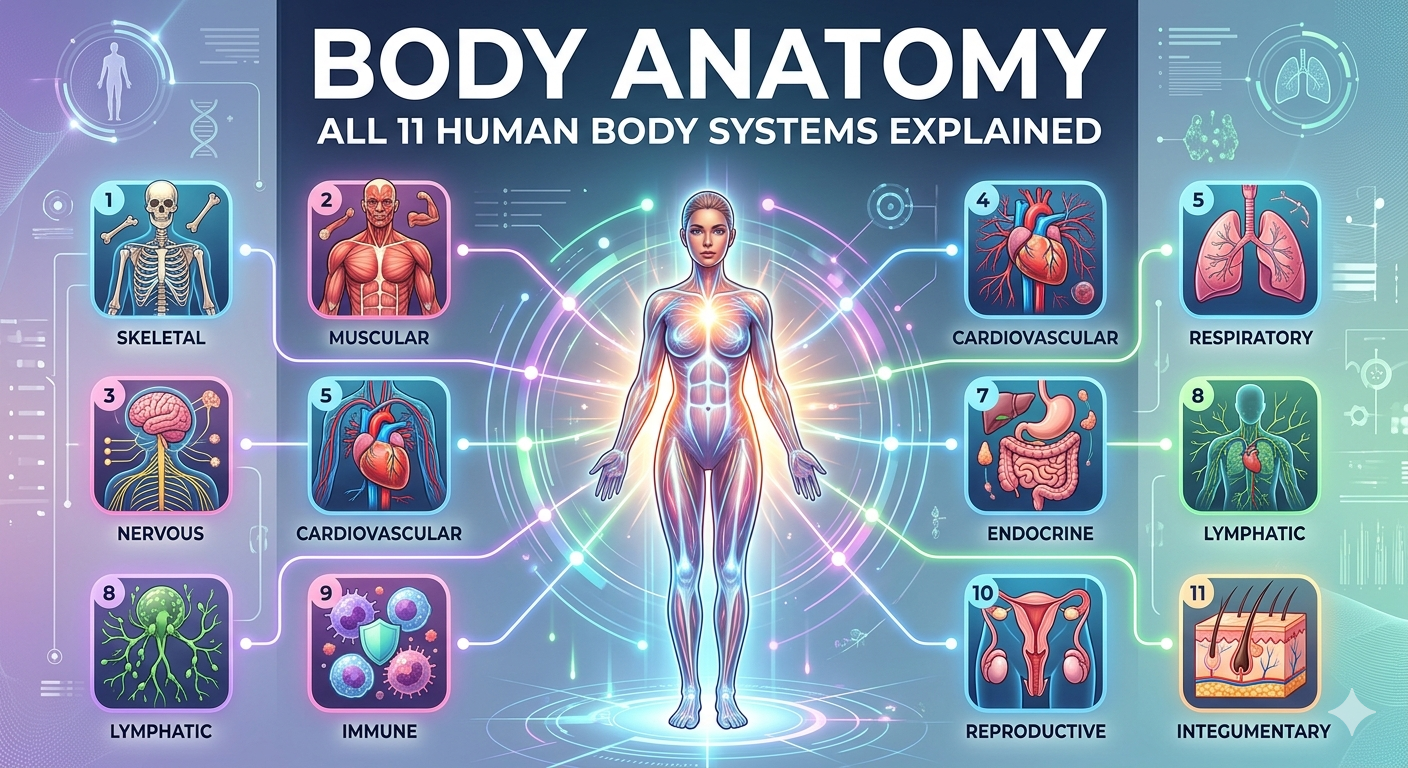
If you’ve ever Googled “body anatomy” and landed on a page that read like a medical textbook you already know the problem. Dense Latin terminology. Isolated diagrams. No explanation of why any of this matters for your actual health or daily life.
This guide fixes that.
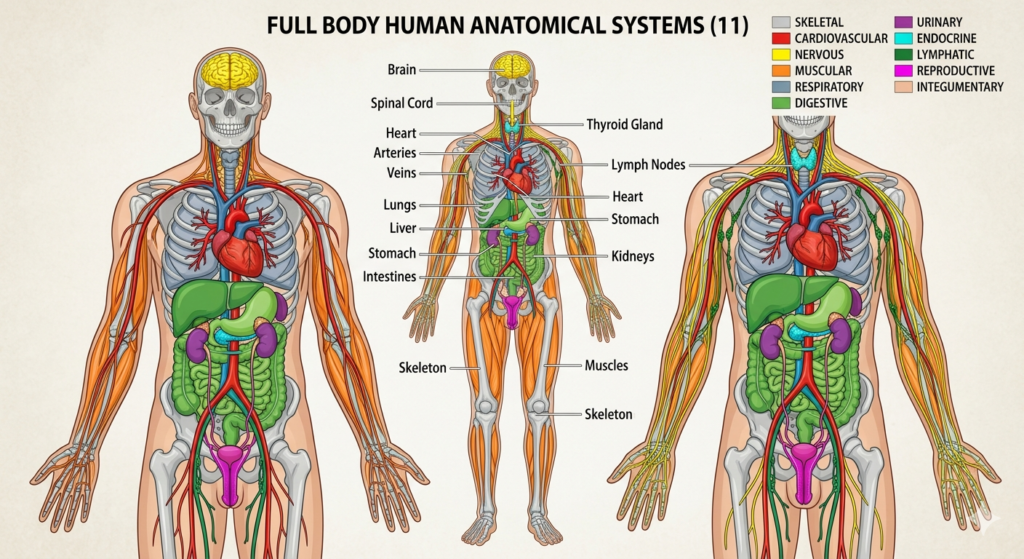
This article covers the 11 major body systems, their primary organs, and one real health implication per system. It does not address cellular biology, embryology, or clinical pathology in depth those are separate topics with their own full treatments. What this covers is the structural framework every informed health decision should start from.
What Human Body Anatomy Actually Means
Most people think anatomy means memorizing organ names. It doesn’t. Not really.
Anatomy is the study of structure where things are, what they’re made of, and how they’re physically connected. Physiology covers function what each structure does once it’s running. Most useful anatomy guides cover both, because structure without function is a map with no roads.
According to the National Institutes of Health (NIH, 2022), over 90 million adults in the U.S. cannot correctly identify basic organ functions or understand how body systems interact. That’s not a failure of intelligence. It’s a failure of how anatomy gets taught which tends to be top down, jargon heavy, and divorced from health context.
The human body contains roughly 37 trillion cells. Those cells organize into tissues, tissues into organs, organs into systems. There are 11 systems total. Understanding even the basics of this architecture changes how you read a symptom, understand a diagnosis, or evaluate a health claim.
Quick note: Some sources list 10 systems, others 12. The 11 system model is the most widely accepted in modern anatomy education, used by institutions including the American Association of Anatomists.
- Start with the skeletal system it’s the framework everything else builds on.
- Learn the cardiovascular system next it physically touches every other system.
- Study one new system per day using a 3D visualization tool like Visible Body.
- After each system, note one real health condition linked to it.
- Test recall using labeled diagram quizzes on Kenhub before moving on.
The 11 Body Systems Plain English Breakdown
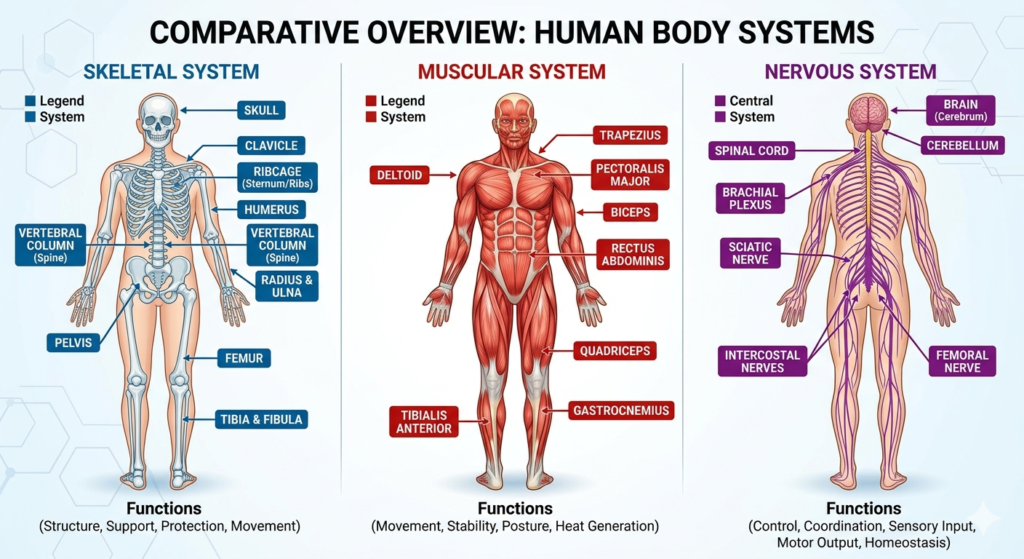
Here’s the thing: most anatomy articles list the systems. They don’t tell you why each one matters outside a biology exam. This section does both one system, one real implication, no Latin required unless it earns its place.
Skeletal System
Muscular System
Nervous System
Endocrine System
Cardiovascular System
Lymphatic System
Respiratory System
Digestive System
Urinary System
Reproductive System
Integumentary System
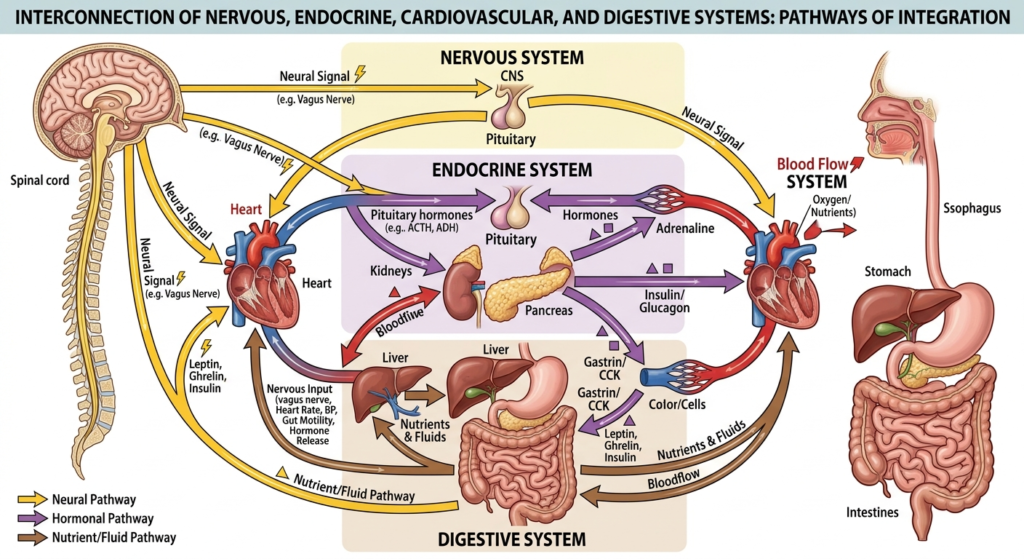
How Body Systems Actually Talk to Each Other
This is what most guides skip entirely.
No body system works in isolation. The nervous and endocrine systems share overlapping control of the stress response. The cardiovascular and lymphatic systems share actual physical vessels. And roughly 70% of immune cells reside in the gut lining a fact confirmed and reconfirmed across multiple reviews published in Clinical & Experimental Immunology since 2008.
Or maybe I should say it this way: the body isn’t 11 separate departments. It’s one organization with 11 teams, and every team copies every other team on every decision that matters.
Some experts argue the systems should be studied in isolation for clarity that it’s a better pedagogical starting point. That’s valid for foundational anatomy courses. But if you’re trying to understand why a symptom appears or why a specific intervention works, systems thinking is the only framework that gives you real answers.
I’ve seen conflicting data on this some educational researchers favor organ by organ teaching, others favor integrated systems approaches from the start. My read is that isolation works for memorization; integration is what builds actual health literacy. Most FitnoraWell readers are here for the latter.
Quick Comparison: All 11 Systems at a Glance
| System | Primary Organs | Core Function | Most Common Issue |
|---|---|---|---|
| Skeletal | Bones, cartilage, joints | Structure + blood cell production | Osteoporosis, stress fractures |
| Muscular | 600+ voluntary + involuntary muscles | Movement + heat generation | Sarcopenia, muscle strains |
| Nervous | Brain, spinal cord, peripheral nerves | Control + rapid communication | Chronic stress disorders, neuropathy |
| Endocrine | Thyroid, adrenals, pituitary, pancreas | Hormone regulation (sustained) | Diabetes, thyroid disorders |
| Cardiovascular | Heart, arteries, veins, blood | Oxygen + nutrient transport | Hypertension, atherosclerosis |
| Lymphatic | Lymph nodes, spleen, thymus, tonsils | Immunity + fluid drainage | Lymphedema, immune deficiency |
| Respiratory | Lungs, diaphragm, trachea, bronchi | Gas exchange + blood pH balance | Asthma, COPD, sleep apnea |
| Digestive | Stomach, intestines, liver, pancreas | Nutrient absorption + waste elimination | IBS, gut dysbiosis, GERD |
| Urinary | Kidneys, ureters, bladder, urethra | Waste filtration + fluid regulation | Kidney stones, chronic UTIs |
| Reproductive | Gonads, uterus/prostate, hormonal glands | Hormone production + reproduction | Hormonal imbalances, fertility issues |
| Integumentary | Skin, hair, nails, sweat/sebaceous glands | Protection + temperature regulation | Eczema, psoriasis, skin cancers |
Three Tools That Make Learning Body Anatomy Actually Stick
Three resources worth your time. None of them feel like a textbook.
Visible Body
Kenhub
Complete Anatomy by 3D4Medical
I’ve seen conflicting peer comparisons on app based anatomy retention some favor Visible Body’s spatial exploration for beginners, others favor Kenhub’s spaced repetition quizzes for long term recall. My read: use Visible Body to understand structure first, then Kenhub to test yourself on terminology before any exam or clinical conversation.
Scope note: This guide covers the 11 major body systems in a general educational context. It does not address rare anatomical variations, pediatric anatomy development, surgical anatomy, or clinical pathology. For any personal health concern, consult a licensed healthcare provider.