
Last updated: May 2026
This article is for educational purposes only and is not a substitute for professional medical advice. If you experience persistent back pain, consult a qualified healthcare provider before starting a new exercise program.
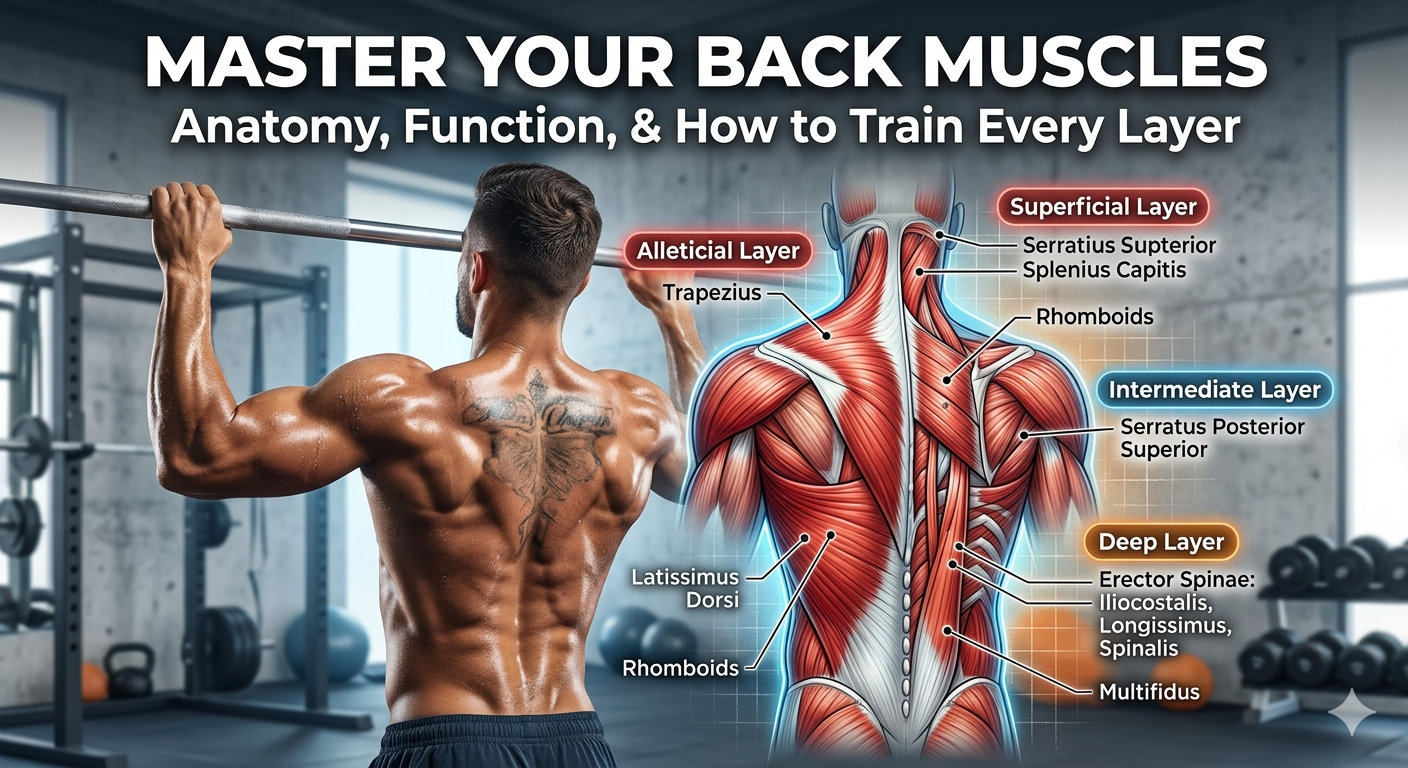
Back muscles are a group of skeletal muscles running from the base of the skull to just above the hips, organized into three layers: superficial, intermediate, and intrinsic (deep). They work continuously to support posture, enable movement of the arms and trunk, and assist with breathing both voluntarily and automatically.
Low back pain affected 619 million people globally in 2020 and that number is projected to reach 843 million by 2050, according to research cited by Healthline drawing on The Lancet (2023). That’s not just a health statistic. It’s a sign that most people don’t truly understand what their back muscles are doing, or what they actually need.
Most guides stop at anatomy. This one won’t.
You’ll get the full picture here: what each layer of back muscle does, why your current training is probably missing key muscles, and exactly how to build a back that’s strong, stable, and resistant to the kind of pain that creeps in after years of desk work and half understood gym sessions.
This guide covers back muscle anatomy and general training principles for healthy adults. It does NOT address post surgical rehab, spinal stenosis, herniated discs, or inflammatory spinal conditions those require individualized clinical care.
What Are Back Muscles? The Three Layer System Nobody Explains
Your back is not one muscle. It’s closer to a dozen stacked in layers, running in different directions, doing completely different jobs.
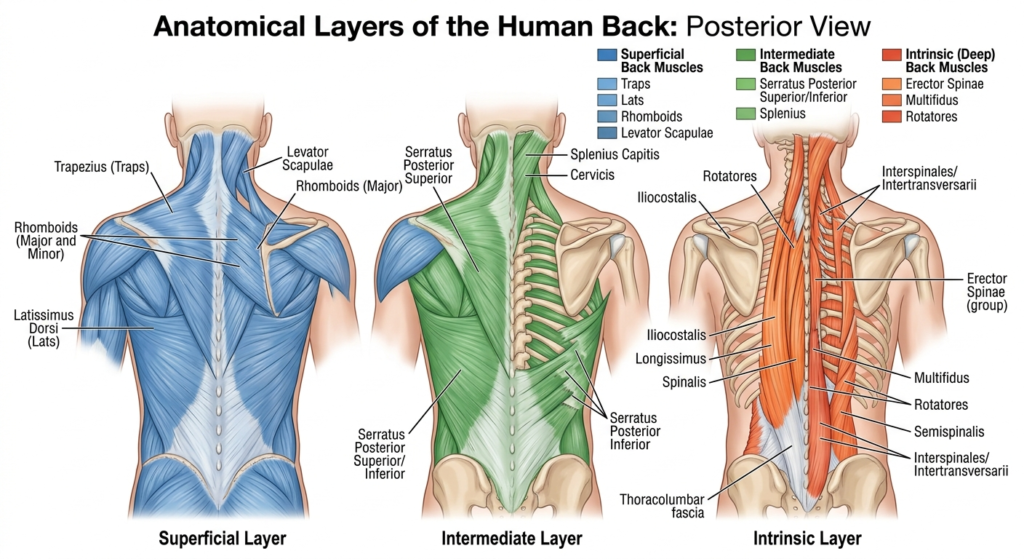
Healthcare providers divide them into three groups: superficial (closest to the skin), intermediate (just beneath), and intrinsic or deep (closest to the spine). Most people in the gym train only the superficial layer. That’s a big part of why so many people with developed looking backs still complain of tightness, rounding posture, or recurring lower back soreness after deadlifts.
The superficial layer your lats, traps, rhomboids, levator scapulae, and serratus anterior is what you see in the mirror. The intrinsic layer, which includes the erector spinae, multifidus, and tiny segmental muscles like the rotatores, is what actually keeps your spine upright and out of pain.
Or maybe I should say it this way: a wide back looks impressive. A deep, strong back functions day after day, load after load.
The Three Layers of Back Muscles, Explained
Superficial Back Muscles: The Ones You Train (and See)
These are the headline muscles of “back day.” They’re large, visible, and directly responsible for every pulling and rowing motion you do in the gym.
Latissimus dorsi (lats): The largest muscles in the upper half of your body. They originate on the spine and pelvis, attaching to the upper arm bone, making them the primary drivers of shoulder adduction and extension. Pull ups, pull downs, single arm rows these are lat exercises.
Trapezius (traps): A diamond shaped muscle running from the neck, across the shoulders, and down to the mid back. The traps aren’t one thing they have distinct upper, middle, and lower regions, each with different functions. Most people overtrain the upper traps with shrugs and undertrain the lower traps, which are critical for scapular stability and healthy shoulder mechanics.
Rhomboids: Two muscles rhomboid major and minor connecting the shoulder blades to the spine. They retract the scapula, the pulling shoulder blades together motion you feel in a bent over row or face pull.
Levator scapulae helps lift and rotate the shoulder blade. Serratus anterior covers the top of the ribcage below the armpit. Both are chronically undertrained. Weak serratus anterior is one of the most under recognized causes of winged shoulder blades and upper back pain in people who otherwise look fit.
Intermediate Back Muscles The Breathing Layer
This layer the serratus posterior superior and serratus posterior inferior sits just above and below the ribcage. Their primary job is elevating and depressing the ribs during breathing.
They’re rarely discussed in fitness content. For most gym goers, compound back training heavy rows, pull ups, deadlifts keeps them functionally engaged as accessory muscles without any direct isolation work needed. Worth knowing they exist, though.
Intrinsic (Deep) Back Muscles Where Real Stability Lives
This is where back training gets genuinely interesting and where most guides completely fall short.
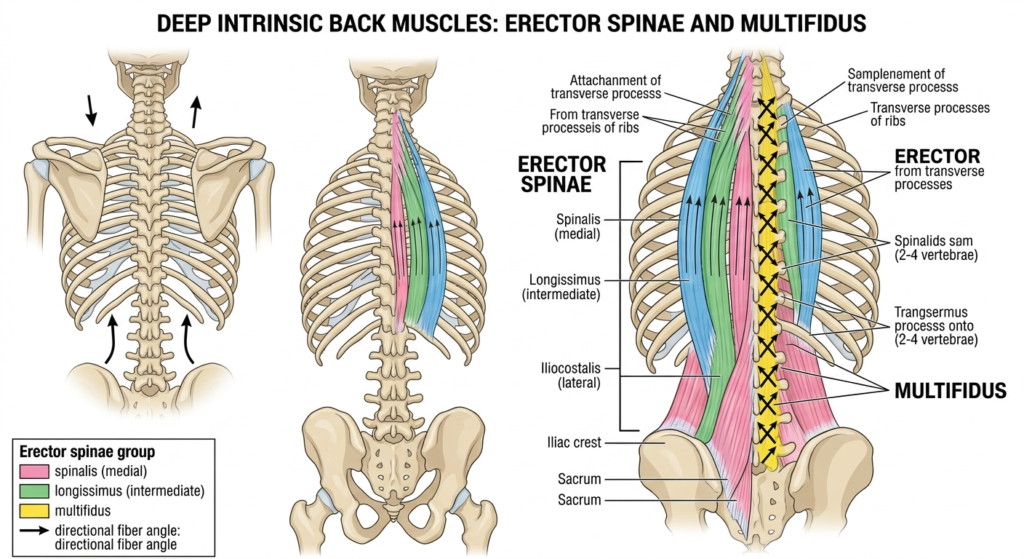
The intrinsic layer spans from the sacrum to the base of the skull. It includes its own three sub layers and houses the erector spinae group, the multifidus, the semispinalis, and small segmental muscles like the rotatores and interspinales.
Erector spinae is the muscle group most people have at least heard of. Three muscles spinalis, longissimus, iliocostalis run the length of the spine, responsible for extension, lateral flexion, and keeping the torso upright under load. Every deadlift, every squat, every time you pick something up these muscles are working isometrically to hold you together.
Multifidus. This one barely appears in fitness content, which is a real problem.
These small, diagonal, segmental muscles run between individual vertebrae and provide moment to moment fine tuning of spinal position. Research published in the Journal of Physical Therapy Science (Chang, Lin & Lai, 2015) found that core training specifically targeting deep back muscles including the multifidus was significantly more effective than general resistance training for alleviating chronic low back pain. Weak multifidus = unstable vertebral segments = the low grade aching that never quite goes away, no matter how many rows you do.
How to Strengthen Your Back Muscles Layer by Layer
Here’s the thing: most back training programs are superficial literally. They load the lats and traps with rows and pull downs and call the session done. That works for aesthetics. It’s incomplete for function, longevity, and real injury prevention.
A well designed back routine hits all three layers.
To strengthen all three layers of your back muscles, follow these steps:
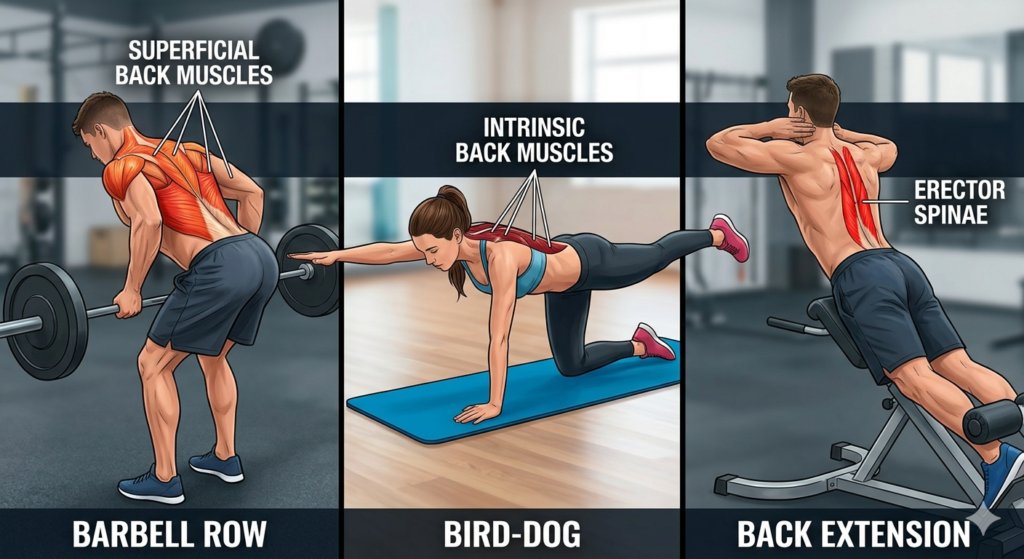
- Train superficial muscles with compound pulls barbell rows, pull ups, lat pull downs.
- Add intermediate support through deadlifts and heavy loaded carries.
- Target intrinsic muscles directly with bird dogs, back extensions, and Pallof presses.
- Use slow, controlled reps to build the mind muscle connection in each exercise.
- Allow at least 48 hours between intense back sessions for full muscle recovery.
Best Exercises for Superficial Back Muscles
Barbell bent over row: The most complete upper-back exercise available. ACE sponsored research led by Dr. John Porcari at the University of Wisconsin La Crosse used EMG measurements to confirm that the bent over row produced high multi muscle activation across the back simultaneously making it among the most efficient compound movements for building both back thickness and pulling strength.
Pull ups and lat pull downs: The primary lat builders. Quick note: Porcari’s ACE research found that for some subjects, the lat pull down was one of the least effective lat activators not because it’s a bad exercise, but because those subjects weren’t mentally focusing on the muscle while performing it. Same movement. Very different activation. That matters.
TRX rows: The TRX Suspension Trainer earns its place here not just for lat work, but for the full body stabilization demand it creates, forcing intermediate and intrinsic layers to activate simultaneously. ACE Research explicitly noted that suspension trainers offer whole body balance and stability benefits that machines simply don’t.
Face pulls: Criminally underused. Essential for the rear deltoids, external rotators, and middle/lower trapezius the muscles responsible for keeping shoulders in healthy alignment over the long term. REP Fitness and Rogue Fitness resistance bands are excellent for home based face pulls, pull aparts, and band rows when gym access isn’t available.
Best Exercises for Intrinsic Back Muscles
Bird dog: Deceptively simple. Extending the opposite arm and leg from a quadruped position forces the multifidus, erectors, and glutes to coordinate in real time. It’s the foundation of spinal stability training and most people either skip it entirely or rush through it without controlling their lumbar spine.
Back extensions (hyperextensions): The erector spinae gets heavy isometric work through deadlifts and squats. For dynamic strengthening where the muscle actively shortens and lengthens through range the back extension is the most direct tool available. Load it progressively with a plate or dumbbell held at chest height.
Pallof press (anti-rotation): Teaches the back and core to resist movement rather than create it. Physical therapist William Kelley, DPT, CSCS, describes these anti movement exercises as what actually protects the spine during real world activities because real life rarely asks you to flex a loaded barbell; it asks you to hold yourself stable while force is applied from an unexpected angle.
Theragun/Therabody percussive therapy devices are worth mentioning as a recovery tool between sessions particularly when training back twice per week. Percussive therapy can help reduce post session tightness and improve blood flow before the next training bout, though it doesn’t replace sleep and nutrition for true muscle recovery.
What Most People Get Wrong About Back Training
Most people assume that more back volume means a stronger, better-functioning back. The data says otherwise.
Look if you’ve been training back consistently for six months and you’ve still got chronic tightness, rounded shoulders, or persistent lower back soreness, here’s what actually works: reduce load by 20-30%, slow your reps down, and start focusing on feeling the specific muscle contract before loading it heavier. This isn’t just anecdotal. It’s measurable.
The ACE research by Porcari et al. recorded significantly different EMG activation levels between subjects performing identical exercises the difference was mental focus. The movement was the same. The muscle recruitment wasn’t. That’s the mind muscle connection and it’s not a bro science concept. It’s electromyography data.
Some coaches argue heavy compound lifts are all you ever need and isolation work is a waste of time. That’s valid if your only goal is functional strength, you’re moving well, and you have no history of pain or asymmetry. But if you’re dealing with recurring lower back issues, uneven development, or tightness that won’t clear up isolation work for the deep intrinsic layer isn’t optional. It’s the missing piece.
I’ve seen conflicting positions on how much direct lower back training is “too much.” Some rehabilitation specialists recommend very conservative loading; strength coaches like those at BarBend argue that direct erector work is not only safe but necessary for full spinal health. My read is: start conservative, progress based on how your body responds, and don’t skip the bird dogs just because they feel too easy at first.
Back Muscle Pain: Common Causes and When It’s Serious
Back muscle injuries are among the most common musculoskeletal complaints worldwide. The most frequent: muscle strain an overuse or improper-loading injury that causes micro-tears in the muscle fibers.
Signs of a muscle strain include localized pain, stiffness, muscle spasm, and pain that worsens with movement. These typically resolve with relative rest, gentle movement, and progressive reloading over one to two weeks. Therabody percussive devices can support recovery by managing tightness and increasing circulation between sessions.
Muscle strain vs. disc herniation: A back muscle strain causes dull, localized pain that worsens with movement and typically improves within 1–2 weeks of rest and gentle activity. A herniated disc often causes sharp, radiating pain traveling into a leg (sciatica) and doesn’t resolve quickly with rest. The key difference: muscle pain stays in the back; disc pain radiates into the limb.
See a healthcare provider if back pain lasts more than one week without clear improvement. Go to an emergency room if pain is accompanied by loss of bladder or bowel control, numbness in the groin, or sudden severe leg weakness.
Quick Comparison: Best Exercises by Back Layer
| Exercise | Best For | Key Benefit | Limitation |
|---|---|---|---|
| Barbell Bent Over Row | Superficial (lats, traps, rhomboids) | Highest multi muscle EMG activation of any back exercise (ACE Research) | Requires solid hip hinge form; lower back fatigue under heavy load |
| Pull Up / Lat Pull Down | Superficial (latissimus dorsi) | Best isolation of the lats in a vertical pulling pattern | Requires deliberate mind muscle focus activation varies widely between individuals |
| TRX Row | Superficial + stabilizers | Recruits entire back plus core simultaneously | Needs a suspension anchor; less load potential than free weights |
| Bird-Dog | Intrinsic (multifidus, erectors) | Builds segmental spinal stability what prevents recurring back pain | Low perceived intensity; most people rush it or abandon it too soon |
| Back Extension | Intrinsic (erector spinae) | Only common exercise that dynamically strengthens the lower back through full range | Often skipped; must be progressively loaded to continue producing results |
This guide covers back muscle anatomy and general training principles for healthy adults without diagnosed spinal pathologies. It does not address post-surgical rehabilitation, spinal fractures, inflammatory arthropathies, or neurological spinal conditions all of which require individualized professional care.