The Real Reason Men Suffer Alone And What to Do About It This June

Men’s mental health month is observed every June. Most content published around it says the same things: the statistics are alarming, stigma is real, “it’s okay to ask for help.” Then June ends. And men keep dying.
This article goes somewhere different into the gap between what we say and what actually works.
What Men’s Mental Health Month Is (And What It’s Trying to Fix)
Men’s Mental Health Month refers to the annual June observance dedicated to raising awareness of the unique mental health challenges men face, reducing stigma, and encouraging men to seek treatment. It runs alongside National Men’s Health Month and is recognized by organizations including NAMI, the Movember Foundation, and the CDC.
The observance exists because awareness campaigns even imperfect ones demonstrably increase help-seeking. Movember Foundation’s research shows that time-bound campaigns meaningfully boost men’s engagement with mental health resources. A month gives clinics, workplaces, and families a structured reason to start the conversation.
But the campaign only works if the people having that conversation understand what they’re actually looking for.
Here’s the thing: most of them don’t.
Male Depression Doesn’t Look Like Sadness This Is the Gap Everyone Misses
This is what most awareness content skips entirely.
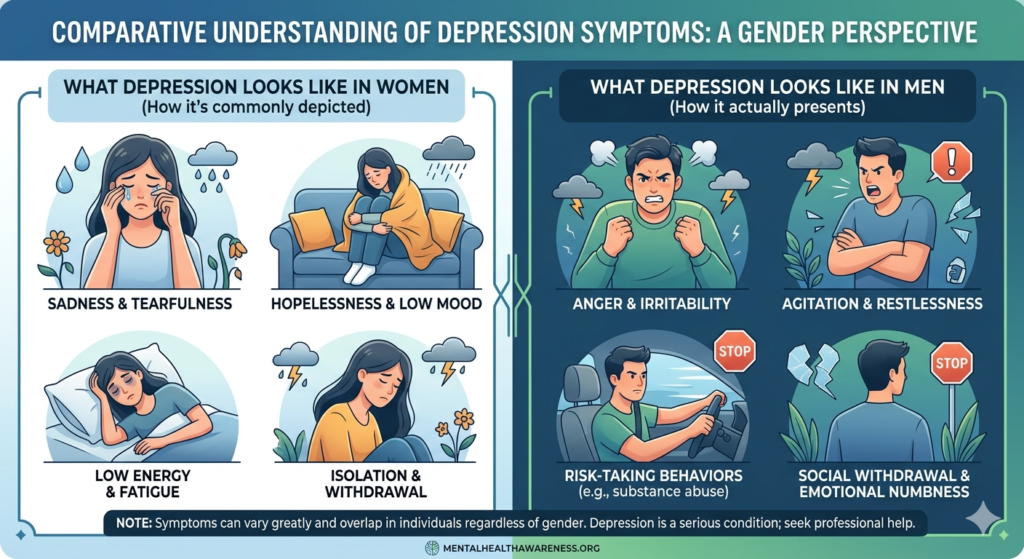
When people picture depression, they picture someone crying, unable to get out of bed, talking about emptiness. That presentation exists. But in men, depression frequently surfaces as something else: irritability, rage, recklessness, excessive drinking, throwing themselves into 70 hour work weeks, picking fights over nothing.
According to the Anxiety & Depression Association of America, depression in men often presents as anger, hostility, and risk taking behavior rather than the tearfulness and sadness more commonly associated with the condition. This isn’t a character flaw or a bad attitude. It’s a symptom one that gets misread by everyone around him, including himself.
What most guides skip is this: loved ones often don’t recognize male depression because it doesn’t ask for sympathy. It looks like withdrawal, short temper, a third drink every night, or a man who’s never home even when he’s in the house.
Look if the man in your life has been angrier than usual, taking risks he didn’t used to, pulling away from people he loves, or drinking more those are signals worth taking seriously. Not proof. Signals.
Common signs of depression in men that aren’t sadness:
- Increased irritability or explosive anger over small things
- Withdrawal from family, friends, hobbies he used to care about
- Reckless behavior: speeding, gambling, substance use
- Chronic physical complaints fatigue, headaches, back pain with no clear cause
- Emotional flatness, not sadness just hollow
- Overworking as a way to avoid being present
I’ve seen conflicting data on exactly how the clinical literature handles this some researchers frame “male type depression” as a distinct subtype with different diagnostic criteria, while others argue it’s the same disorder expressed through culturally shaped behavior. My read is that the distinction matters practically even if it’s contested academically, because if he doesn’t recognize it as depression, he won’t name it. And if he doesn’t name it, he can’t ask for help he doesn’t know he needs.
Or maybe I should say it this way: the awareness gap IS the treatment gap.
The Numbers Behind the Silence
Men account for nearly 80% of all suicides in the United States.
Read that once more before moving on.
According to the American Foundation for Suicide Prevention’s 2025 statistics report using CDC 2023 data men died by suicide 3.8 times more than women that year. White males alone accounted for 68% of all suicide deaths in 2023. And according to NAMI, only 45.9% of men with a diagnosed mental illness received any treatment in the past year.
The gap between suffering and receiving care isn’t a crack. It’s a chasm.
Some researchers argue the disparity is partly biological men may have different neurological stress responses than women, which shapes how mental illness manifests. That’s valid for explaining some of the variance. But the data also points somewhere simpler: men who don’t recognize their symptoms as symptoms don’t seek treatment for them. You can’t treat what you haven’t named.
Men also die from suicide at higher rates than women despite lower attempt rates not because their pain is greater, but because they tend to choose more lethal methods and show fewer visible warning signs beforehand. A man in crisis may not look like he’s in crisis.
Quick Comparison: Men’s vs. Women’s Mental Health Patterns
| Factor | Men | Women |
|---|---|---|
| Depression presentation | Anger, irritability, withdrawal, risk taking | Sadness, tearfulness, guilt, appetite changes |
| Likelihood of seeking help | Significantly lower | Higher across age groups |
| Suicide attempt rate | Lower | Higher |
| Suicide death rate | ~3.8x higher (2023) | — |
| Treatment rate for mental illness | 45.9% (2023) | Higher across groups |
Sources: AFSP 2025 Statistics Report (citing CDC 2023), NAMI 2023, ADAA
Men’s Mental Health Month matters because these numbers don’t improve without sustained, visible conversation. Not because a single June campaign saves lives but because it shifts the baseline of what men and their families consider normal to talk about.
How to Actually Start a Conversation With a Man Who Shuts Down
This is the section most awareness articles don’t write.
Saying “it’s okay to ask for help” assumes he’s already decided to. Most men haven’t. And asking “are you okay?” hands him a yes/no exit he’ll take it every time.
To start a real mental health conversation with a man who resists talking, follow these steps:
- Do something side by side first. A drive, a walk, a game anything that removes face to face intensity.
- Ask about behavior, not feelings. “You’ve seemed stressed lately what’s going on at work?” is easier to answer than “how are you feeling?”
- Don’t push a label. Don’t say “I think you’re depressed.” Say “You haven’t seemed like yourself lately.”
- Offer one small, specific step. “Want to try one session with someone? No commitment after that.” Framing it as finite removes the permanence that feels threatening.
- Plant the seed and come back. One conversation almost never opens the door. Two or three, spread out, sometimes does.
Each step has a reason. Side by side activities reduce the intensity of direct eye contact and research on male communication patterns shows men are measurably more likely to open up during shared tasks than in direct face to face conversations. Asking about behavior instead of emotions gives him something concrete to respond to. Behavior is fact; feelings are vulnerability.
Quick note: if you believe someone is in immediate danger, don’t wait for the right conversation. Text or call 988. That’s what it’s there for.
Men who’ve already tried therapy often report that the hardest part wasn’t the sessions themselves it was getting through the door the first time. Removing every barrier to that first appointment is the real job here.

Resources That Were Actually Built for Men
Most mental health resources weren’t designed with men in mind. These three were.
Movember Foundation runs year round campaigns on men’s mental health and suicide prevention. Their ALEC framework Ask, Listen, Encourage action, Check in gives practical conversation guidance in plain language, without the therapy speak that causes most men to disengage before they’ve started.
HeadsUpGuys offers a free online depression self check built specifically around how male depression presents including irritability, withdrawal, and the physical symptoms that don’t get labeled as emotional. Men who’d never search “am I depressed” will sometimes click a “check your stress level” quiz. The language matters.
Man Therapy uses humor and irreverence as a front door to serious content. Their approach isn’t gimmicky it’s backed by research showing that humor-forward mental health messaging significantly increases male engagement compared to standard awareness campaigns. If the person you’re worried about won’t engage with traditional resources, this is worth sending.