
Build Your Lower Chest at Home No Bench, No Cable Machine, No Excuses
Note: This guide is written for healthy adults training without injury. If you’re managing a shoulder impingement, rotator cuff issue, or any chest/wrist condition, get clearance from a physiotherapist before starting any programme here.
The exercises exist. You don’t need a decline bench.
What you actually need is one principle: the angle of your body determines which part of your chest gets loaded. Tilt your torso down relative to your hands your lower pecs take the hit. Most home chest workouts get this backwards. That’s exactly why millions of people have done push ups for six months and still have a flat lower chest.
According to CivicScience (2025), 52% of U.S. adults now exercise regularly at home vs. only 28% at a gym. That’s a lot of people who deserve a lower chest that actually shows without a single piece of gym equipment.
What is a lower chest workout at home? A lower chest workout at home targets the sternal (lower) head of the pectoralis major using exercises that position the hands higher than the chest recreating the downward push angle of a decline bench press using only bodyweight, furniture, or a floor. No gym membership or equipment required.
Why Your Lower Chest Isn’t Growing (Even If You’re Doing
Push Ups)
Here’s the thing: the lower pec isn’t a fully isolated muscle. The pectoralis major contracts as one unit but where it’s loaded hardest depends entirely on the direction of force relative to your torso.
Look if you’ve been doing push ups every other day and you’re getting nowhere with lower chest definition, the problem probably isn’t volume. Flat push ups load the mid chest. Feet elevated push ups shift emphasis upward. The lower chest only receives dominant recruitment when your hands are placed on a raised surface, pushing your torso into a downward angle toward the floor.
Most people get this completely wrong. They hear “incline push-up” and assume upper chest. It’s the opposite. The word “incline” refers to your hand position: hands elevated = you’re pressing in a downward direction. Or maybe I should say it this way think of the decline bench press. Your chest is lower than the barbell, pressing down and away. That’s the exact angle you recreate when your hands sit on a couch arm or kitchen counter.
One misunderstanding. That’s why most people’s lower chest hasn’t responded.
The landmark rule to remember: if your hips are higher than your hands at any point in the movement, your lower chest is in the driver’s seat.
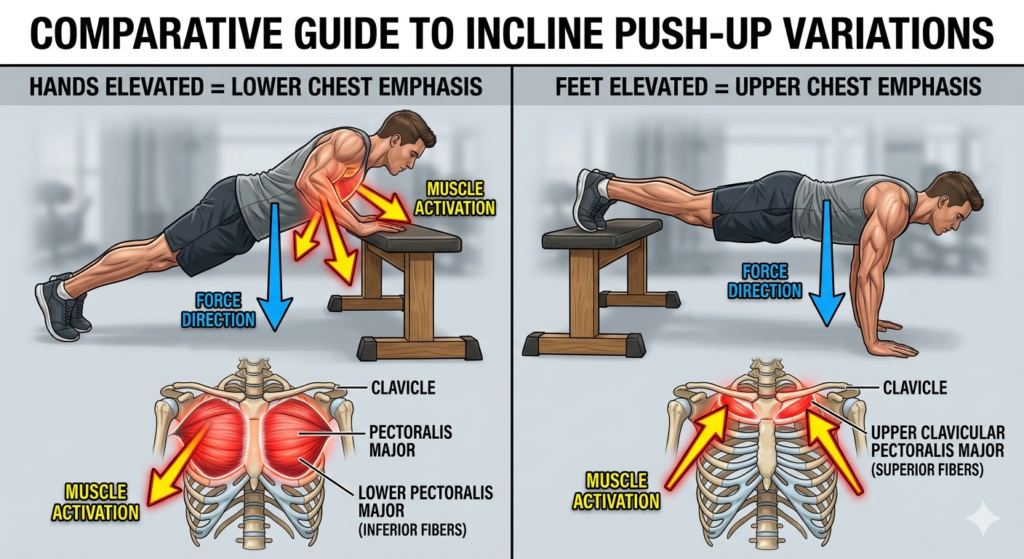
Lower chest training at home the direct answer: The lower chest can be effectively trained at home without weights. The body responds to mechanical load regardless of its source, meaning bodyweight at the correct angle produces the same regional recruitment as a decline bench press. Hands elevated push ups, chair dips with a forward torso lean, and pseudo push ups all generate the downward force angle the lower pecs require. According to exercise analysis published by Madbarz (2022), body position not load type is the primary variable in lower chest recruitment during push up variations.
The 7 Best Lower Chest Exercises at Home
These are ranked beginner to advanced. Don’t skip ahead because an exercise looks too simple the first two build the neural recruitment patterns that make the advanced ones actually work.
1. Hands Elevated Push Up
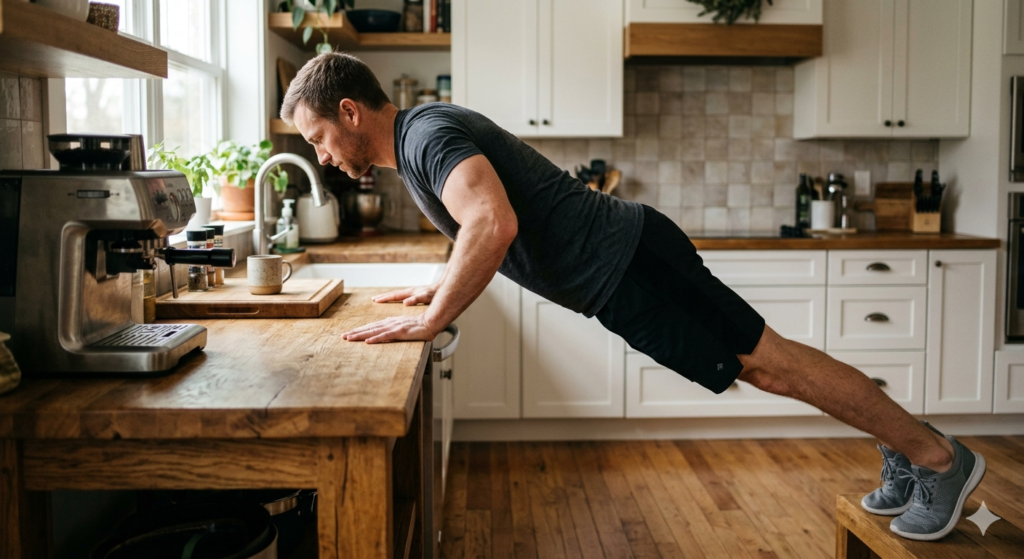
The foundation of all lower chest bodyweight training. Place both palms on a stable surface a couch armrest, sturdy chair seat, kitchen counter, or stair step. Walk your feet back until your body is in a straight line from heels to ears. Lower your chest toward the surface, elbows at roughly 45 degrees to your sides. Drive through your palms back to start.
The higher the surface, the easier it is. Start at counter height (about 36 inches). Over weeks, work toward a lower surface.
Sets/reps 3 × 10–15 Rest 60 seconds between sets
2. Hands Elevated Push Up Slow Eccentric
Same setup. This time, lower yourself over exactly 4 seconds. Pause at the bottom for 1 full second. Push up at normal speed. That slow lowering phase the eccentric significantly increases muscle tension without adding any load. Users who’ve tried this after months of normal push ups often report feeling their lower chest work for the first time.
Sets/reps 3 × 6–10 Rest 75 seconds
3. Chair Dips with Forward Lean
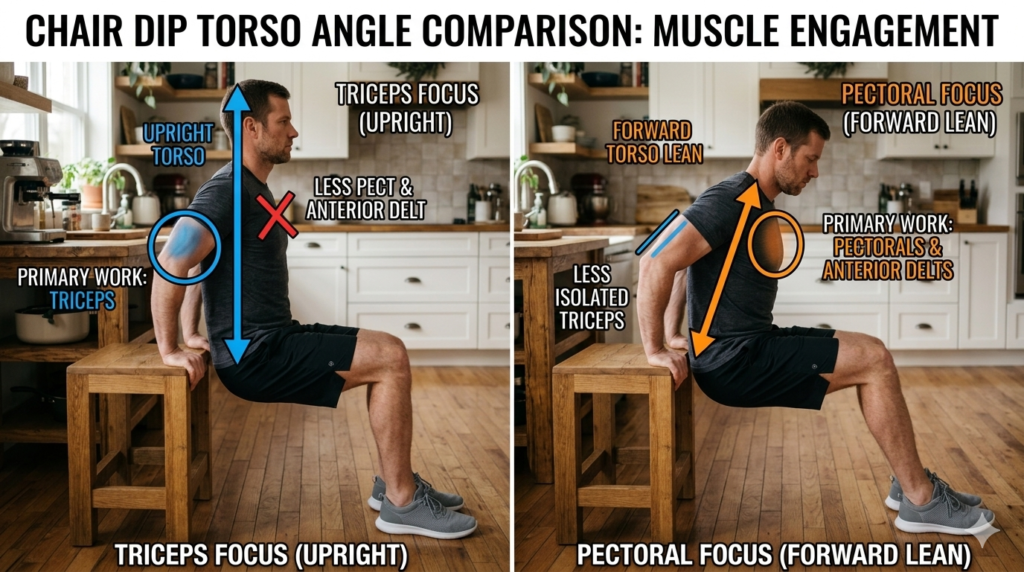
Place two sturdy chairs side by side, slightly wider than shoulder width apart, or use a kitchen counter with two clear edges. Hold yourself up, arms straight. Lean your torso forward this is non-negotiable. Without the forward lean, this becomes a pure triceps exercise.
Lower until your upper arms are roughly parallel to the floor. Press back up. Don’t lock out fully at the top keep tension on the chest.
Quick note: forward lean = chest. Vertical torso = triceps. Check your position on every single rep.
Sets/reps 3 × 8–12 Rest 90 seconds
4. Pseudo Push Up (Planche Lean Variation)
Underused. Very effective. Set up like a normal push up, but position your hands much lower on your body roughly level with your hips, not your chest. Fingertips angled slightly outward. Lean your shoulders forward over your hands before you lower down. This angle shifts load aggressively onto the lower pecs and forces core engagement throughout.
Most people manage 3–5 reps their first attempt. That’s normal.
Sets/reps: 2–3 × 4–8 Rest: 90 seconds
5. Feet on Floor Decline Push Up (Book Stack Variation)
Place your hands on a surface roughly 6–12 inches off the floor a stack of hardcover books, a low step, or a foam block. Your feet stay flat on the floor. This creates a mild decline in the body chest lower than hips mimicking a decline bench press closely. It’s gentler on the wrists than fully elevated variations and much easier to control.
Sets/reps: 3 × 10–15 Rest: 60 seconds
6. Explosive Hands Elevated Push Up (Clap Variation)
Advanced. Only add this after weeks 3–4. Perform the same hands elevated push up, but press explosively enough to briefly lose contact with the surface clapping hands mid-air if you can. The fast twitch fiber recruitment adds a stimulus that slow, controlled reps simply don’t create. Never do this first in a session or when fatigued.
Sets/reps: 2 × 5–8 Rest: 2 minutes
7. TRX Suspension Trainer Decline Chest Press
The only piece of equipment worth naming here. A TRX Suspension Trainer (~$100 at retail) anchors to any door frame. Set the straps so your body leans into a 30–45 degree downward angle during the press. The instability forces continuous pec engagement through the full range of motion something fixed-surface exercises can’t replicate. If you already own one, this becomes your primary lower chest tool.
Sets/reps: 3 × 10–12 Rest: 75 seconds
To perform a hands elevated push-up for lower chest activation:
- Place both hands on a stable surface 12–24 inches high.
- Walk feet back form a straight line from heels to head.
- Lower your chest toward the surface, elbows 45 degrees from your ribs.
- Pause 1 second at the bottom.
- Push through your palms back to the start position.
- Complete 10–15 reps with control before adding any progression.
Your Weekly Lower Chest Workout Plan
This is where most guides stop giving you anything useful.
Knowing seven exercises isn’t a plan. Below is a 6-week progressive structure three sessions per week, 48 hours minimum between sessions. The model is simple you advance when 3 full sets at the current rep target feel controlled at a 7–8/10 effort.
Week 1–2 Foundation Phase
- Hands elevated push-up: 3 × 10
- Chair dips (forward lean): 3 × 8
- Pseudo push-up: 2 × 5
- Rest: 60–75 seconds between all sets
Week 3–4 Intensity Phase
- Hands elevated push-up (4-sec eccentric): 3 × 8
- Chair dips: 3 × 12
- Pseudo push-up: 3 × 6
- Explosive push-up: 2 × 5 (add after completing the above)
Week 5–6 Progression Phase
- Lower your push up surface height by 4–6 inches (increases difficulty significantly)
- Add a loaded backpack (~10 lbs) to chair dips if bodyweight feels easy
- Pseudo push up: 3 × 8
- All working sets at 1–2 reps in reserve not to failure, but close
Most people need to repeat one phase before advancing. That’s not failure that’s how muscle tissue works.
How quickly does a lower chest workout at home produce visible results? According to certified physical therapist and strength coach Jeff Cavaliere (AthleanX), visible regional muscle changes require 4–8 weeks of consistent, progressive training. For home lower chest work specifically, trainees following a 3x per week programme with progressive overload and adequate protein intake (0.7–1g per lb of bodyweight daily) typically observe noticeable definition in the 6–8 week window. Early results (weeks 2–4) are largely neural strength improves before size is visible.
Quick Comparison Bodyweight vs Gym Equipment for Lower Chest
| Exercise | Best For | Key Benefit | Limitation |
|---|---|---|---|
| Hands-Elevated Push Up | Beginners | Immediate lower pec activation | Limited load ceiling past 6 months |
| Chair Dips (forward lean) | Intermediate | Mimics cable crossover mechanics | Shoulder stress if form breaks down |
| Pseudo Push Up | Intermediate Advanced | Aggressive lower pec + core engagement | High technique demand upfront |
| TRX Chest Press (decline angle) | All levels with ~$100 to spend | Full range, instability recruitment | Requires equipment investment |
| Explosive Clap Push Up | Intermediate | Fast twitch fibre activation | High fatigue cost use late in session |
Bodyweight lower chest vs. decline bench press: Bodyweight is better suited for beginners and home trainers because it builds correct recruitment patterns before adding load and needs zero equipment. Decline bench pressing is better for intermediate to advanced lifters chasing maximum hypertrophy because heavier progressive overload is achievable faster. The key difference is load ceiling not angle. Both approaches use the same downward push mechanics.
The One Real Debate in Lower Chest Training
Some coaches argue you simply cannot build meaningful lower chest mass without external load that bodyweight will take you so far and then plateau permanently. That’s a valid position for competitive level physique athletes or anyone past 24 months of consistent training.
But here’s the counterpoint: if your lower chest is currently underdeveloped, you’re almost certainly not at that stage. The limiting factor isn’t available load. It’s the angle being wrong, and the absence of progressive overload in a structured plan. Fix those two things first then revisit the free weight question in 12 months if you’ve maxed out.
I’ve seen conflicting data on this some sports science research emphasises that bodyweight training at high enough intensity produces equivalent hypertrophy in untrained to early trained populations, while other literature argues weighted decline movements are irreplaceable for advanced development. My read: for the person 6–18 months into training who has never specifically targeted the lower chest with correct mechanics, bodyweight alone is more than adequate for the next 12 months of real, visible progress.
What most guides skip entirely is the progression architecture. Pick three of the seven exercises above and get genuinely stronger at them over 8 weeks. Just that nothing else will change what you see in the mirror.
Conclusion
Your lower chest isn’t lagging because you’re not working hard enough.
It’s lagging because the angle has been wrong.
Fix the angle hands elevated, hips higher than hands, torso pressing downward and the lower pecs finally get the mechanical stimulus they’ve been missing. Do that three times a week, progress the difficulty every two weeks, and you’ll see definition in that area within 6–8 weeks that months of flat push ups never produced.
You don’t need a gym for this. You need a counter, a sturdy chair, and a plan you’ll actually stick to.
Start with the hands elevated push-up today. Three sets. That’s it. Build from there.
The lower chest you want isn’t a gym problem it never was.