Build Your Chest at Home Without Dumbbells 10 Exercises + 4 Week Plan
This guide is written for healthy adults looking to build chest strength at home. It does not cover rehabilitation or pre existing shoulder and wrist injuries. If either applies to you, speak with a physiotherapist before starting.
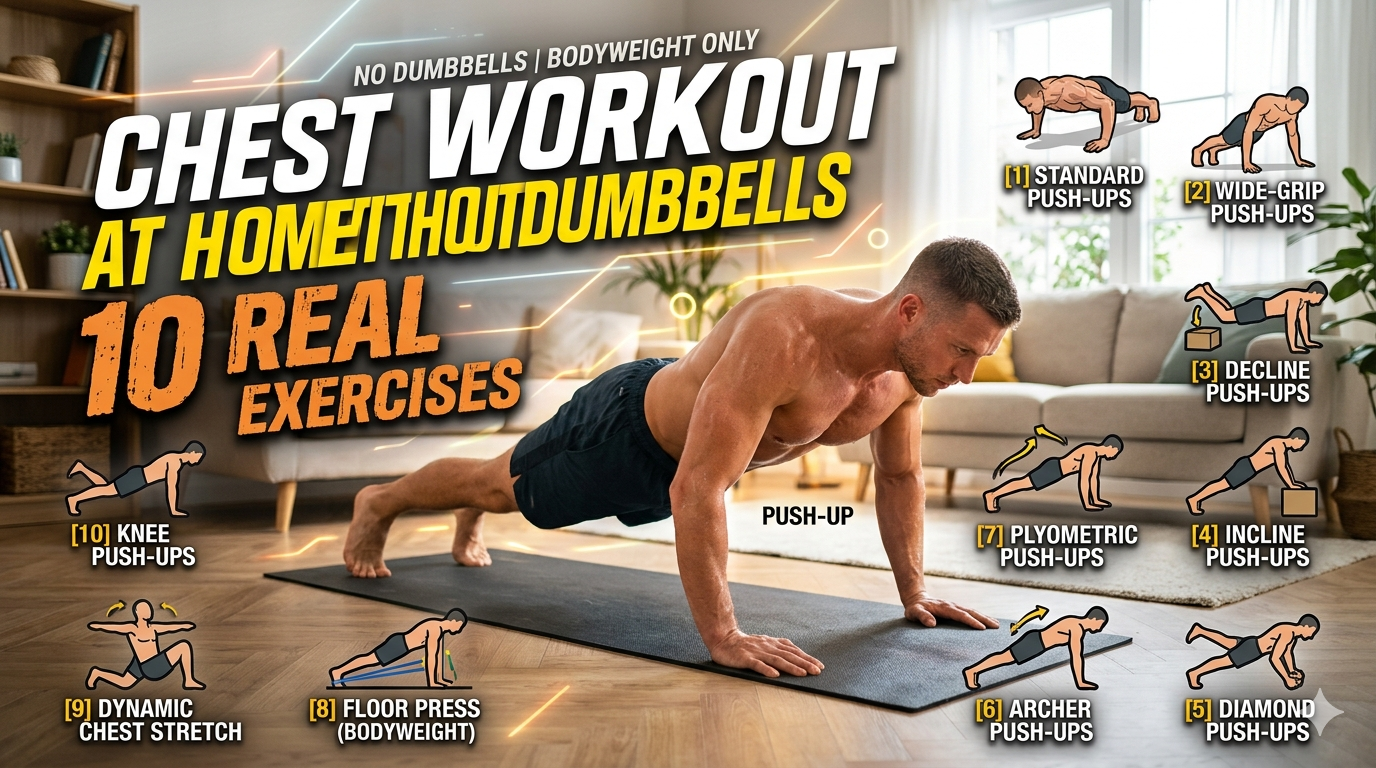
A chest workout at home without dumbbells relies on push up variations, angle manipulation, and tempo control to target the pectoralis major and minor. No bench, no bar, and no equipment beyond floor space and a sturdy chair. You can build a defined, functional chest this way provided you follow a real progression structure, not just a list of exercises.
That’s the direct answer. Here’s the science behind it, and then the full plan.
Does Bodyweight Training Actually Build Chest?
Most people assume you need weights to grow your chest. The data says otherwise.
According to a 2012 ACE-sponsored EMG study (American Council on Exercise), the decline push up activates approximately 69.2% of the pectoralis major a figure directly comparable to a standard barbell bench press. The regular push-up clocked 61.4%. What this tells us: angle and mechanics matter far more than load, at least until you’re well into intermediate territory.
The chest doesn’t know whether you’re pressing a 30kg barbell or your own bodyweight. It responds to mechanical tension, time under load, and stretch at the bottom position. Change any one of those variables, and you’ve changed the training stimulus entirely.
Some exercise scientists argue bodyweight training hits a hypertrophy ceiling faster than weighted work. That’s valid for advanced athletes chasing maximum muscle mass. But if you’re a working adult trying to build a strong, visually defined chest at home, you won’t approach that ceiling for months.
How to Do a Chest Workout at Home Without Dumbbells
Block B Featured Snippet (How To):
To do a chest workout at home without dumbbells, follow these steps:
- Pick 4–5 push-up variations targeting different chest regions
- Perform 3 sets of 8–15 reps per variation
- Rest 45–60 seconds between sets
- Apply tempo control: 3 seconds down, 1 second hold at the bottom, 3 seconds up
- Progress weekly by increasing reps, variation difficulty, or added load
Each step takes under 10 seconds to understand. The execution is what most people skip.
The 10 Best Chest Exercises Without Dumbbells
Push ups and their variations are your entire toolkit. Not a limitation a system. Each variation shifts load, angle, and fiber recruitment. Together, they cover every region of the chest without a single piece of equipment.
Start with the standard push up as your warm up. Then move through the list in order easier to harder.
1. Standard Push Up
The baseline movement. Hands slightly wider than shoulder-width, body in a straight line from heel to crown. Lower until your chest nearly brushes the floor.
Targets: Mid chest, front deltoids, triceps. Sets/Reps: 3 × 12–15. Rest 45 seconds.
2. Wide Grip Push Up
Move your hands 10–15cm wider than normal. The wider the placement, the shorter the range of motion but the greater the chest emphasis and the less the triceps dominate.
Targets: Outer pectoral fibers. Sets/Reps: 3 × 10–12. Rest 45 seconds.
3. Decline Push Up
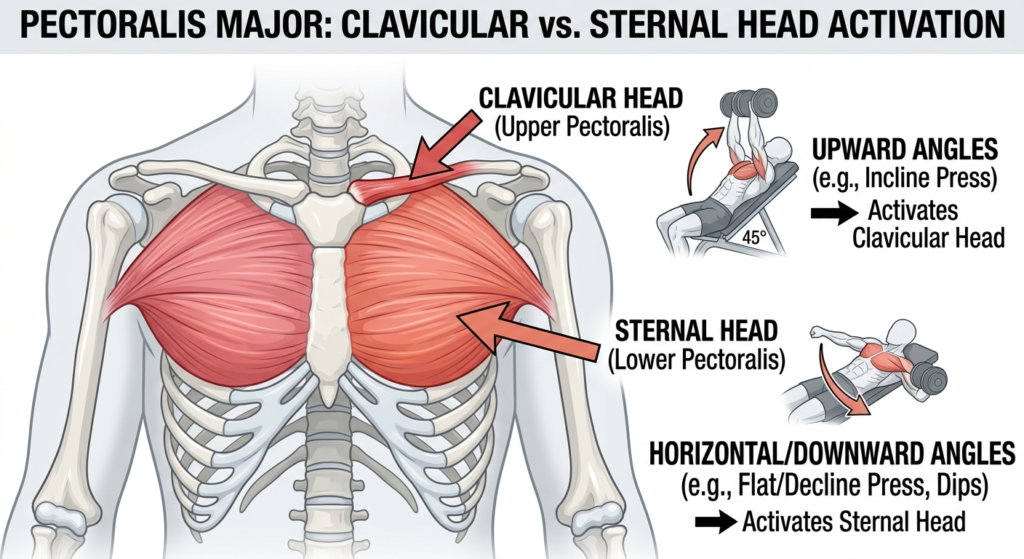
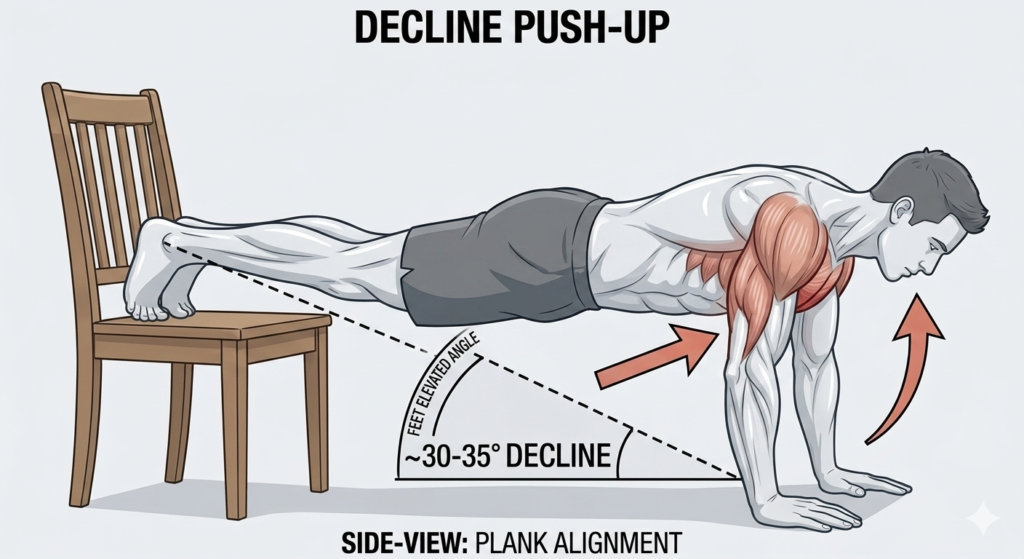
Feet on a chair or step, hands on the floor. This is the highest activating bodyweight chest exercise per ACE research it shifts load toward the upper chest (clavicular head), which most people massively under develop.
Targets: Upper chest, anterior deltoid. Sets/Reps: 3 × 8–12. Rest 60 seconds.
4. Incline Push Up
The reverse position. Hands elevated on a surface, feet on the floor. This is your lower chest builder and the most useful starting point for beginners who can’t yet do 10 clean full push-ups.
Targets: Lower chest (sternal head), accessible difficulty level. Sets/Reps: 3 × 12–15. Rest 45 seconds.
5. Diamond Push Up
Thumbs and index fingers touching beneath your sternum, forming a diamond shape. This is genuinely hard. It loads the inner chest and triceps simultaneously expect your arms to shake by rep 6.
Targets: Inner chest, triceps. Sets/Reps: 3 × 5–8. Rest 60 seconds.
6. Archer Push Up
One arm extends straight to the side as you lower toward the bent arm. It’s a halfway progression to a single arm push-up and creates unilateral chest loading important for correcting left right strength imbalances that most people have and ignore.
Targets: Full pectoralis major, with unilateral load emphasis. Sets/Reps: 3 × 5 per side. Rest 60 seconds.
7. Pike Push Up
Hips high, body forming an inverted V, lower your head toward the floor between your hands. Primarily a shoulder movement, but it builds the upper chest and clavicular region when layered with decline work.
Sets/Reps: 3 × 8–10. Rest 45 seconds.
8. Tempo Push Up (3-1-3)
Standard push up position. Three seconds down. One second hold at the very bottom chest just above the floor. Three seconds back up.
This is time under tension training, and it’s the single most underused technique in home chest workouts. It turns a movement you can do 20 times into one you can barely complete 6 times. The stimulus is completely different from standard reps.
Targets: Full chest slow twitch fibers and connective tissue adaptation. Sets/Reps: 3 × 5–8. Rest 90 seconds.
9. Bottom Position Push Up Hold
Lower yourself to the bottom of a push-up. Hold there for 20–30 seconds without moving. This isometric contraction forces your chest to sustain tension under stretch a stimulus you genuinely cannot replicate with fast reps.
Sets/Reps: 3 × 20–30 second holds. Rest 60 seconds.
10. Backpack Push Up
Load a standard backpack with textbooks, water bottles, or any dense objects. Wear it while performing push ups. Or maybe I should say it this way: this is the closest available substitute to a dumbbell chest press when you own nothing. Five to eight kilograms changes the exercise completely.
This isn’t for beginners. Build the foundation over 2–3 weeks first.
Targets: Full chest with added mechanical load. Sets/Reps: 3 × 8–10. Rest 60–90 seconds.
The 4 Week Progression Plan (What Other Guides Skip)
A list of exercises is a menu. A progression plan is a program. Without week by week escalation, you’ll plateau within 10–14 days same reps, same feel, same chest. This is the structure both 8fit and SquatWolf omit entirely.
The core principle: manipulate one variable per week volume, tempo, variation difficulty, or density. Never try to progress everything simultaneously.
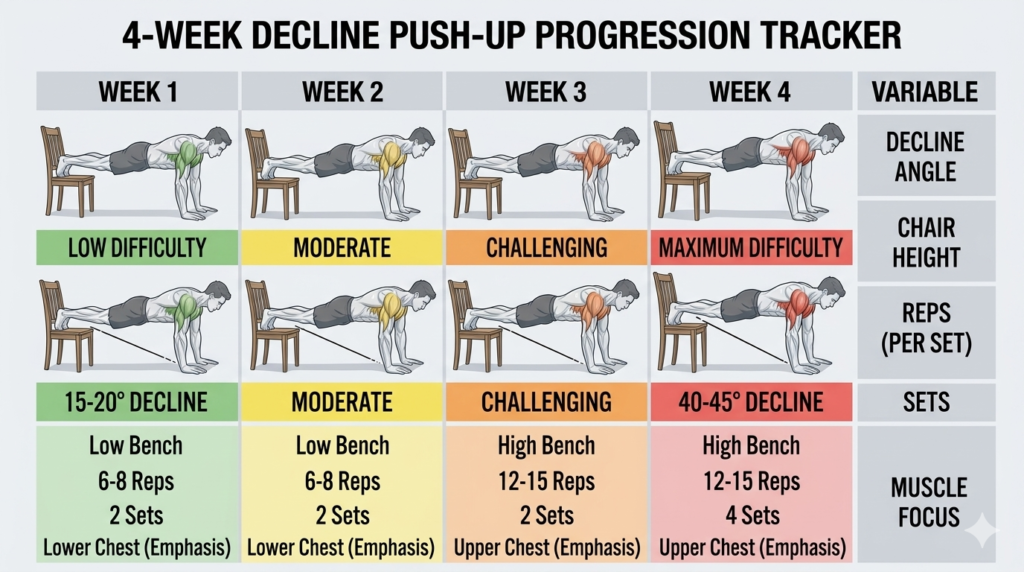
Week 1 Volume Foundation
Goal: build work capacity. Your chest needs to adapt to the movement patterns before you add intensity.
Workout A (3x per week, alternating days e.g. Mon/Wed/Fri):
- Wide Push Up: 3 × 12
- Incline Push Up: 3 × 12
- Standard Push Up: 3 × 15
- Diamond Push Up: 3 × 6
- Bottom Position Hold: 2 × 20 seconds
Rest 45 seconds between all sets.
Week 2 Tempo Control
Keep the same exercises. Change everything else.
Switch all sets to 3-1-3 tempo 3 seconds lowering, 1 second hold at the bottom, 3 seconds pressing back up. Drop rep count by 30–40%. This is harder than adding reps. Trainees who’ve been doing push ups for months are consistently surprised by how different this feels.
Week 3 Variation Upgrade
Replace standard push ups with Archer push ups. Replace incline push ups with Decline push ups. Add 1 set of Backpack push ups (body weight plus 5–8kg). Keep rest at 60 seconds maximum.
This is where your upper chest starts responding.
Week 4 Max Effort
Cut rest periods to 30–45 seconds. Add one extra set to every exercise. On the final set of each movement, go to genuine failure not one rep short, not two reps short. To the point where you physically cannot complete another rep.
Take 3–4 full rest days after Week 4. Then restart from Week 1 with higher baseline numbers across every exercise.
Upper Chest vs Lower Chest A Practical Breakdown
What most guides skip entirely the chest is not a uniform slab of muscle. The pectoralis major has two distinct fiber groups the clavicular head (upper) and the sternal head (lower) and they respond to different angles.
If you only do flat push ups, you’re training one half of your chest.
Quick Comparison
| Exercise | Best For | Key Benefit | Limitation |
|---|---|---|---|
| Decline Push Up | Upper chest | Highest EMG activation (ACE, 2012) | Needs elevated surface |
| Incline Push Up | Lower chest | Accessible for beginners | Less load than flat variations |
| Wide Grip Push Up | Outer chest | Isolates pec over tricep | Reduced range of motion |
| Diamond Push Up | Inner chest | Strong tricep co activation | Demanding for beginners |
| Archer Push Up | Full chest, unilateral | Corrects side to side imbalances | Requires shoulder mobility |
| Backpack Push Up | Full chest, loaded | Progressive overload without weights | Not suitable for beginners |
Decline for upper. Incline for lower. Wide for outer. Diamond for inner.
That’s the complete architecture of a bodyweight chest program.
Four Mistakes That Kill Your Progress at Home
Look if you’ve been doing push ups three times a week for a month and your chest looks and feels exactly the same, it’s almost certainly one of these.
Mistake 1: Only doing standard push ups. One variation trains one angle. Your upper and lower chest have different fiber directions and require different angles to activate meaningfully. No variation equals incomplete development.
Mistake 2: Rushing through reps. Fast reps reduce time under tension. Your chest barely contracts before you’re already pressing back up. Slow down the lowering phase minimum. If you’ve never tried 3 second negatives, do it once you’ll understand immediately.
Mistake 3: Training chest daily.
I’ve seen conflicting approaches here some calisthenics coaches advocate daily push up practice for skill and volume accumulation, while sports science generally recommends 48 hour recovery windows between sessions. My read: beginners should train chest 3 times per week, maximum. Muscle protein synthesis peaks roughly 24–36 hours after training and needs time to complete. Daily training for untrained individuals typically causes accumulated fatigue, not accelerated growth.
Mistake 4: Cutting range of motion short. Your chest needs a genuine stretch at the bottom of each rep. If you don’t feel a stretch, your hands are likely too close together or your elbows are flaring too wide. Widen your hand placement by a few centimeters and lower all the way until your chest nearly contacts the floor.
Conclusion
You don’t need a gym. You don’t need dumbbells. You don’t even need a bench.
What you need is the right angles, a progression structure, and enough patience to trust that the stimulus is working even when it doesn’t feel dramatic.
The decline push up activates your upper chest as effectively as a barbell press. The tempo push up builds more time under tension than most people get from a full weighted set. The 4 week plan above gives your body a reason to keep adapting week after week without spending a single dollar.
Start with Week 1. Master the standard variations before touching the advanced ones. And if you’re three weeks in and still feel like nothing is happening, the answer is almost always the same: slow your reps down, go lower, and actually rest between sessions.
Tools worth exploring if you want guided structure: Freeletics offers a free bodyweight plan with chest specific programming, and Calisthenics Movement on YouTube breaks down push up progressions with more technical depth than almost anyone else online.
One last thing this guide covers healthy adults training at home without equipment. It doesn’t address shoulder impingement, rotator cuff restrictions, or post surgery rehab. If any of those apply to you, get cleared by a physiotherapist first.
Now go do the workout.