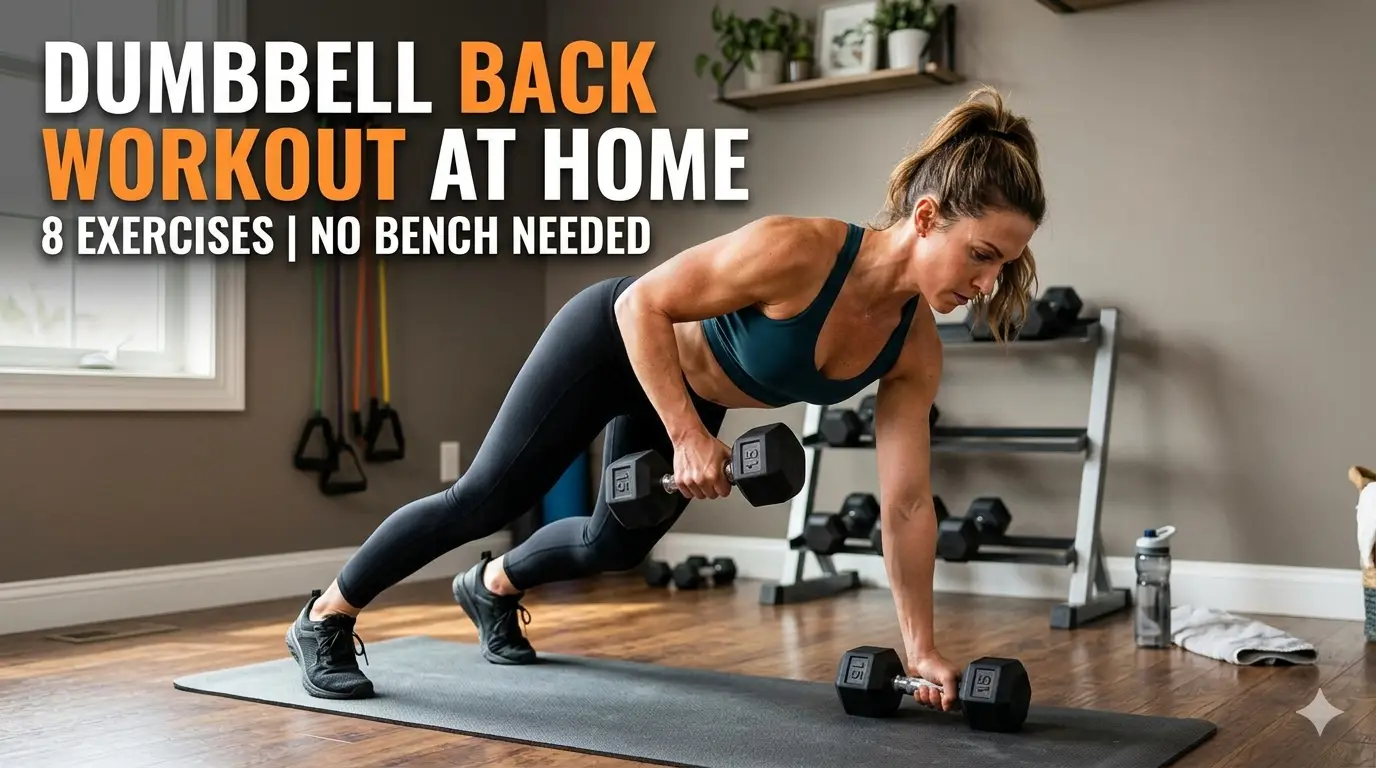
Build a Real Back With This Dumbbell Home Workout (No Bench Required)
This guide is for healthy adults training at home with one or two pairs of dumbbells. It does NOT cover rehab for existing back injuries if you have a diagnosed spinal condition, check with a physiotherapist before starting.
A dumbbell back workout at home is a complete resistance training session targeting the lats, rhomboids, traps, and erector spinae using only dumbbells no pull up bar, no cable machine, and no bench required. Done consistently with progressive overload, it builds the same functional back strength as gym-based programs.
That’s the short answer. Here’s the longer one.
Why Your Back Never Gets Trained at Home (And Why That’s a Problem)
According to the American Chiropractic Association, roughly 31 million Americans deal with lower back pain at any given moment. A significant share of that pain traces directly back to weak posterior chain muscles the exact muscles that get ignored when home training defaults to push-ups and bicep curls.
Here’s the thing: back training gets skipped at home because most routines assume you own a bench. Single-arm rows need something to brace against. Chest supported rows need an incline surface. Gymshark’s popular back article lists five solid exercises three of them require a bench. That’s the gap this guide closes.
Weak back muscles don’t just look bad. They pull your shoulders forward, compress your lumbar spine, and turn an 8 hour desk day into chronic pain by 9 PM. Training your back twice a week at home isn’t optional if you sit for a living.
It really is that direct.
What Muscles Does a Dumbbell Back Workout Actually Hit?
You’re targeting four main regions:
- Latissimus dorsi (lats) the broad muscle that creates the V-taper, responsible for pulling your arms down and back
- Rhomboids sit between your shoulder blades, retract the scapula, fix forward-rounded posture
- Trapezius (traps) upper and mid-back, controls shoulder blade movement and neck stability
- Erector spinae three muscles running the length of your spine, responsible for extension and upright posture
A well designed home dumbbell session should hit all four. Most articles online cover lats and traps reasonably well. The rhomboids and erector spinae get an afterthought mention, if that. This plan doesn’t make that mistake.
The 8 Best Dumbbell Back Exercises for Home (No Bench)
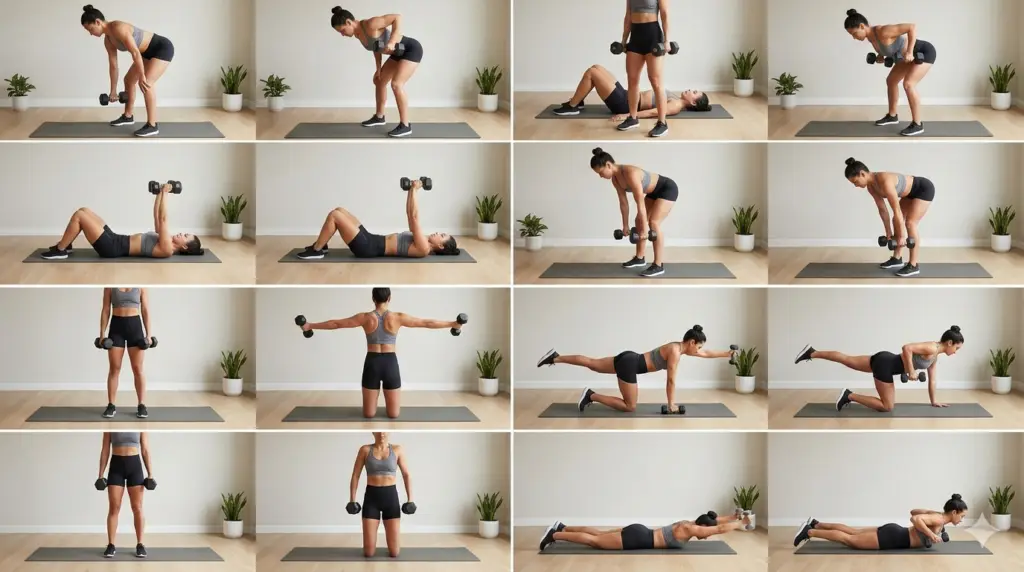
Quick note: every exercise below is selected specifically because it works without a bench. Where a bench is normally used for stability, we’ll use the floor, a wall, or a hip hinge position instead.
1. Bent Over Dumbbell Row (Bilateral)
Muscles: Lats, rhomboids, mid traps, rear delts, biceps
How to do it:
- Stand feet hip width apart, dumbbells in each hand
- Hinge at the hips until your torso is 45–60 degrees from vertical, knees soft
- Let arms hang straight down, palms facing each other
- Drive both elbows back and up pull dumbbells to your lower ribcage
- Squeeze shoulder blades together at the top for one second
- Lower with control 3 seconds down
Sets/Reps/Rest: 4 sets × 8–10 reps / 75 seconds rest
What most guides skip: The hinge angle matters more than the weight. A torso that’s too upright turns this into a shoulder exercise. Stay closer to parallel for genuine lat engagement.
2. Single Arm Dumbbell Row (Floor Supported)
Muscles: Lats, rhomboids, traps unilaterally
This is your primary lat builder. Without a bench, place your non-working hand on your knee or a stable chair for light balance support only don’t lean into it.
How to do it:
- Take a staggered stance, right foot forward
- Hinge forward, place left hand lightly on left knee
- Dumbbell in right hand, arm fully extended
- Row the dumbbell to your hip pocket not your armpit
- Pause one second, lower slowly
Sets/Reps/Rest: 4 sets × 10–12 reps each side / 60 seconds between sides
Training unilaterally forces each side to work independently, which research published in Biosensors (Wong et al., 2022) links to greater muscle fiber recruitment through enhanced attentional focus essentially, your brain sends a stronger signal when one side isn’t able to compensate for the other.
3. Dumbbell Deadlift
Muscles: Erector spinae, lats (isometric), glutes, hamstrings
Some experts argue the dumbbell deadlift is inferior to the barbell version because you can’t load it as heavy. That’s valid if you’re chasing a one-rep max. But if you’re training back health and posterior chain strength at home, the dumbbell deadlift done slowly and with full hip hinge is one of the most complete exercises in this list.
How to do it:
- Stand with dumbbells in front of thighs, feet hip width
- Push hips back don’t squat down
- Keep dumbbells close to legs, lower until you feel a hamstring stretch (roughly shin level for most people)
- Drive hips forward to stand, squeeze glutes at the top
Sets/Reps/Rest: 3 sets × 10 reps / 90 seconds rest
4. Dumbbell Romanian Deadlift (RDL)
Muscles: Erector spinae, lats (stabilizing), hamstrings, glutes
The RDL differs from the conventional deadlift in one key way: the knees stay nearly straight throughout. This maximizes hamstring stretch and puts more sustained tension on the lower back musculature. A 2014 study in the Journal of Strength and Conditioning Research (McAllister et al.) confirmed the Romanian deadlift produces significantly higher erector spinae activation than a standard deadlift.
Sets/Reps/Rest: 3 sets × 12 reps / 75 seconds rest
5. Dumbbell Reverse Fly
Muscles: Rear delts, rhomboids, mid traps
This is the most underrated exercise in any home back program. The rear delts and rhomboids are the muscles that physically pull your shoulders back the movement pattern that directly counteracts forward posture from desk sitting.
How to do it:
- Hinge to 45 degrees, dumbbells hanging below chest, palms facing each other
- Keep a slight bend in the elbow arms aren’t fully rigid
- Sweep both arms out to your sides, squeezing shoulder blades together at the top
- The movement is an arc, not a row elbows stay at shoulder height
Sets/Reps/Rest: 3 sets × 15 reps / 60 seconds rest
Use lighter weight here than you expect. Most people immediately go too heavy and turn this into a shrug.
6. Renegade Row
Muscles: Lats, mid back, core, obliques, rear delts
This is a full body effort. Your core is working as hard as your back to hold the plank and resist rotation. If you can’t hold a plank for 45 seconds without form breakdown, build that first before loading renegade rows.
How to do it:
- Place dumbbells parallel on the floor, shoulder width apart
- Set up in a plank hands on dumbbell handles, body in a straight line from heels to head
- Row one dumbbell to your hip, keeping hips square and still
- Place it back down, repeat the other side
- That’s one rep one row on each side
Sets/Reps/Rest: 3 sets × 8 reps each side / 90 seconds rest
7. Dumbbell Shrug
Muscles: Upper traps, levator scapulae
Stand upright, dumbbells at sides. Shrug straight up no rolling. Hold one second at the top. The trap fibers run vertically; rolling your shoulders doesn’t add range, it adds joint stress.
Sets/Reps/Rest: 3 sets × 12–15 reps / 45 seconds rest
8. Superman Hold (Bodyweight, No Dumbbell)
Muscles: Erector spinae, glutes, rear delts
Include this as a finisher or warm up activator. Lie face down, arms extended overhead. Lift chest, arms, and legs simultaneously off the floor. Hold for 2 seconds. Lower. This is direct erector spinae activation with zero load risk important for people with a history of lower back sensitivity.
Sets/Reps: 3 sets × 12 reps
The Complete Home Dumbbell Back Workout Plan
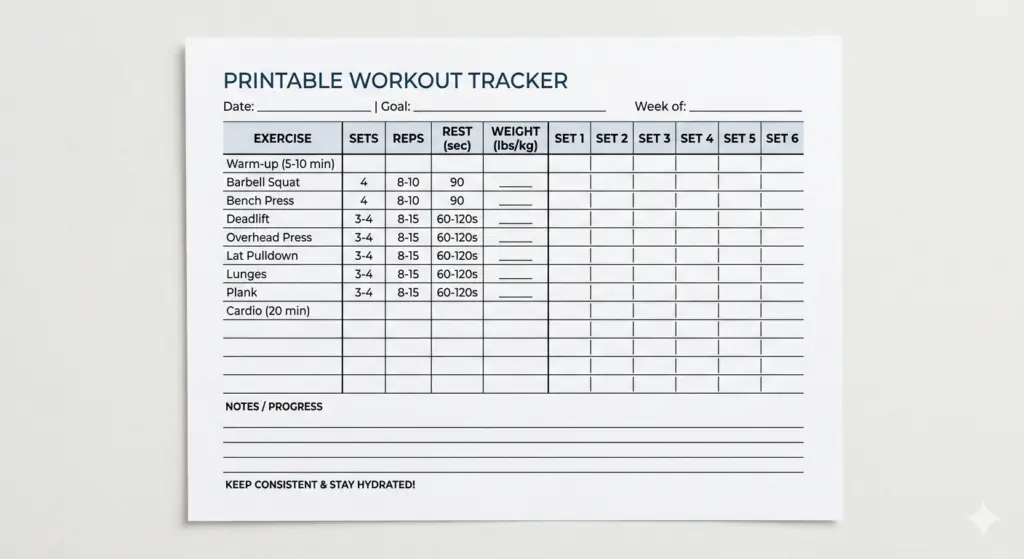
Workout A (45–50 minutes) Use twice per week with 48+ hours between sessions
| Exercise | Sets | Reps | Rest |
|---|---|---|---|
| Superman Hold (warm up) | 2 | 12 | 30 sec |
| Dumbbell Deadlift | 3 | 10 | 90 sec |
| Bent Over Row (bilateral) | 4 | 8–10 | 75 sec |
| Single Arm Row | 4 | 10–12 each | 60 sec |
| RDL | 3 | 12 | 75 sec |
| Reverse Fly | 3 | 15 | 60 sec |
| Renegade Row | 3 | 8 each | 90 sec |
| Dumbbell Shrug | 3 | 12–15 | 45 sec |
Weekly frequency: 2× per week (e.g. Monday + Thursday, or Tuesday + Friday) Progressive overload: Add 1–2 reps per set each week. Once you hit the top of the rep range for all sets, increase weight by the smallest available increment.
How to Pick the Right Starting Weight (The Part Nobody Explains)
This is the question both Gymshark and Kickoff leave completely unanswered and it’s the one that actually determines whether you make progress or spin your wheels.
General starting guidelines for home beginners:
| Exercise | Suggested Starting Weight (Men) | Suggested Starting Weight (Women) |
|---|---|---|
| Bent Over Row | 15–25 lbs each | 8–15 lbs each |
| Single Arm Row | 20–30 lbs | 10–20 lbs |
| RDL / Deadlift | 20–35 lbs each | 12–20 lbs each |
| Reverse Fly | 8–12 lbs each | 5–10 lbs each |
| Renegade Row | 15–20 lbs each | 8–12 lbs each |
| Shrug | 25–40 lbs each | 15–25 lbs each |
These are entry points, not rules. The right weight for any exercise is one where the last 2 reps of each set feel genuinely hard not impossible, but not comfortable either.
Or maybe I should say it this way: if you finish a set and feel like you could do 6 more, the weight is too light. If your form breaks down on rep 7, the weight is too heavy. Chase the middle.
Quick Comparison: Fixed Dumbbells vs. Adjustable Dumbbells for Home Back Training
| Option | Best For | Key Benefit | Limitation |
|---|---|---|---|
| Fixed hex dumbbells (e.g. Rogue) | Users who know their working weights | Grab and go speed, durable | Need multiple pairs for different exercises |
| Bowflex SelectTech 552 | Limited space, varied exercises | One unit replaces 15 pairs | Slower to adjust mid workout |
| PowerBlock Elite | Serious home lifters, heavy loading | Compact, goes up to 90 lbs | More expensive upfront |
Fixed dumbbells are better suited for anyone who wants zero friction between sets. Adjustable dumbbells win when floor space matters more than transition speed. The key difference is workflow not strength outcomes.
I’ve Seen Conflicting Advice Here’s My Read
Some coaches argue you genuinely can’t build a thick, wide back without a pull-up bar or cable column. There’s data supporting that view cable rows and lat pulldowns are hard to fully replicate with free weights. That’s valid for competitive physique athletes chasing the last 10% of development.
But if you’re someone who just wants a functionally strong, pain free back that doesn’t embarrass you when your shirt comes off you’re not in that 10%. You’re in the 90% where consistent dumbbell rows, progressive overload, and twice a week frequency will get you further than you think.
Look if you’re the person who has been skipping back day because the standard advice assumes a gym you don’t have access to, here’s what actually works: pick three exercises from this list, run them twice a week for six weeks, add reps every session, then layer in the rest. Starting imperfect beats not starting.