INTRODUCTION
So here’s something I don’t usually tell people. I spent close to a year going in circles with fitness. Gym membership used it maybe eight times. Protein powders on my shelf expired. Workout apps downloaded, forgotten. Nothing stuck. And the whole time I kept blaming myself, thinking I just didn’t have the discipline.
Then one day my cousin shows up looking noticeably different. Leaner, broader shoulders, stronger. I asked what gym he joined. He laughed. Said he hadn’t stepped inside a gym in months. He was doing calisthenics push-ups, pull-ups, squats in the small courtyard outside his house. Nothing else. I thought he was joking. He wasn’t.
That conversation changed how I think about fitness completely. Calisthenics training doesn’t need a gym, doesn’t need money, and doesn’t need fancy equipment. What it does need is consistency and a proper understanding of how to train. That’s what this article gives you. Go through it properly and it covers everything a beginner actually needs to know.
1. What Calisthenics Actually Is And Why Beginners Get It Wrong
Most people hear the word calisthenics and picture gymnasts doing impossible things on rings. That’s advanced stuff. For beginners, calisthenics is much simpler; it just means training your body using your own body weight as resistance. Push-ups. Squats. Planks. Pull-ups. Movements that challenge your muscles without a single piece of gym equipment.
What surprises most people when they actually try it is how hard it is. They assume bodyweight training is easy because there’s no added weight. But think about it, a push-up moves roughly 60 to 70 percent of your total body weight. A pull-up lifts your entire body. For someone starting out, that’s more than enough load to build serious muscle and strength.
The reason calisthenics workouts are especially good for beginners is that they train movement patterns, not just isolated muscles. Your whole body learns to work as one unit. Balance, coordination, posture all of it improves alongside raw strength. That’s something gym machines, which lock you into fixed movement paths, honestly can’t replicate as well.
And the location thing is genuinely a game changer. No commute to a gym. No waiting for equipment. No monthly fee. You wake up, you roll out of bed, and your calisthenics starts right there. That kind of accessibility is what turns fitness from a sometimes-thing into an everyday habit.
2. The Exercises Learn These Before Anything Else
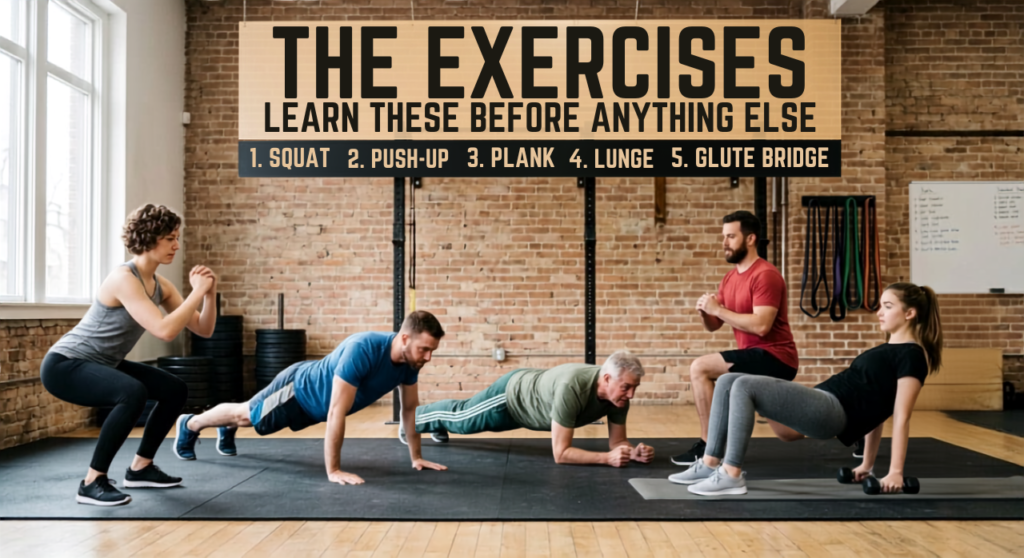
Before you build a routine, you need to understand the movements. These are the fundamental calisthenics that form the backbone of every beginner program. Don’t rush past this section knowing what each exercise does and how to do it properly is the difference between results and wasted effort.
Push-Ups The most important upper body exercise in calisthenics. It works your chest, shoulders, and triceps while your core holds everything stable. The key thing most beginners miss is depth, go all the way down, chest almost touching the floor, and push back up with control. Fast, shallow push-ups build nothing. Slow, deep ones build real strength. Start on your knees if you need to. No shame in that.
Squats Your legs carry you everywhere and they deserve serious training. Bodyweight works your quads, hamstrings, and glutes simultaneously. Stand with feet shoulder-width apart, keep your chest tall, push your hips back like you’re sitting into a chair, and go down. Come back up through your heels. Three sets of squats done properly and you’ll feel it in your legs the next morning. That feeling means it’s working.
Plank Looks simple. Isn’t. The plank builds the deep core that holds your entire body together during every other movement. Elbows under shoulders, body in a straight line, core tight, don’t let your hips drop. Hold for 20 seconds to start. Add a few seconds each week. This one exercise alone will improve every other movement in your routine.
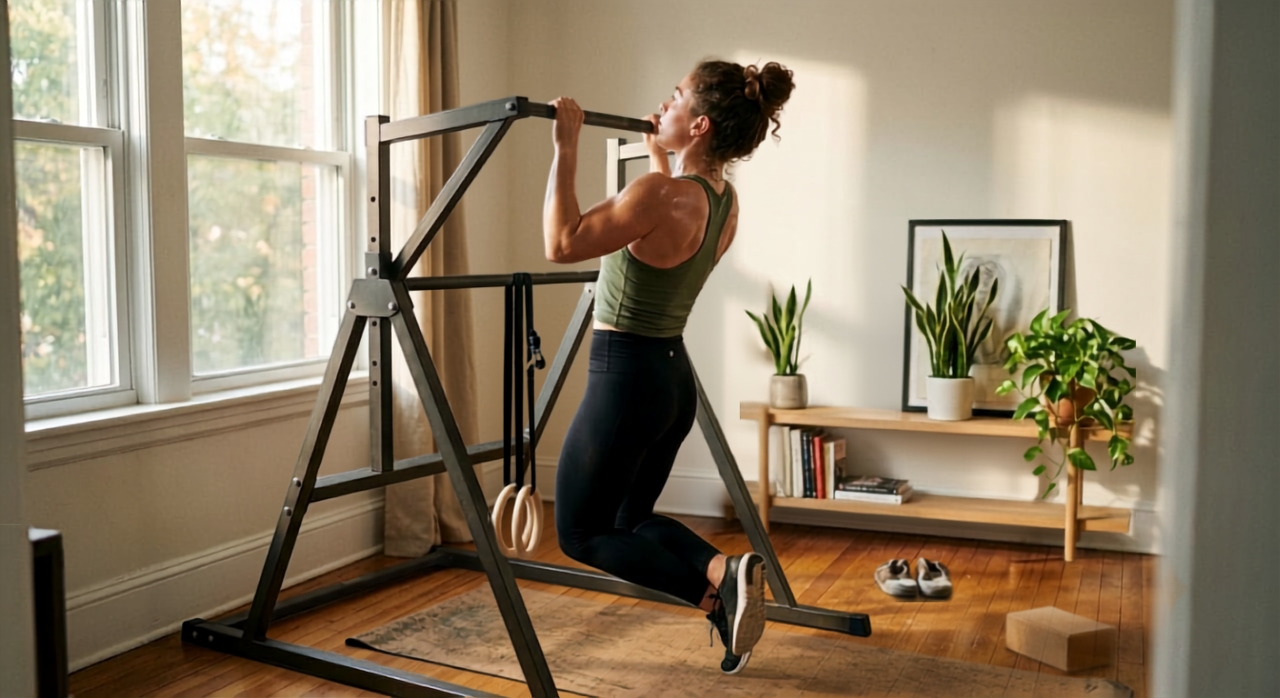
Pull-Ups If you can hang from something, you can start pull-up training. Pull-ups are the most effective upper back and bicep exercise in calisthenics, full stop. Can’t do one yet? Jump to the top position and lower yourself down slowly over three to five seconds. These are called negatives and they build pull-up strength faster than most people expect. A cheap doorframe bar makes this accessible to everyone.
Lunges Step forward, lower your back knee toward the ground, push back up. Alternate legs. Lunges work each leg independently, which fixes strength imbalances most people don’t even know they have. Strong glutes, strong quads, better balance all from one straightforward movement. Add these to your leg training and you’ll notice the difference.
Dips Two sturdy chairs placed side by side work perfectly. Grip the edges, lower yourself by bending your elbows, push back up. Dips target the triceps harder than almost anything else in calisthenics. Pair them with push-ups and your upper body pushing strength will grow noticeably within a few weeks.
Mountain Climbers Get into a push-up position and drive your knees in alternately at pace. Mountains are a brutal finisher; they spike heart rate, burn the core, and torch fat all at once. Add them at the very end of your session when you think you’re finished. You’re not finished.
3. Building a Routine That Actually Gets Results
The single biggest mistake beginners make is training without structure. Doing whatever exercises come to mind on whatever days feel convenient is not a plan, it’s just moving around. A proper calisthenics routine has a shape. Here’s how to build one.
Warm Up Every Five to ten minutes of light movement before training protects your joints and gets your muscles ready to work. Arm circles, hip rotations, leg swings, slow bodyweight squats. It’s not exciting but it matters. The people who skip warm-ups are usually the same ones who end up injured three weeks in.
Three Days a Week Is Your Point Monday, Wednesday, Friday is the classic structure and it works well. The gaps between sessions are not wasted days your muscles grow during recovery, not during the calisthenics itself. Three quality sessions per week beats six rushed ones every time, especially when you’re just starting out.
Keep It Full Body for Now Forget chest day and leg day splits. As a beginner, full body training every session is more effective. Pick one pushing exercise (push ups or dips), one pulling exercise (pull-ups or rows), one leg exercise (squats or lunges), and one core exercise (plank). Three sets of each. Rest about 60 to 90 seconds between sets. That’s a complete beginner calisthenics simple, balanced, proven.
Push the Edge Every Week This is called progressive and it’s the most important training principle that nobody talks about enough. Do one more rep than last week. Rest ten seconds less. Try a harder variation. Without this, your body adapts and stops changing. Results don’t come from doing the same thing forever they come from constantly and gradually asking your body to do a little more.
Stretch When You’re Done Five minutes of stretching after your calisthenics workout reduces soreness, improves flexibility over time, and keeps your joints healthy for the long haul. Chest opener, quad stretch, hamstring stretch, shoulder rolls. People who stretch consistently get injured far less often. It’s a small habit with a big payoff.
4. The Mistakes That Slow Most Beginners Down

These aren’t theoretical warnings. These are the exact mistakes I made, and that I’ve watched dozens of other beginners make too. Every one of them costs time and progress.
Chasing Advanced Skills Too Early Handstands and muscle ups look incredible. They also require months of foundational work before your joints and tendons are ready for that kind of load. I tried learning a handstand in week three of calisthenics. I could barely hold a plank. It was pointless. Build the base first 8 to 12 weeks of basics before you even think about advanced movements.
No Rest Days Training every day sounds dedicated. What it actually is is counterproductive. Muscles don’t grow during your calisthenics, they grow during the hours and days after, while you’re resting and sleeping. Overtraining leads to fatigue, stalled progress, and eventually injury. Build rest days from day one. They’re not optional.
Sloppy Form Half rep push ups and shallow squats look like exercise but they don’t build much. The muscle needs to work through its full range of motion under tension to actually grow. Slow down. Feel each rep. Film yourself occasionally seeing your own form on camera is uncomfortable but genuinely useful. Fix it early before bad habits become automatic.
Ignoring Food Training breaks muscle tissue down. Protein is what builds it back up, stronger than before. Without enough protein in your diet, all your calisthenics workout effort produces very little visible result. Eggs, chicken, lentils, curd, paneer whatever fits what you eat. It doesn’t have to be complicated, but it does have to be consistent.
Quitting During the Adaptation Phase Weeks three and four are when most beginners quit. The initial soreness has faded, visible changes haven’t appeared yet, and motivation drops. But this is actually the most important phase of calisthenics training. Your nervous system is learning the movements and your joints are adapting to the load. Real visible change starts around week six or seven. Push through weeks three and four. They’re the filter between people who transform and people who don’t.
5. Staying Consistent The Real Work
After two weeks of reading about calisthenics, most beginners know exactly what to do. The information isn’t the problem. Showing up on the days you don’t feel like it ‘s the problem. Here’s what actually helps.
Track Everything: Keep a note on your phone or a small notebook. Date, exercises, sets, reps, how you felt. After a month, scroll back and read it. Watching your numbers climb week by week 8 push ups to 20, 15 second planks to 60 seconds is one of the most motivating things you’ll experience on your fitness journey. It makes the progress feel real because it is real.
Make Goals Specific “Get fit” is not a goal, it’s a wish. “Complete 20 clean push-ups by the end of month two” is a goal. Specific targets create specific actions and, when you hit them, a real sense of achievement that keeps the momentum going. Set small targets inside your bigger calisthenics training goal and knock them down one at a time.
Schedule It Like a Meeting Your calisthenics workout needs a fixed time in your day. Morning before breakfast, lunch break, evening after work pick one and protect it. When training is scheduled, it happens. When it’s “I’ll do it when I have time,” life fills that time with something else.
Find a Community Even Online. Reddit has active calisthenics communities. Instagram has thousands of people documenting their home training journeys. YouTube has coaches who reply to comments. Share your progress somewhere. Accountability from strangers on the internet is surprisingly real and it keeps you showing up.
Recognise the Small Wins First clean pull up. Sixty second plank. Finishing a full session without stopping. These aren’t small things. They’re evidence that calisthenics training is changing your body and your habits. Celebrate them. They’re the fuel that carries you through the harder weeks.
Frequently Asked Questions (FAQs)
Q1. I’ve never exercised a day in my life. Can I really start calisthenics?
You can. Calisthenics is one of the most beginner-friendly training methods that exists precisely because every exercise scales to where you are. Can’t do a push up? Start on your knees. Can’t squat deep? Go halfway. You’re never asked to lift more than your body can manage the load adjusts with your fitness level automatically. Start where you are, not where you think you should be.
Q2. How long before I actually see a difference?
You’ll feel stronger in two to three weeks. That’s when your nervous system starts learning the movements properly. Visible changes in muscle tone usually show up between weeks five and seven. People around you start noticing somewhere between month two and month three. There’s no honest shortcut to this timeline but the results from consistent calisthenics workouts are real and they compound over time.
Q3. Do I genuinely need zero equipment?
For the first month or two, genuinely yes. Push ups, squats, lunges, planks, and dips off a chair cover all the major muscle groups and require nothing except your body and some floor space. The one thing worth buying at some point is a pull up bar for your door frame inexpensively and it unlocks a whole range of back and bicep calisthenics exercises. But even that isn’t necessary to start seeing results.
Q4. Three days a week seems low. Should I train more?
For a beginner, three days is not low, it’s right. Your body needs 48 hours between calisthenics workouts to repair and grow the muscles you’ve worked. Training more before your body has adapted leads to fatigue, not faster results. After six to eight weeks of consistent training, you can move to four days by splitting the upper and lower body. Let your body earn the extra days don’t force them from the start.
Q5. Can I seriously build a strong body without a gym?
Seriously, yes. Calisthenics training has produced some of the most athletic, functional, and well built bodies in the world including military forces, professional gymnasts, and martial artists who rely primarily on bodyweight exercises. You won’t become a competitive powerlifter without added weight, but a strong, lean, athletic body is absolutely achievable. Your own body weight, applied consistently and with the right progression, is more than enough.
Conclusion
What I want you to leave this article understanding is that calisthenics is not a backup plan for people who can’t afford a gym. It’s a complete method of building real, lasting strength and it’s been working for people long before gyms existed. The barrier to entry is almost zero. The only real requirement is showing up.
We went through what calisthenics workouts are, the exercises that matter, how to structure your training, the mistakes that slow people down, and how to build the kind of consistency that actually produces a transformation. That’s everything you need to begin.
Here’s what I’d ask you to do right now. Close this tab. Find a clear bit of floor. Do ten push ups. That’s your first session it counts. One session leads to the next, one week builds on the last, and a few months from now you’ll barely recognise where you started. That’s not motivation talk. That’s just what calisthenics training does when you actually commit to it.
Disclaimer
The information in this article about calisthenics workouts is shared for general educational purposes only and is not a substitute for professional medical or fitness advice. Every person’s body responds differently to training. If you have existing injuries, health conditions, or physical limitations, please speak with a qualified doctor or certified fitness professional before starting any new exercise program. Results from calisthenics training will vary from person to person based on consistency, nutrition, rest, and individual health. The author and publisher take no responsibility for any injury or adverse health outcome resulting from the use of information presented in this article.