This guide covers goal setting for generally healthy adults beginning or restarting a fitness journey. It does NOT address clinical weight management, eating disorder recovery, or goals set under medical supervision consult a qualified healthcare provider for those scenarios.
How to Set Real Body Goals That You’ll Actually Achieve
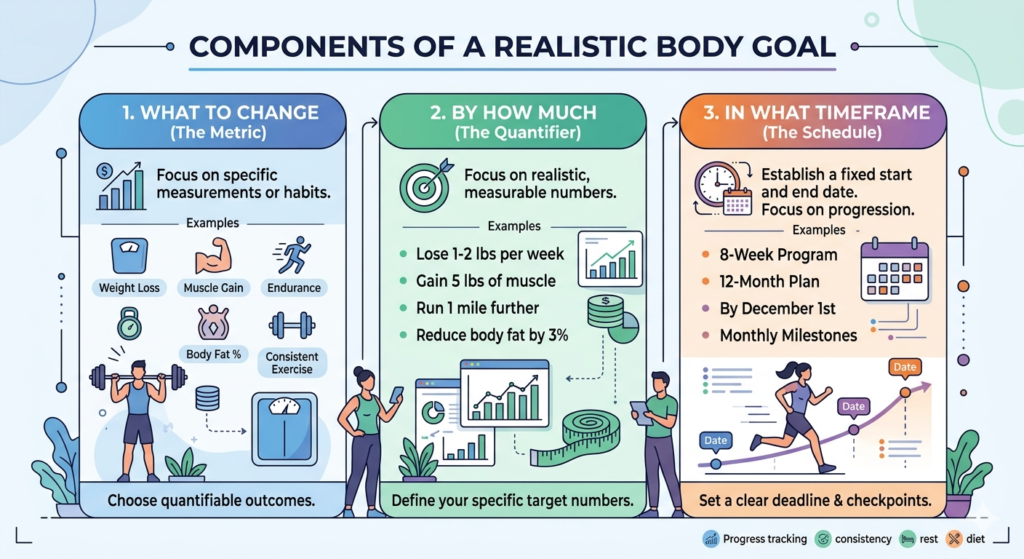
Body goals are specific, measurable targets a person sets for their physical fitness, body composition, or athletic performance. Unlike vague intentions like “get fit,” real body goals define what you want to change, by how much, and within what timeframe giving your training and nutrition a concrete direction to follow.
What Are Body Goals, Really?
Here’s the thing: most people searching “body goals” are actually searching for permission. Permission to want something specific for themselves. Permission to believe it’s possible not just for the person they saw on Instagram at midnight, but for them, with their schedule, their body, their life.
Body goals sit at the intersection of what you want your body to do, how you want it to look, and what your current life can realistically support. All three matter. Ignoring any one of them is exactly why most plans fall apart inside two weeks.
According to a January 2025 nationwide survey by the Health & Fitness Association (HFA) conducted across 2,000 U.S. adults approximately 96 million Americans planned to prioritize fitness that year, making health the single most popular New Year’s resolution category. Yet 43% of those people abandon their goals within the first month (Statista/Ink+Volt, 2024). That’s not a motivation problem. That’s a goal design problem.
Setting body goals means defining a measurable physical outcome tied to a realistic timeline and a specific method. According to the HFA’s 2025 data, the top fitness aspirations among goal setters are building muscle or strength (50%), establishing a regular exercise routine (44%), and improving mental health through physical activity (42%). These aren’t random priorities they reflect what people actually want when they say “I want to hit my body goals.”
Why Most Body Goals Collapse Before Week Four
The failure isn’t willpower. It almost never is.
People set goals based on what they want to look like pulled from a transformation photo or an influencer’s reel rather than what their current body composition, sleep schedule, stress load, and weekly calendar can actually support. You can’t set a goal you’ll stick to if you’ve designed it around someone else’s life, someone else’s starting point, and someone else’s schedule.
The Scale Is Lying to You
Here’s a counter intuitive truth most guides skip entirely: the scale is one of the worst tools for tracking body goal progress, especially in the first four to six weeks of training. Water retention from new muscle stimulus, hormonal fluctuations, and increased food volume can all push your weight upward even while you’re making genuine body composition improvements.
People who rely exclusively on scale weight in the early stages frequently report feeling like total failures when their body fat percentage has actually dropped, their strength numbers are climbing, and their clothes are fitting differently. The scale registered “up two pounds.” The mirror, the tape measure, and the barbell all said something very different.
Track body fat percentage, how your clothes fit, your strength numbers in the gym, and your energy levels. Use the scale as one data point. Not the verdict.
Social Media Goals vs. Bodies That Actually Exist
One study cited by POW8R (2025) found that constant exposure to idealized body images on social media can contribute to poor body image and, in more serious cases, body dysmorphia. Setting a body goal that’s essentially a filtered photo isn’t a fitness target. It’s a comparison trap dressed up as motivation.
Or maybe I should say it this way: your goal should describe your future body defined by your health markers, your strength levels, your energy not someone else’s current one after two years of dedicated training and a ring light.
How to Set Body Goals That Match Your Actual Life
To set realistic body goals, follow these steps:
- Measure your current baseline weight, body fat %, waist circumference.
- Choose one primary goal: fat loss, muscle gain, or body recomposition.
- Set a 12 week target using conservative benchmarks (0.5–1 lb muscle/month; 1–2 lbs fat loss/week).
- Map your workouts to your real weekly schedule not your ideal one.
- Pick one tracking tool: MyFitnessPal for nutrition, or a Garmin/Whoop for recovery data.
- Schedule a four week check in to adjust based on actual results not theoretical ones.
Use the SMART Framework But Apply the “A” Correctly
The SMART framework (Specific, Measurable, Achievable, Relevant, Time bound), widely used in fitness coaching by organizations like NASM (National Academy of Sports Medicine), remains the clearest structure for goal design. Most people know the acronym. Almost nobody applies the “Achievable” component with any real honesty.
“Achievable” doesn’t mean easy. It means calibrated to your current starting point. For a beginner, deadlifting bodyweight in 12 weeks is achievable. Deadlifting double bodyweight in 12 weeks probably isn’t and building a plan around the second target sets you up for perceived failure even if you make significant real progress.
Look if you’re starting from zero exercise history and working a full time job with two kids, here’s what actually works: three 40 minute sessions per week, 0.7–1g of protein per pound of bodyweight daily, and seven to eight hours of sleep. That unsexy formula produces real, measurable results. Five days a week sounds better. Three days you actually do sounds better than that.
Set Targets Based on Body Composition, Not Just Weight
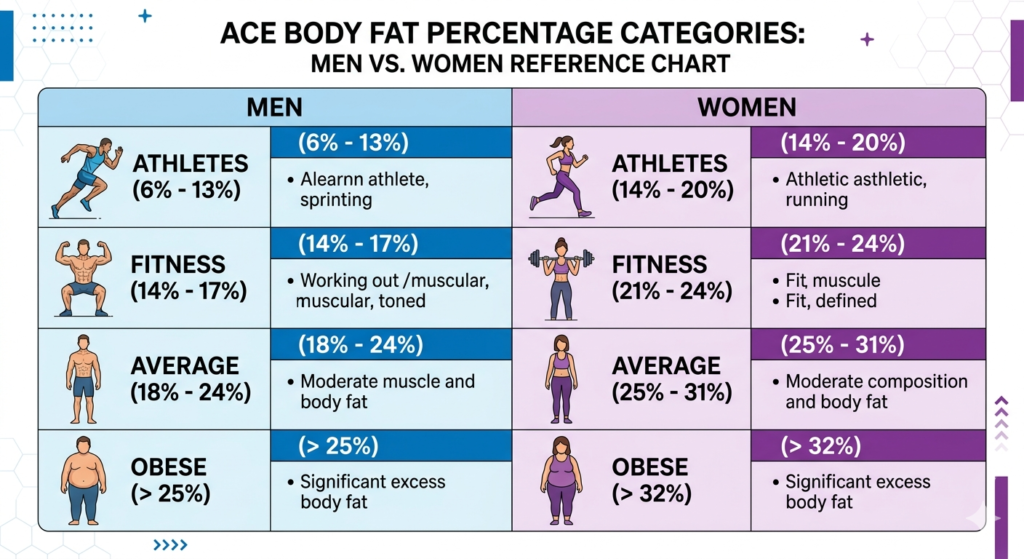
For context, the American Council on Exercise (ACE) defines the “fitness” category of body fat percentage as 21–24% for women and 14–17% for men. These numbers give you a target range rather than an arbitrary number on a scale. Knowing your current body fat percentage transforms “I want to lose weight” into “I want to move from 28% to 23% body fat in 16 weeks” which is specific, trackable, and achievable.
Body fat percentage can be estimated at home with a quality tape measure and an online Navy Method calculator, or more precisely through a DEXA scan, hydrostatic weighing, or an InBody assessment at most commercial gyms.
Body Recomposition vs. Weight Loss Which Goal Is Actually Right for You?
Body recomposition vs. weight loss goals: Body recomposition simultaneously losing fat while gaining muscle is better suited for beginners and those returning after a break, because the body responds most dramatically to new training stimulus at that stage. Weight loss as a standalone goal works better when someone has significant excess body fat and limited prior strength training experience. The key difference is that recomposition requires more precision in protein intake and recovery management, while pure fat loss can tolerate simpler calorie deficit approaches.
Quick Comparison
| Goal Type | Best For | Key Benefit | Limitation |
|---|---|---|---|
| Fat Loss | Those with 15%+ excess body fat | Fast visible results, improved metabolic markers | Risk of muscle loss without adequate protein intake |
| Muscle Gain | Lean beginners, hardgainers | Increased metabolism, long term physique change | Slow 0.5–1 lb/month for natural lifters is excellent |
| Body Recomposition | Beginners, those returning after a gap | Fat loss + muscle gain simultaneously | Requires protein precision; slower than either goal in isolation |
| Performance Goals | Athletes, those with specific functional targets | Functional strength, injury resilience | Scale weight and aesthetics are secondary measures |
| Maintenance | Those who’ve reached their target | Long term sustainability, habit reinforcement | Can feel directionless without defined micro goals |
A note on recomposition timelines: Body recomposition is often the most psychologically sustainable goal for beginners but it demands patience. According to the training philosophy published by BodyGoals.com, one of the few coaching resources that addresses this honestly, true body recomposition for natural lifters proceeds at roughly 0.5–1 lb of muscle gain per month. That’s not a bug. That’s the biological reality that crash programs and 12 week “shred” challenges deliberately obscure.
Some coaches argue that beginners should just focus on fat loss first and muscle gain second in separate phases. That’s valid if someone has a significant amount of body fat to lose and finds tracking nutrition overwhelming. But if you’re dealing with a relatively average starting composition and want to see simultaneous change across the mirror, the scale and the barbell, recomposition built around a solid protein target is the more efficient path.
The Two Variables Most Body Goal Guides Completely Ignore
This is the section that gets cut in most generic fitness articles. It shouldn’t be.
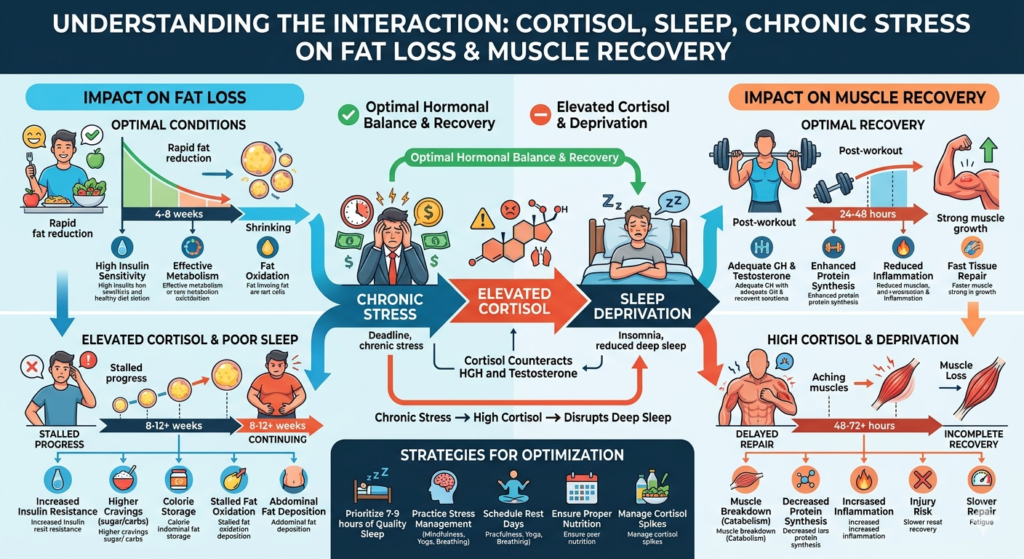
Sleep and Stress Are Training Variables Not Lifestyle Side Notes
You can have a perfect workout program and a dialed in nutrition plan and still stall completely if you’re sleeping five hours a night and running on cortisol. Sleep deprivation blunts muscle protein synthesis, elevates cortisol (which directly promotes fat storage), and reduces insulin sensitivity. These aren’t minor inconveniences operating in the background. They actively and measurably work against every body goal you’ve set.
I’ve seen conflicting data on exactly how many hours of sleep produce optimal muscle building hormonal output some research suggests 7 hours is sufficient, while other studies point to 8–9 hours for peak testosterone and growth hormone levels. My read: aim for 7.5 hours minimum, prioritize consistency over single night perfection, and treat chronic under sleeping as a training variable, not a personal failing.
Wearables like Whoop and Garmin fitness trackers now measure recovery scores and HRV (heart rate variability) giving you real data on whether your body is in a state to adapt to training that day, or just surviving it. That data changes how you train. It’s not vanity tech.
Hormones Interact With Body Goals in Ways Most Beginner Content Skips
For women especially, hormonal fluctuations across the menstrual cycle affect water retention, perceived energy, and actual strength output in the gym. A woman who feels noticeably weaker or more fatigued three days before menstruation isn’t weaker than she was two weeks prior she’s hormonally different in ways that directly affect performance metrics.
Building this reality into your goal tracking framework prevents what feels like a “plateau” or failure from triggering a complete restart. It also means your body goal timeline should account for this variation not demand uniform output every week regardless of where you are in your cycle.
What most guides skip is this: body goal progress is nonlinear, hormonally influenced, and highly dependent on variables outside the gym. A four week check in that shows no scale movement might actually show a body fat decrease, a strength increase, and better sleep data if you’re tracking the right things.
Quick note: this guide covers the goal-setting layer of body transformation for generally healthy adults. It does NOT go deep into hormone testing protocols, PCOS specific programming, or postmenopausal fitness considerations those warrant their own dedicated and clinically informed resources.
Disclaimer: The information in this article is for general educational purposes only and does not constitute medical advice. If you have an underlying health condition, are pregnant, or are managing a diagnosed eating disorder or body image disorder, consult a qualified healthcare provider before beginning any fitness program.